
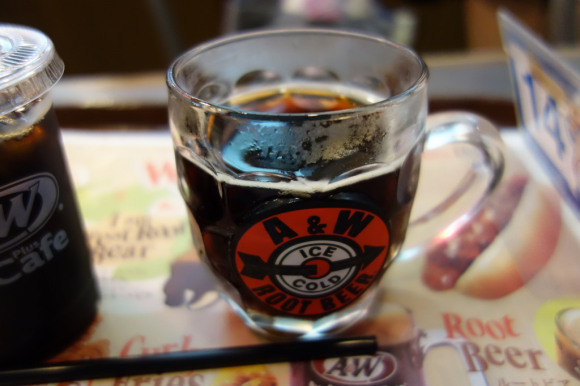
When living in another country it’s only natural to miss some of the tastes of home. In my case, the extreme rarity of root beer has been a source of sadness. Time to time I’ll come across a supermarket or import shop that carries it and am sure to pick up a can despite its often exorbitant price of around 200 yen (US$1.69).
The reason for the absence of the drink on the Japanese market is obvious though. Although root beer has its share of detractors even in its home of America, the sheer number of people who can’t stand the stuff in Japan is huge. What is it that makes root beer so overwhelmingly disgusting to Japanese people?
■ Okinawa: Land of root beer
Recently our reporter Nakano made the trip down to Okinawa to get a taste of the frothy brown soft drink for the first time. Okinawa was the one enclave of Japan where root beer could flourish thanks to the presence of American military installations there.
Nakano figured he’d do it right and went to an A&W restaurant for a fountain style glass of it. On researching root beer, he found that its reputation in Japan was that you’d either get completely disgusted by it or completely addicted to it on the first sip.
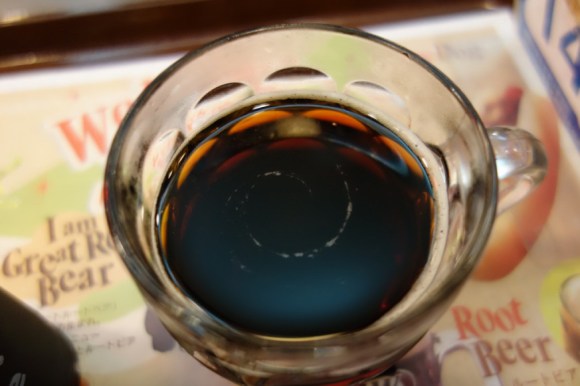
It turned out he was firmly in the completely disgusted camp and could barely finish his glass. He offered it to his travel companions who gave their opinions as “Aw, this is sh*t! F**k you!”
▼ Thank you! Come again!

■ Empirical Studies
In my many years living in Japan I have offered drinks of root beer (A&W mostly) to as many Japanese people as possible, well over a hundred. Although I haven’t recorded the reactions for a solid figure, I can say with confidence that about 90% of people who tasted it were immediately turned off.
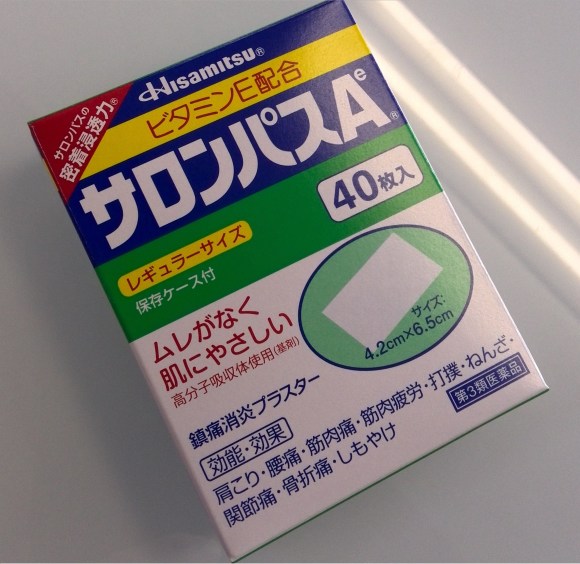
Kids and teens tended to show a slight preference for it, but into adulthood there seems to be no correlation between age and a hatred of root beer. By far the most popular reason for disliking it is that “it tastes like medicine.” By a wide margin most people I’ve talked to compare it to the scent of a shippu which is a chemical hot or cold patch used for muscle aches and injuries. Nakano mentioned a popular comparison to a pain-relief patch by the name of Salonpas “with just a hint of sugar mixed in.”
■ Off to the drug store
I could understand the comparison to medicine in the sense that root beer does use various roots (hence the name) that might be used in medicines such as licorice. There are also hints of mint and wintergreen but hardly enough to remind me of medicine. Furthermore, I’ve never encountered any medicine that even remotely reminded me of root beer. At best some cough syrups have that sickly attempt at a cherry flavor that some associate with a Dr. Pepper (also fairly hated in Japan), but nothing like an A&W.
So I went down to the local drug store and picked up a pack of Salonpas that Nakano mentioned for a smell test. Sure enough right upon opening up the sealed plastic back I was hit with a whiff that smelled just like root beer with slightly more mint to it. I actually found myself taking deeper and deeper sniffs attracted to the sweet flavor but then realized that inhaling a medicinal patch probably wasn’t good for the old brain cells and stopped.
Suddenly it all added up. People in Japan would likely associate the smell of root beer to the inedible pain-relieving patch and perhaps even on a deeper level to the painful situation that came along with it for an extra kick of negativity. On the other hand, I found Salonpas pads to have an utterly delightful smell and would recommend them for anyone who loves root beer and has stiff shoulders. It also kind of explained why kids didn’t mind the taste as much since they were less likely to use Salonpas.
■ Different floats for different folks
There are likely other factors at play in the widespread dislike of root beer in Japan. Perhaps its flavor doesn’t mesh well with the standard cultural tastes of the land, but in a country that embraces natto, fermented beans which smell like a turd wrapped in a sweaty sock, that seems unlikely.
There’s also a chance of a genetic factor in Japanese people’s sense of taste which makes something in root beer stand out as particularly unpleasant. However, judging by people’s overwhelmingly popular comparisons to medicine it would seem that is the culprit here.
This leaves the question of why Salonpas smells like root beer. The ingredients listed on the box say that it has “added scents” suggesting that the fragrance was chosen deliberately by the makers. Regardless of whether this scent was designed to be like root beer or merely a coincidence, it seems to have really put the kybosh on the drink’s popularity in the entire country.
UPDATE: As Kim Pennebaker pointed out in the comments, it appears that wintergreen oil (methyl salicylate) is the common scent between Salonpas and root beer rather than any added scent. Methyl Salicylate is the active ingredient in highest content in Salonpas and tends to have a pungent scent. It’s used in other medicines and foods as well, but in the case of Salonpas and root beer it appears to be all in the amounts.
Photos: RocketNews24
Read Nakano’s full report in Japanese on RocketNews24
[ Read in Japanese ]
 The perks of drinking root beer at A&W in Japan
 Japanese people reveal the six western foods they find most disgusting
 Our Japanese reporter visits Czechia’s famous beer spas and boozily bathes in a bath of beer
 Five Okinawan foods that have changed our reporter’s view on local cuisine forever
 Japanese people most like to drink green tea with their chips, incredibly dull survey finds
 Pokémon and Ikea Japan cross over into each other’s worlds with collaboration events
 Can a downtown Tokyo super sento bathhouse beat a hotel for a one-night stay?
 Two food hacks take Japan’s convenience store fried chicken to amazing new sandwich heights
 Pokémon Centers across Japan cancel April events after stabbing in Tokyo
 Tokyo turns its phone booths into free Wi-Fi hotspots, and here’s how to use them
 Does this video about an abandoned dog leave you wiping your eyes or shaking your fist?
 Japan’s prime minister exchanges Dragon Ball kamehamehas with president of France[Video]
 Tokyo has a “phantom egg shop” with ingredients for the best tamago-kake gohan rice bowl ever
 Genuine Muramasa blade and Muromachi katana on display at Tokyo’s Touken Ranbu store【Photos】
 A Kyoto factory vending machine sells gourmet mystery meals at bargain prices
 Tokyo’s best museum for foreign travelers finally reopens after being closed for four years
 Pokémon lacquerware series expands for Year of the Horse with new handcrafted design[Video]
 Famous Tokyo cherry blossom spot installs view-blocking screens to fight overcrowding[Video]
 Tokyo subway and almost all Tokyo train lines now accepting credit card tap payments
 Fading Tokyo – Searching for signs of the Showa era as local neighborhoods evolve[Photos]
 Totoro Fund line of beautiful artwork and apparel lets you help the real-world Totoro Forest
 Studio Ghibli adds new My Neighbour Totoro 2026 Corn Gift to its anime store for Mother’s Day
 Japan now has a special desk for people who work at home with a pet cat[Photos]
 Uniqlo announces new T-shirts for One Piece, Naruto and more for manga publisher’s 100th birthday
 Train station platform ramen store closes its doors on half a century of history in Tokyo
 Starbucks Japan releases new My Fruit³ Frappuccino at only 34 stores around the country
 Studio Ghibli releases Catbus pullback keychain that runs like the anime character
 Krispy Kreme releases Super Mario doughnuts in Japan for a limited time
 Japanese onsen egg maker from 100-yen store Daiso needs to be on your shopping list
 Nine great places to see spring flowers in Japan, as chosen by travelers (with almost no sakura)
 Survey asks foreign tourists what bothered them in Japan, more than half gave same answer
 Japan’s human washing machines will go on sale to general public, demos to be held in Tokyo
 Starbucks Japan releases new drinkware and goods for Valentine’s Day
 We deeply regret going into this tunnel on our walk in the mountains of Japan
 Studio Ghibli releases Kodama forest spirits from Princess Mononoke to light up your home
 Starbucks Japan releases new sakura goods and drinkware for cherry blossom season 2026
 Japan’s newest Shinkansen has no seats…or passengers [Video]
 Major Japanese hotel chain says reservations via overseas booking sites may not be valid
 Put sesame oil in your coffee? Japanese maker says it’s the best way to start your day【Taste test】
 No more using real katana for tourism activities, Japan’s National Police Agency says