
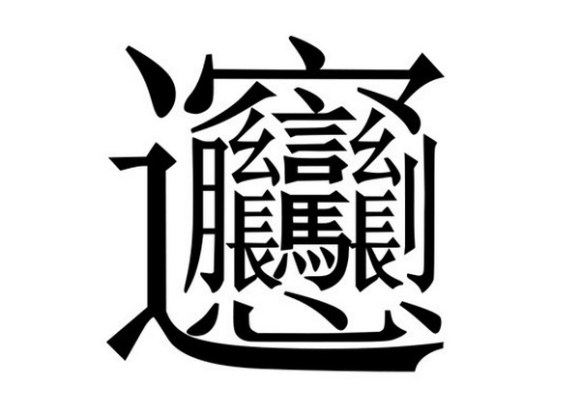
Most schools expect their students to attend classes punctually and students are commonly penalized when they fail to do so. At a certain school in China, a teacher used to punish his students by making them write English sentences when they were late for class, until he came across the “most complicated” Chinese character, which now has become an effective measure in keeping his students on the ball where punctuality is concerned.
If you’ve ever faced such a punishment and felt that writing “I will not be late for class again” over and over again was a dreadful experience, try writing this!
School teaches us about many things apart from academic subjects, and punctuality is one of them. Wang Sijun, an educator at the Chengdu campus of the University of Electronic Science and Technology of China, is very particular about his students’ attendance and punctuality.
Wang used to make his students copy 1,000 English words whenever they failed to be on time, but he realized that although 1,000 words may sound like a lot of work, it is in fact barely a challenge as his students are used to writing English words repetitively as part of their curriculum.
On a trip to Xi’an, Wang came across an unusual Chinese word which the locals claimed to be the most complicated character in the Chinese language. He was then inspired to change the contents of his little punishment from 1,000 English words to 1,000 repetitions of this writing nightmare:
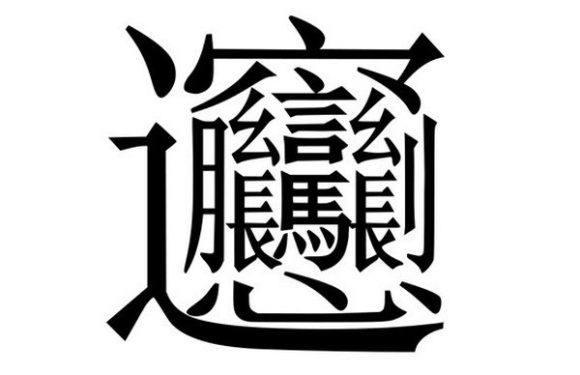
Made up of a whopping 56 strokes, the onomatopoeia word, pronounced “biang”, was derived from the sounds produced during the traditional making process of the locally famous noodles commonly known as Biang Biang Noodles.
▼ The word is commonly seen on the signboards of Biang Biang Noodle stalls in the Shaanxi area.

The first student who received a serving of the big “biang” treatment initially thought that Wang was joking about the change. In terms of page count, 1,000 Chinese characters is definitely less than the same number of English words. However, the student reportedly broke down and threw in the towel after writing the word 200 times, pleading her teacher to let her off the hook and promising never to be late again.
There have been disputes over whether biang is indeed the most complicated Chinese character of all, but Wang has remained loyal with his choice of word, explaining that the motive of this exercise isn’t punishment.
We’re not sure what subject Wang teaches at the institute but we can be sure that there are two things the students in his class will learn: to be punctual, and how to read that 56-stroke monster of a word, “biang”.
Source, images: ETToday
 W.T.F. Japan: Top 5 most difficult kanji ever【Weird Top Five】
 Why do Chinese characters in anime say -arimasu/-aru ALL the time?
 Four ways Japanese isn’t the hardest language to learn
 Japan reportedly adding Japanese language skill requirement to most common foreigner work visa
 Peanuts and Coke becomes a viral hit in Japan, but is it a trend worth joining?
 Deer that appeared in downtown Osaka gets a new home, a new name, and a lot of snacks[Video]
 Famous koi ponds overwhelmed with tourists throwing thousands of coins in them
 How to take your home ramen to the next level by making your own chashu pork in a frying pan
 7-Eleven Japan’s new baked-in-store sweet treat is only available in three parts of the country
 A six-year-old smashed the previous limbo skating record, in case you wanted to know
 The secret of Starbucks Japan’s Chocolate Chunk Cookie: It’s not made by Starbucks!
 Gene Kelly inspires short anime from Japan, captures hearts around the world
 This regional pizza buffet offers so many flavors you won’t be able to try them all
 Pokémon and Ikea Japan cross over into each other’s worlds with collaboration events
 Pokémon lacquerware series expands for Year of the Horse with new handcrafted design[Video]
 Starbucks Japan closing only Shinkansen platform branch for popularity-triggered renovations
 Two food hacks take Japan’s convenience store fried chicken to amazing new sandwich heights
 Tokyo’s best museum for foreign travelers finally reopens after being closed for four years
 Totoro Fund line of beautiful artwork and apparel lets you help the real-world Totoro Forest
 Fading Tokyo – Searching for signs of the Showa era as local neighborhoods evolve[Photos]
 You can assemble a well-balanced team of Pokémon, them eat them, thanks to Japanese cake chain
 Tokyo turns its phone booths into free Wi-Fi hotspots, and here’s how to use them
 Japan now has a special desk for people who work at home with a pet cat[Photos]
 Famous Tokyo cherry blossom spot installs view-blocking screens to fight overcrowding[Video]
 Uniqlo announces new T-shirts for One Piece, Naruto and more for manga publisher’s 100th birthday
 Train station platform ramen store closes its doors on half a century of history in Tokyo
 Starbucks Japan releases new My Fruit³ Frappuccino at only 34 stores around the country
 Studio Ghibli releases Catbus pullback keychain that runs like the anime character
 Krispy Kreme releases Super Mario doughnuts in Japan for a limited time
 Japanese onsen egg maker from 100-yen store Daiso needs to be on your shopping list
 Nine great places to see spring flowers in Japan, as chosen by travelers (with almost no sakura)
 Survey asks foreign tourists what bothered them in Japan, more than half gave same answer
 Japan’s human washing machines will go on sale to general public, demos to be held in Tokyo
 Starbucks Japan releases new drinkware and goods for Valentine’s Day
 We deeply regret going into this tunnel on our walk in the mountains of Japan
 Studio Ghibli releases Kodama forest spirits from Princess Mononoke to light up your home
 Starbucks Japan releases new sakura goods and drinkware for cherry blossom season 2026
 Japan’s newest Shinkansen has no seats…or passengers [Video]
 Major Japanese hotel chain says reservations via overseas booking sites may not be valid
 Put sesame oil in your coffee? Japanese maker says it’s the best way to start your day【Taste test】
 No more using real katana for tourism activities, Japan’s National Police Agency says