

A research group from the Kyushu Institute of Technology have announced that they have successfully read certain words and letters from people’s minds without them saying anything.
■ Method
The study was carried out by a team led by Professor Toshimasa Yamazaki from the Systems Engineering Department of the Kyushu Institute of Technology. In it they gathered a few dozen men and women and analyzed their brainwaves when saying the Japanese words for the game rock (gu). paper (pa), scissors (choki).
They then asked the subjects to simply think about the word strongly and measured their brainwaves again. When comparing the two they found similar patterns both times. Although the words generated the same waves when spoken or thought, they were different for each person.
They also expanded the tests to include the Japanese words for summer (natsu), winter (fuyu), spring (haru), and autumn (aki) and from two of those words they could isolate the brainwave patterns for the Japanese letters ha, ru, na, and tsu with 80 to 90 percent accuracy.
■ How did they do it?
Professor Yamazaki and his group focus their study on the part of the brain known as Broca’s area, which is associated with human speech. According to the professor, Broca’s area triggers a signal from the brain called a “readiness potential” than prepares the muscles needed to utter the word conjured in one’s mind. So, any time you think of a word your brain is already working to make your body say it, even if you don’t.
▼ Broca’s area (in red) is located right where I used to punch myself every time I lost at Street Fighter II, which probably explains my slurred speech.
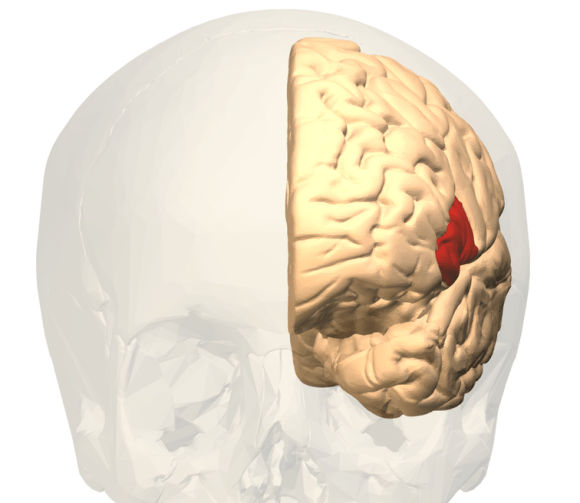 Image: Wikipedia/Database Center for Life Sciences (Cropped by RocketNews24)
This signal causes a slight disturbance in the person’s brainwaves which can detected by EEG. Since different sounds require different muscle combinations, their readiness potential would be unique as would the disturbance it caused to the brainwaves making their verbal thoughts possible to decipher.
■ Challenges
Although possible, this method is far from easy. Research into mind-reading words through brainwave analysis has been going on for decades, but is so complex that little progress has been made until now. Part of the reason that Professor Yamazaki and his group has made such a breakthrough is because they’re Japanese.
One roadblock that researchers have met in the past was that they could successfully read vowel sounds from brainwaves but could not identify those associated with consonant sounds. The Japanese language has a distinct advantage in here because nearly every character has a vowel sound in it.
▼ One line of the Japanese syllabary, or the sound I make when my pizza has arrived.
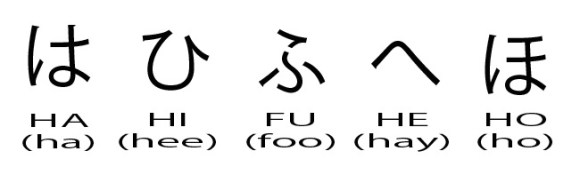
In addition, the number of vowel sounds are very limited compared to other languages making it much easier to identify and catalog each element. English, on the other hand, with its plethora of voiceless consonant sounds and wide range of vowel sounds, would be vastly more difficult to read in people’s brainwaves.
That’s why Prof. Yamazaki is confident that Japan will lead the way in this type of mind-reading technology, and with more advancement the benefits would be huge.
■ Applications
If fully realized, this technology has the potential to be a great help people with speaking disabilities, and perhaps even patients locked in a coma or state of shock, to communicate. It can also be used to allow people to interact with each other in areas where sound doesn’t travel, such as the ocean or outer space.
Yamazaki told Nishi Nippon Shimbun how he would like to see it used: “Sci-Fi-like applications become possible such as controlling robots with our minds.”
▼ That would be the opposite of Johnny-5, the robot who moved Ally Sheedy and Steve Gutenberg with his beautiful mind.
 Image: Amazon
The benefits to reading-minds certainly can bring about massive positive change to the world, but like any technology there is also a dark side. Even though it is in its early infancy, it has already proven effective at making the unbeatable rock-paper-scissors robot army even stronger than before…
Source: Nishi Nippon Shimbun via Itai News (Japanese)
Top Image: Wikipedia/The Photographer (Edited by RocketNews24)
 Creepy Robotic Cat Ear Maker Neurowear Releases Mindreading Headphones That Play Music Based on Your Mood
 Six Japanese business terms you already know, even if you didn’t realize it
 “We wasted so much time in English class” — Japanese Twitter user points out major teaching flaw
 Testing English “loan words” on people who don’t speak Japanese (Spoiler: they don’t make sense)
 Pronunciation anxiety: many Japanese people don’t want to speak English unless it’s “perfect”
 Fatal stabbing at Pokémon Center in Tokyo reignites concern over rising stalking cases in Japan
 Uniqlo announces new T-shirts for One Piece, Naruto and more for manga publisher’s 100th birthday
 Japan now has a special desk for people who work at home with a pet cat[Photos]
 Japanese politicians working to promote plastic model culture as a cultural asset
 Totoro and Calcifer become little light-up lanterns for Ghibli-style excursions or at-home decor
 Japanese kindness restores our faith in humanity after a highway bus accident in Tokyo
 Keanu Reeves gets a ninja lesson with Kyary Pamyu Pamyu at John Wick 3 premiere in Japan
 Better living through gambling at Japan’s “Day Service Las Vegas”
 Yakuzen ramen restaurant in Tokyo is very different to a yakuza ramen restaurant
 8 sakura sweets to enjoy under the cherry blossoms at your next hanami picnic in Japan
 Krispy Kreme releases Super Mario doughnuts in Japan for a limited time
 7-Eleven Japan releases a crazy new viral sandwich: Chocolate Sprinkles and Whipped Cream
 Starbucks Japan releases new My Fruit³ Frappuccino at only 34 stores around the country
 Japan now has a “for foreign tourists only” Mt. Fuji sightseeing train[Video]
 Nine amazing off-the-beaten-path cherry blossom spots in Japan for yaezakura and shidarezakura
 Stunning central Japan wisteria festival is like a purple fantasy straight out of a Ghibli movie
 Studio Ghibli releases the My Neighbour Totoro tea caddy, with a magical self-closing lid
 Create a tiny Ghibli anime world on your bookshelf with new miniature papercraft art kits
 Studio Ghibli unveils new Rollbahn notebook in honour of Howl’s Moving Castle
 Starbucks Japan unveils new sakura cherry blossom collection for hanami season 2026
 Train station platform ramen store closes its doors on half a century of history in Tokyo
 Studio Ghibli releases Catbus pullback keychain that runs like the anime character
 Japanese onsen egg maker from 100-yen store Daiso needs to be on your shopping list
 Nine great places to see spring flowers in Japan, as chosen by travelers (with almost no sakura)
 Starbucks Japan releases first-ever Hinamatsuri Girls’ Day Frappuccino
 Cherry blossoms begin blooming in Japan with record-early starts for sakura season
 Survey asks foreign tourists what bothered them in Japan, more than half gave same answer
 Japan’s human washing machines will go on sale to general public, demos to be held in Tokyo
 Starbucks Japan releases new drinkware and goods for Valentine’s Day
 We deeply regret going into this tunnel on our walk in the mountains of Japan
 Studio Ghibli releases Kodama forest spirits from Princess Mononoke to light up your home
 Starbucks Japan releases new sakura goods and drinkware for cherry blossom season 2026
 Japan’s newest Shinkansen has no seats…or passengers [Video]
 Major Japanese hotel chain says reservations via overseas booking sites may not be valid
 Put sesame oil in your coffee? Japanese maker says it’s the best way to start your day【Taste test】
 No more using real katana for tourism activities, Japan’s National Police Agency says
 Japanese government to make first change to romanization spelling rules since the 1950s
 NTT showcases technology which can “correct” Japanese people’s English pronunciation
 Hachiji juppun mae – A Japanese phrase that even Japanese people can’t agree on the meaning of
 Language fail: 22 funny and embarrassing tales of Japanese language missteps
 Eating ice cream at breakfast boosts mental performance, Japanese researcher finds
 Magazine teaches Japanese using Kemono Friends anime, Japanese netizens can’t stop laughing
 The surprising reasons why some hiragana aren’t allowed to be used on Japanese license plates
 LoCoS: The universal language we’ll be using by 2065, according to legendary Japanese designer
 Mistaking “vertical” for “horizontal” readings in Japanese can have hilarious consequences
 Seven mistakes foreigners make when speaking Japanese—and how to fix them
 Why does Japanese writing need three different sets of characters? (Part 1)
 Learners beware! Even Japanese people agree that their language can be really ambiguous
 Does Comiket need to revise its booth code system for foreigners who don’t understand Japanese?