
You can learn all the words and practice all the kanji, but there’s one little Japanese language quirk that will almost certainly trip you up when you first encounter it.
An enormous number of westerners who come to Japan on a work visa do so to teach English. Often, speaking Japanese is not a prerequisite for being a native English teacher or teaching assistant in Japan (in fact, many language schools would rather you didn’t, so that you’re not tempted to use Japanese in the classroom), but this very often means that how well you and your coworkers communicate will depend entirely on their English-speaking ability, at least to begin with.
In most cases, with the help of a few gestures and repetition, everything goes relatively smoothly. But even when your Japanese coworker speaks close to perfect English, there’s one major difference between English and Japanese (and Korean, and a number of other languages, for that matter) that causes sometimes comical levels of confusion between the two parties involved: answering a negative statement.
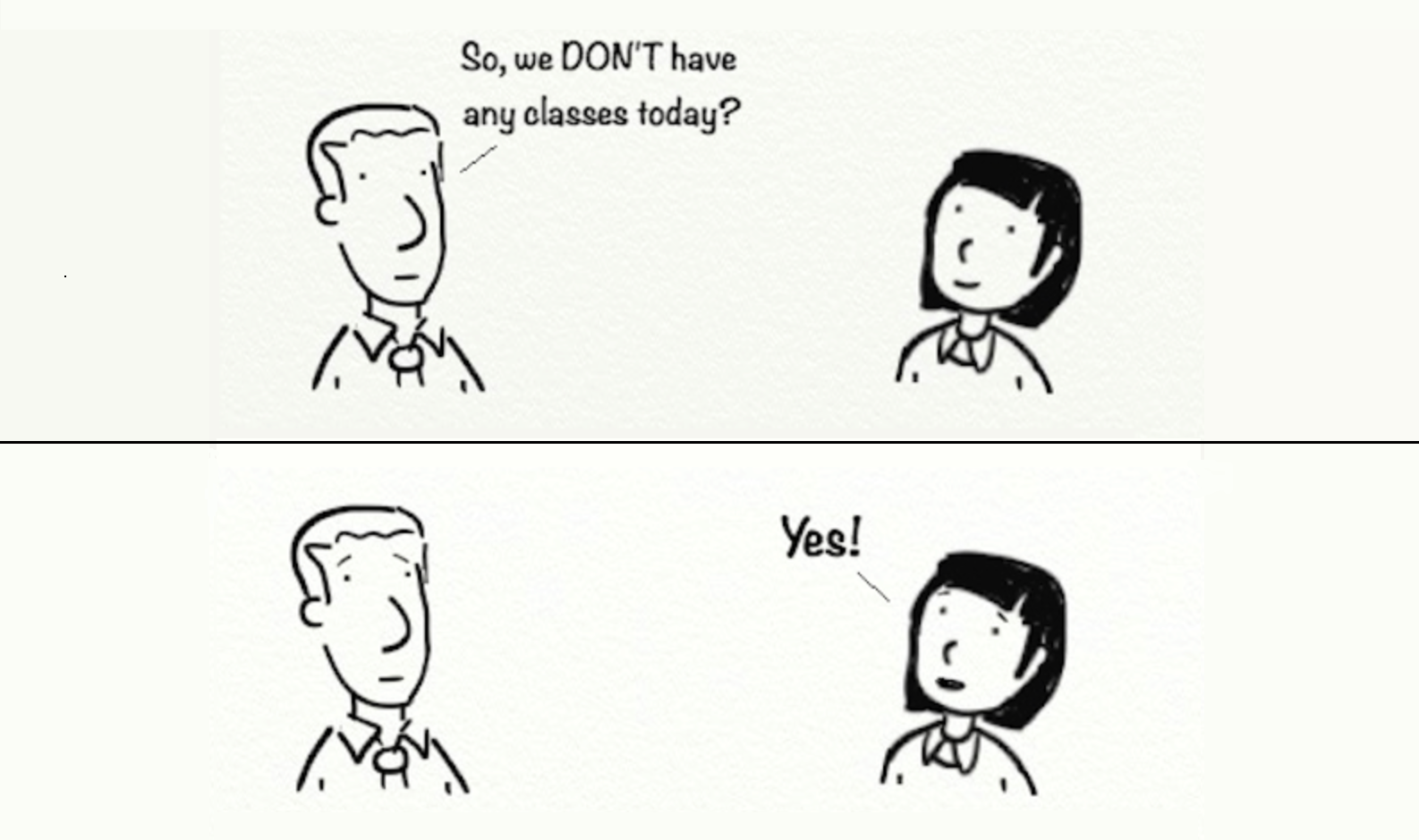
Anyone who has worked in Japan as an English teacher will undoubtedly have had at least one conversation that went like this:
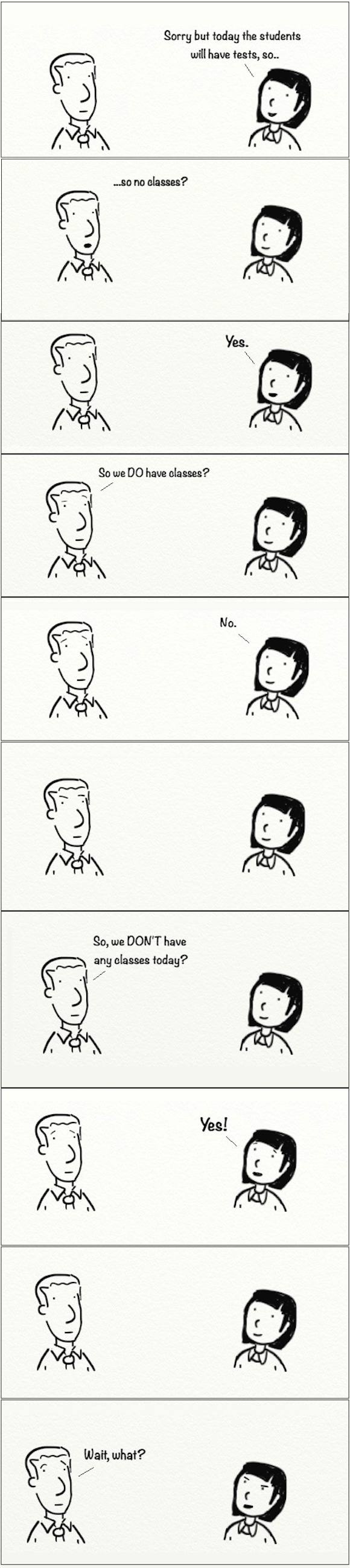
Regardless of whether it’s a lack of classes, hair on your head or money in your wallet, when a Japanese person responds to a native English-speaker’s negative question, or vice-versa, there’s almost always a moment or of confusion before they’re both on the same page.
You see, in Japanese, the following exchange would make perfect sense.
A: あら!牛乳ない!買いに行かなきゃ。
Ara! Gyuunyuu nai! Kai ni ikanakya.
Ah, there’s no milk! I’d better go and buy some.
B: 牛乳ないって?
Gyuunyuu nai tte?
We don’t have any milk?
A: うん。
Un.
Yes.
Of course, in English, the last utterance here would usually be “No (there isn’t any milk),” but in Japanese, the speaker, rather than affirming the presence or absence of said delicious cow-juice, either confirms or denies the statement that the other person just made. Rather than meaning “Yes (there’s no milk)”, this final “うん/un” actually means “Yes, what you’ve just said is true.”
Still confused? A few more examples:
Question: You aren’t going to the party?
Japanese response: Yes (that’s right; I’m not going).
English response: No (I’m not going).
Question: Oh, so you don’t like dogs?
Japanese response: Yes (that’s right; I don’t like dogs).
English response: No (I don’t like dogs).
Question: There aren’t any trains after 1am?
Japanese response: Yes, there aren’t any.
English response: No, there aren’t any.
I suppose the key thing for English speakers to remember is that Japanese yes/no responses to negative questions are intended to tell the questioner that whatever they’ve just said either is or isn’t the case. When you think about it, in a funny way it’s English, rather than Japanese, that’s the quirky one…
 Learners beware! Even Japanese people agree that their language can be really ambiguous
 Tea cups and biting breasts: Japanese phrases that sound like weird English
 Foreign shop clerk and Japanese customer fail to communicate because of Japanese language quirk
 Japanese elementary school student teaches us all how to pronounce English like a native speaker
 Sumikko Gurashi origin book gets English/Japanese bilingual release, great for language learners
 Krispy Kreme releases Super Mario doughnuts in Japan for a limited time
 Starbucks Japan has a new Frappuccino on the menu, but does it really taste like a cream puff?
 Uniqlo announces new T-shirts for One Piece, Naruto and more for manga publisher’s 100th birthday
 Ramen restaurant in top Tokyo tourist neighborhood skips price gouging, but how does it taste?
 Starbucks Japan releases new My Fruit³ Frappuccino at only 34 stores around the country
 Nine amazing off-the-beaten-path cherry blossom spots in Japan for yaezakura and shidarezakura
 7-Eleven Japan releases a crazy new viral sandwich: Chocolate Sprinkles and Whipped Cream
 Japan’s ministry of economy reminds us to “use sound judgment” before buying toilet paper
 These are Tokyo train lines people most want to live along【Survey】
 The top 5 ice creams you should try at Family Mart convenience stores in Japan this summer
 Tokyo government organizes food truck event to clear out delinquent/homeless teen gathering area
 Japan now has a “for foreign tourists only” Mt. Fuji sightseeing train[Video]
 Stunning central Japan wisteria festival is like a purple fantasy straight out of a Ghibli movie
 Studio Ghibli releases the My Neighbour Totoro tea caddy, with a magical self-closing lid
 Japanese onsen egg maker from 100-yen store Daiso needs to be on your shopping list
 Create a tiny Ghibli anime world on your bookshelf with new miniature papercraft art kits
 Starbucks Japan unveils new sakura cherry blossom collection for hanami season 2026
 Train station platform ramen store closes its doors on half a century of history in Tokyo
 Studio Ghibli releases Catbus pullback keychain that runs like the anime character
 Nine great places to see spring flowers in Japan, as chosen by travelers (with almost no sakura)
 Starbucks Japan releases first-ever Hinamatsuri Girls’ Day Frappuccino
 Cherry blossoms begin blooming in Japan with record-early starts for sakura season
 Studio Ghibli adds new Mother’s Day gift sets to its anime collection in Japan
 Virtual idol Hatsune Miku redesigned with look that adds new elements and brings back old ones
 Survey asks foreign tourists what bothered them in Japan, more than half gave same answer
 Japan’s human washing machines will go on sale to general public, demos to be held in Tokyo
 Starbucks Japan releases new drinkware and goods for Valentine’s Day
 We deeply regret going into this tunnel on our walk in the mountains of Japan
 Studio Ghibli releases Kodama forest spirits from Princess Mononoke to light up your home
 Starbucks Japan releases new sakura goods and drinkware for cherry blossom season 2026
 Japan’s newest Shinkansen has no seats…or passengers [Video]
 Major Japanese hotel chain says reservations via overseas booking sites may not be valid
 Put sesame oil in your coffee? Japanese maker says it’s the best way to start your day【Taste test】
 No more using real katana for tourism activities, Japan’s National Police Agency says
 How to respond to Japanese people saying “I don’t speak English” when you’re speaking Japanese?
 The top 70 words that keep showing up in Japanese light novel titles (and yes, isekai is one of them)
 Seven mistakes foreigners make when speaking Japanese—and how to fix them
 What does “Konnichiwa” really mean? Understanding Japanese greetings
 Learn Japanese through ridiculous manga: Two Piece 【Episode #1】
 10 Japanese phrases for travelers that will help, amuse, or just plain confuse
 Wait, the Japanese word daijoubu can mean both “yes” and “no?” Why? HOW?!?
 North Japan prefecture creates guide to help new foreign workers understand local language quirks
 Spice up boring Japanese classroom vocab with the cooler words in this cute video【Video】
 Japanese Twitter reveals the one Japanese word that gets English-speakers super excited
 Japanese, Korean, and Chinese speakers pronounce English words in their native languages 【Video】
 Learn Japanese from YouTube: Amp up your listening skills with this four-step guide
 To –san or not to –san? Should you use the Japanese honorific suffix when speaking English?
 The science behind why English speakers can’t pronounce the Japanese “fu”
 Google’s English translation for short Japanese phrase hints at huge, TV-series-length backstory
 Hachiji juppun mae – A Japanese phrase that even Japanese people can’t agree on the meaning of