
No, it’s not because the Japanese language hates you.
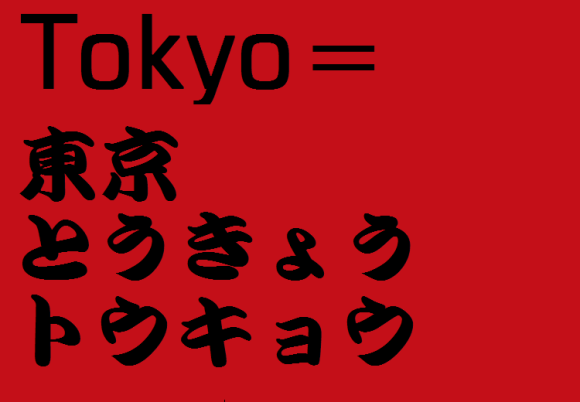
So if you wanted to write, say, Tokyo, in Japanese, you’d write it like this.

Oh, wait, you could also write it like this.

And, finally, this, too, is an option.

Yes, it’s true. Japanese has three completely separate sets of characters, called kanji, hiragana, and katakana, that are used in reading and writing. That first rendering of “Tokyo” is in kanji, with the hiragana version next, and the katakana one at the bottom.
The reason for this triple threat to language learners’ sanity isn’t that teachers of Japanese want to lessen their workload by convincing you to study Spanish instead. There’s actually a fairly logical, slightly lengthy explanation for using all three, so pour yourself a cup of green tea and let’s dive right in.
▼ Into the explanation, of course (unless you’ve got a very big teacup).
First, let’s take a look at kanji, which are complex characters, originally coming from Chinese, that represent a concept. For example, kuruma, the Japanese word for “car,” is written in kanji as 車.
▼ 車!

Hiragana, though, are much simpler in both form and function. They take fewer strokes to write than all but the simplest kanji, and instead of representing concepts, hiragana are used for writing phonetically. In other words, hiragana characters function like English letters, in that they don’t have any intrinsic meaning. They just represent sounds.
Because of this, any Japanese word that can be written in kanji can also be written in hiragana. Kuruma, which we saw written in kanji as 車, can also be written in hiragana as くるま, with those three hiragana correlating to the sounds ku, ru, and ma.
▼ くるま!
So why do sentences have a mixture of kanji and hiragana? Because hiragana gets used for grammatical particles and modifiers. Remember, each kanji represents a concept. So when writing a verb, you use a kanji for the base concept, then hiragana to alter the pronunciation and add more meaning, such as the tense.
For instance, the verb miru, meaning “see,” is written 見る, combining the kanji 見 (read mi) with the hiragana る (ru). If you wanted to change that to the past tense, mita/saw, you’d leave the kanji as-is and replace the る with the hiragana た (ta) to get 見た/mita, which means “saw.”.
But wait, if anything that can be written in kanji can also be written in hiragana, why not use only hiragana? After all, while the complete set of 46 hiragana is bigger than the 26-letter English alphabet, it’s still way more manageable than the 2,000 or so regular-use kanji, the collected group that serves as the litmus test for full adult Japanese literacy.
Actually, there are three pretty solid arguments against writing exclusively in hiragana.
1. Because kanji were developed before hiragana, writing with kanji generally imparts a more educated and mature feeling. Sure, you could write kuruma as くるま and be understood, but it’ll look childish to Japanese readers, so adults are expected to go with 車.
2. Still, if everyone in Japan did it, eventually the childish stigma of using only hiragana would fade away, just like if humanity collectively decides that, starting tomorrow, chocolate milk is a perfectly acceptable beverage to serve/request at formal business meetings.
▼ Come on, people, together we can do this!
But Japanese has a very limited number of sounds. Aside from famously having no L, very few consonants can be blended together, and every syllable has to end in a vowel or N. Because of this, the Japanese language is filled with words that are pronounced the same but have different meanings.
As a matter of fact, there are so many homonyms that without kanji, it can be confusing to tell which one is being written about. Sure you could write koutai in hiragana as こうたい, but koutai can mean “replacement,” “antibody,” or “retreat.” Because of that, if you want to get your point across, you’re much better off using kanji, 交代, 抗体, or 後退, to clarify which koutai you’re writing about.
3. Japanese writing doesn’t put spaces, at all, between different words. This sounds like it would have the potential to turn every sentence into a confusing mass of congealed language bits, but written Japanese tends to fall into patterns where kanji and hiragana alternate, with the kanji forming base vocabulary and the hiragana giving them grammatical context.
For example, here’s Watashi ha kuruma wo mita, or “I saw the car,” written with the customary mix of kanji and hiragana.

Right away, we can see the pattern of kanji-hiragana-kanji-hiragana-kanji-hiragana, which quickly tells us we have three basic ideas in the sentence.
1. 私は: Watashi (I) and ha (the subject marker)
2. 車を: kuruma (the car) and wo (the object marker)
3. 見た: mi– (the verb “see”) and -ta (marking the verb as past tense)
Without the mix of kanji and hiragana, those breaks would be a lot harder to spot. Here’s how it would look in all hiragana
▼ Writing everything in hiragana also takes a lot more space.
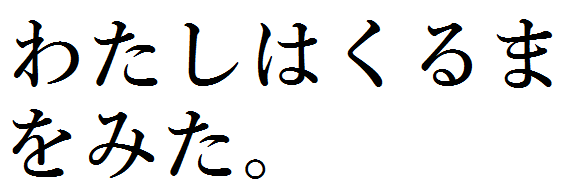
Suddenly, it’s a lot more difficult to tell where one idea stops and another starts, since it’s all one unbroken string of hiragana. Trying to read something written only in hiragana is kind of like tryingtoreadEnglishsentenceswrittenlikethis. The rhythm that comes from having a mix of kanji and hiragana, though, makes written Japanese an intelligible way of conveying ideas instead of a mad dash to the finish line.
Speaking of finish lines, we’ll be back again soon with this topic’s thrilling conclusion, in which we tackle the mysterious lone wolf outsider of Japanese writing: katakana, the third and final form of Japanese text.
▼ ウォーン!

Follow Casey on Twitter, where he sometimes tweets about how much he misses his 車.
Chocolate milk image: Wikipedia/BotMultichillT
Wolf image: Wikipedia/Retron
All other images ©RocketNews24
 Why does Japanese writing need three different sets of characters? (Part 2)
 Why are some types of Japanese rice written with completely different types of Japanese writing?
 Japanese writing system gets turned into handsome anime men with Hiragana Boys video game
 Japanese study tip: Imagine kanji characters as fighting game characters, like in this cool video
 One simple kanji character in super-simple Japanese sentence has five different pronunciations
 Japanese gacha machine in Shibuya now sells tiny capsule terrariums
 Study finds hundreds of people in Indonesia legally named after Naruto, Inuyasha, other anime stars
 12-year-old British girl who went missing in Tokyo found safe after visiting anime sites around Yokohama
 12-year-old foreign tourist missing in Japan, police asking for help finding her [Video]
 Best burger in Tokyo? JB’s serves up a cheap craft burger that not a lot of people know about
 Visiting Japan’s muscular mascot character dog at his free museum near Kansai International Airport
 Teen girl in Japan refuses to be victim, personally escorts train pervert to police for arrest
 Google’s first Google Store outside the U.S. is now open in Tokyo
 New Wet Rice Cracker Burger from Dom Dom breathes new life into a “miracle” snack
 Krispy Kreme Japan is baking up two new donuts that you can only get at one spot in the country
 Studio Ghibli adds new Jiji’s baby plush toy to its anime merchandise range in Japan
 The Japanese city where ordering grilled chicken doesn’t guarantee you’ll actually get chicken
 Japan’s new beer glass is designed to force you to drink…water [Video]
 Japanese airlines set to cut fuel surcharges for international flights in September and October
 Beautiful off-the-beaten-path spot near samurai castle in rural Japan looks like a Monet painting
 New Japanese vending machine at Shinkansen station sells cups of ice on platform
 This beautiful rural Japan river is a great alternative to touristy summer retreats [Photos]
 Tokyo subway installing new ticket gates that don’t accept payment through Suica or other IC cards
 Japan now has human refrigerators inspired by Japanese vending machines
 New Shinkansen luggage drop-off system begins in Japan, making train travel even easier
 Hatsune Miku collaborates with Hokusai’s art in new Vocaloid ukiyo-e illustration series [Pics]
 Studio Ghibli releases anime T-shirts that pay homage to one of Hayao Miyazaki’s most personal films
 Air-conditioned dress shirts arrive in Japan to save working professionals from sweltering heat
 Japanese Shinkansen becomes an overnight hotel for three nights this summer
 Pokémon Center Online designates first Pokémon items that will require Japanese ID card to buy
 Japanese toilet aims to attract foreign tourists but not everybody is happy about it
 99-year-old woman rescued while attempting to climb Mt. Fuji
 Japan announces sudden 400-percent increase in visa fees for foreigners entering the country
 Japan’s human washing machines will go on sale to general public, demos to be held in Tokyo
 Studio Ghibli has a new anime out, and there’s only one place in the world where you can see it
 Starbucks Japan releases new drinkware and goods for Valentine’s Day
 Starbucks Japan releases new sakura goods and drinkware for cherry blossom season 2026
 Japan’s newest Shinkansen has no seats…or passengers [Video]
 Japanese ninja certification exam attracts 131 candidates from Japan and abroad
 Salomon releases Japan-exclusive Mt. Fuji hiking gear that doubles as an amazing souvenir
 Put sesame oil in your coffee? Japanese maker says it’s the best way to start your day【Taste test】
 What does a kanji with 12 “kuchi” radicals mean? A look at weird, forgotten Japanese characters
 Why is the Japanese kanji for “four” so frustratingly weird?
 Foreigners in Japan vote for the best-looking katakana character
 How to write “sakura” in Japanese (and why it’s written that way)
 How to tell Japanese’s two most confusing, nearly identical characters apart from each other
 The extremely violent backstory of how to write the word “take” in Japanese
 Brain Gymnastics Quiz: Move one matchstick to create the name of a Japanese Prefecture
 Discrimination fears lead Japanese genetics society to replace words for dominant, recessive gene
 Video of each Japanese hiragana getting “measured up” is oddly cute and satisfying【Video】
 German linguist living in Japan says kanji characters used for Germany are discriminatory
 The top 70 words that keep showing up in Japanese light novel titles (and yes, isekai is one of them)
 Learn Japanese through ridiculous manga: Two Piece 【Episode #1】
 Six (and a half) essential resources for learning Japanese
 Japanese teacher shares surprising reason why the kanji for crow has one less line than bird
 Why Does Engrish Happen in Japan? – Breakfast buffet edition
