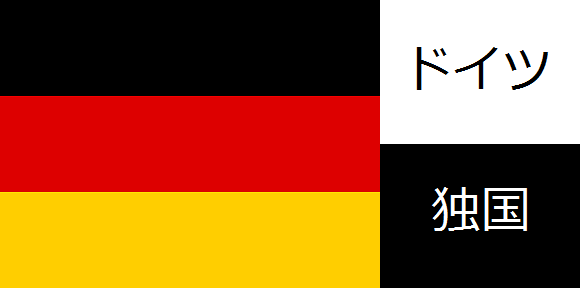
Though the kanji can translate as “lonely country,” his complaint lies elsewhere.
For the most part, the Japanese language uses the phonetic script called katakana to render the names of places outside Asia. However, as we’ve looked at before, there are also standardized kanji, the characters originally brought over from China, that are also used to refer to foreign countries, especially in newspaper articles and other media reports.
These “country kanji” aren’t necessarily a perfect match up with the nation’s original, or even corrupted katakana, pronunciations, and are instead usually an approximation of the initial syllable. Still, it is kind of cool for people from England, for example, to know that sometimes they’re referred to as being from Eikoku, meaning “Hero Country” or “Glory Country.”
However, Tokyo resident and linguist Christoph Schmitz doesn’t feel so happy when he sees his native Germany rendered as Dokukoku, written in kanji like this:
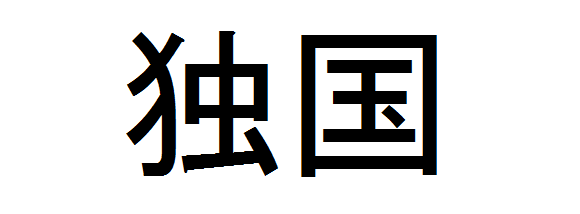
The first kanji, read doku, was chosen because of its similarity to “Doitsu,” the corrupted Japanese pronunciation of the “Deutsch” portion of “Deutschland,” as Germany is called in the German language. Doku ordinarily means “alone,” and the kanji shows up in such dreary Japanese vocabulary as kodoku (“loneliness”) and dokudan (“arbitrary judgement”), but it’s part of more positive members of the lexicon like dokuritsu (“independence”) and dokusou (“originality”).
However, Schmitz takes issue not with the meaning of doku, but with how the character is written. The 47-year-old, who recently finished a 12-year project translating and self-publishing an English version of respected Japanese kanji scholar Shizuka Shirakawa’s Lexical Interpretation of General-Use Kanji, is specifically bothered by the left half of the character.
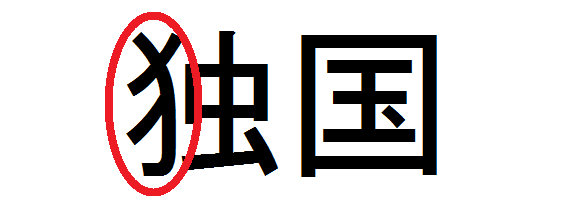
Like many kanji, doku is a compound of other, older kanji, which have had their shapes altered and/or compacted for aesthetic balance and ease of writing. In the case of doku, the strokes that make up the left half are collectively called the kemono-hen, or “beast radical,” which is an altered form of the kanji…

…which means “dog.” The right half of doku, by the way, is written exactly like the kanji for mushi, or “bug,” but is actually held to be a modified form of…

…which is related to the concept of avarice, leading to the image of a covetous animal taking things for itself and not showing interested in being part of a group, thus the meaning of “alone” associated with doku.
Schmitz contends that the presence of the animal-based kemono-hen within the kanji used for Germany carries discriminatory connotations. While he hasn’t filed any official complaints with the Japanese government or educational authorities, he has said that “As a German who understands kanji, I would like to see a change.”
However, Schmitz is not asking for Japanese society to decide on new kanji to use for Germany, nor for the doku kanji to be recast without use of the kemono-hen. Instead, he’s voiced his hope that instead of using kanji at all to refer to Germany, media outlets will begin rendering the country’s name using the phonetic, intrinsically meaningless katakana script in all instances, thus removing any unwanted association with the base origins of the kanji and utilizing the purpose for which katakana were developed.
Source: Tokyo Shimbun via Hachima Kiko, OK Jiten, Goi Jiten, Kanji Chishiki
Top image: Wikipedia/Anomie (edited by RocketNews24)
Insert images: RocketNew24
Follow Casey on Twitter, where he’s pretty much OK with America being “Rice Country” in its official kanji.



Why does Japanese writing need three different sets of characters? (Part 2)
Twitter users say Japanese Prime Minister’s name is hiding in the kanji for Japan’s new era name
Why does Japanese writing need three different sets of characters? (Part 1)
What does a kanji with 12 “kuchi” radicals mean? A look at weird, forgotten Japanese characters
Foreigners in Japan vote for the best-looking katakana character
Dorayaki from 89-year-old Japanese confectionery shop is one of the best sweets hidden in Tokyo
War in Iran threatening Japan’s pudding production
“Get paid to chat online with Japanese girls” part-time job sounds like scam, is apparently legit
South Korea’s “Idol School” proves Korean idols are more than just pretty faces【Pics & Vids】
Japan’s new ID photo booths give you a virtual boyfriend/girlfriend, tsundere included
New Travelling Bento pouches turn your luggage into a Japanese lunch box
Tokyo Cancel Christmas protest march cancelled by Revolutionary Alliance of Unpopular Men
We try “the best milk soft cream” in Tokyo
W.T.F. Japan: Top 5 most ridiculous kanji handwriting shortcuts【Weird Top Five】
Japanese man accepts hostess’ invitation for night view date, sees type of stars he didn’t want to
New Kyoto Converse sneakers celebrate Japan with traditional kimono fabrics for your feet
Japan’s 5.3 million beautiful Hitachi Nemophila flowers are now in full bloom[Photos]
Studio Ghibli launches huge new anime movie T-shirt collection with special design details
Tifa’s Final Fantasy VII bar is going to pop up in real-world Tokyo
Brand-new Square Enix Cafe to open in Tokyo…and in Los Angeles too!
Japanese convenience store gives away free ice cream with creative ad at Shinjuku Station
Japan is so hungry for workers it used up its five-year visa quota in record time
Tsujihan sushi bowl restaurant goes viral with foreign tourists, but is it worth the hype?
Hello Kitty is now a transforming truck robot[Photos]
7-Eleven Japan’s cooked-in-store takoyaki is here! How does it fare against the street food king?
Japan reportedly adding Japanese language skill requirement to most common foreigner work visa
Pokémon and Ikea Japan cross over into each other’s worlds with collaboration events
Wisteria season starts early with blooming of Japan’s Great Wisteria in its beautiful garden
Japan’s best conveyor belt sushi restaurant of seven years ago has now, finally, come to Tokyo
Brand-new Pokémon manhole covers coming to help the recovery of a disaster-stricken part of Japan
Japan’s awesomely beautiful Alpen Route snow corridor is now open
Injuries on stairs in Tokyo highlight an overlooked design flaw
Mt. Fuji decorated with a 500,000-flower pink carpet is Japan’s ultimate spring view
Survey asks foreign tourists what bothered them in Japan, more than half gave same answer
Japan’s human washing machines will go on sale to general public, demos to be held in Tokyo
Starbucks Japan releases new drinkware and goods for Valentine’s Day
We deeply regret going into this tunnel on our walk in the mountains of Japan
Starbucks Japan releases new sakura goods and drinkware for cherry blossom season 2026
Japan’s newest Shinkansen has no seats…or passengers [Video]
Major Japanese hotel chain says reservations via overseas booking sites may not be valid
Put sesame oil in your coffee? Japanese maker says it’s the best way to start your day【Taste test】
No more using real katana for tourism activities, Japan’s National Police Agency says
Clever font sneaks pronunciation guide for English speakers into Japanese katakana characters
How to tell Japanese’s two most confusing, nearly identical characters apart from each other
Pokémon Center apologizes for writing model Nicole Fujita’s name as Nicole Fujita
Why is the Japanese kanji for “four” so frustratingly weird?
Yahoo! Japan finds most alphabetic and katakana words Japanese people want to find out about
Japanese study tip: Imagine kanji characters as fighting game characters, like in this cool video
Japan’s kanji character of the year for 2017 is “north”
Japan’s Kanji of the Year announced, shows the bright and dark spots of 2024【Video】
W.T.F. Japan: Top 5 kanji with ironic meanings【Weird Top Five】
Chinese bootleg invites us to learn about the wonderful world of anime legend…Guzuo Miyazaki?!?
Five different ways to say “children” in Japanese
Japan announces Kanji of the Year for 2020
W.T.F. Japan: Top 5 kanji with the longest readings 【Weird Top Five】
Japan’s Kanji of the Year for 2023 reveals the worries of Japanese society
“Bear” voted Japan’s Kanji of the Year for 2025 in extremely close race
International-hit candy Hi-Chew adds English to in-Japan logo, makes it bigger than the Japanese