
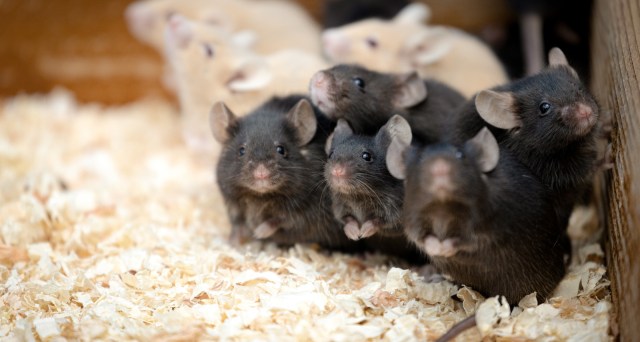
Scientists use flashes of light in the brain to really wipe away memories…in mice.
Ironically, few things stick in the memory of those who watched the 1997 blockbuster Men In Black like the Neuralyzer. It’s a fictional tool that, once directed at a hapless witness to supernatural or alien phenomena, emits a quick burst of light that wipes away the memory of whatever they saw.
▼ Since we’re a Japanese news website, please enjoy the Japanese dub of that very scene.
It feels…at least semi-plausible, right? Really good fiction can make you suspend your belief, and since it’s disorienting to get a light flash in your eye, it’s easy to make the leap that certain kinds of light flashes might affect your memory. But there’s no scientific basis for that fact, obviously. It’s just a movie. Isn’t it?
Well, a recent study from Kyoto University has made things a little more complicated with their recent research on mice. The findings were published on November 11, in a paper for Science titled “Stepwise synaptic plasticity events drive the early phase of memory consolidation” — the scientists managed to relax newly created synapses (the neural connections responsible for forming memories). The study involved mice learning that if they entered a dark chamber annexed to their bright habitat, they would receive an electric shock. Mice learned that they would be shocked upon entering, and thus became cautious and fearful around the dark chamber. Those that had their memories undone with the treatment would instead bound into the dark chamber happily as though they had never been exposed to it.
They achieved this result by using a protein derived from sea anenomes that produces destructive oxygen atoms in response to light exposure. This protein was introduced to the mice by way of a harmless virus, after editing the protein to reduce the damaging effects from the oxygen atoms. Rather than damaging neural pathways, now they just relax them, preventing recently formed memories from being recalled.
New memories are created from experience, like the experience of the mice entering the dark room and receiving a shock. These memories are transferred through the brain via sleep, where they enter the long-term memory. In the case of this experiment, a mouse was injected with the modified SuperNova protein and had an optic fibre inserted into its brain to stimulate it with light. After introducing it to the shock chamber with other control mice, this mouse had its brain stimulated with light right after it was shocked so that the newly learned information would be deleted. After sleeping and returning to the room, it didn’t demonstrate fear as the other mice did.
The scientists also tried erasing the memory another way by flashing light onto another part of the brain — one that summons more distant memories. Two days after the learning experience, they managed to erase what the mouse had learned. After 25 days, however, it had been too long and the memories had consolidated within the brain.
The field of studying light-sensitivities in neurons is called optogenetics. Previous studies by optogeneticists have concerned the whole brain, rather than specific areas where new memories might be formed. This study, though, concerns the specific time window where memories are created. Rather than existing as a single physical concept inside the brain, memories are actually thought to be recalled by cross-referencing various different neural highways—which might explain why certain memories are triggered by certain smells or sounds.
Using the knowledge derived from earlier experiments, the twelve authors of this study (Akihiro Goto, Ayaka Bota, Ken Miya, Jingbo Wang, Suzune Tsukamoto, Xinzhi Jiang, Daichi Hirai, Masanori Murayama, Tomoki Matsuda, Thomas J. McHugh, Takeharu Nagai, and Yasunori Hayashi) successfully showed that long-term memory formation can be stopped or even reverted in a localized window.
Online reactions have likened the procedure to something out of Doraemon or the SCP Foundation, joked “do me a favor and get rid of the last ten years,” and expressed concern about unsavory uses for the technology. Theoretically, as long as the synapses for specific memories can be determined and the technique performed in a timely manner, it could possibly be used in treating sufferers of PTSD and other forms of mental trauma. For the time being, though, this research is limited solely to mice. If you’d rather improve your memory than lose it, then you may want to read up on the benefits of coffee…or this gum from 2017, though we can’t remember if that one was especially successful or not.
Sources: Science – Stepwise synaptic plasticity events drive the early phase of memory consolidation, Nazology, Twitter/@NazologyInfo via My Game News Flash
● Want to hear about SoraNews24’s latest articles as soon as they’re published? Follow us on Facebook and Twitter!
 Japan now has a special desk for people who work at home with a pet cat[Photos]
 Uniqlo announces new T-shirts for One Piece, Naruto and more for manga publisher’s 100th birthday
 Famous Tokyo cherry blossom spot installs view-blocking screens to fight overcrowding[Video]
 Japan’s favorite sandwich pockets now come with sakura filling, but how do they taste?[Taste test]
 Japanese city abolishes 88th birthday celebratory money gift because people are living longer
 Japan now has a special desk for people who work at home with a pet cat[Photos]
 Uniqlo announces new T-shirts for One Piece, Naruto and more for manga publisher’s 100th birthday
 Famous Tokyo cherry blossom spot installs view-blocking screens to fight overcrowding[Video]
 Japan’s favorite sandwich pockets now come with sakura filling, but how do they taste?[Taste test]
 Japanese city abolishes 88th birthday celebratory money gift because people are living longer
 Tokyo/Saitama train line to hold cherry blossom viewing tour with meal included
 Japan’s lap-pillow ear-cleaning salons aren’t just for pervy guys, we find out
 Peko-chan Milky Time Cafe opens in Chiba and we go to check out all of the pastries and merch
 Picturesque Tokyo park plays host to millions of flowers and soap bubbles this spring
 Cherry blossom parties allowed at Tokyo’s most popular sakura spots for first time since pandemic
 Krispy Kreme releases Super Mario doughnuts in Japan for a limited time
 7-Eleven Japan releases a crazy new viral sandwich: Chocolate Sprinkles and Whipped Cream
 Japan now has a “for foreign tourists only” Mt. Fuji sightseeing train[Video]
 Studio Ghibli releases the My Neighbour Totoro tea caddy, with a magical self-closing lid
 Totoro and Calcifer become little light-up lanterns for Ghibli-style excursions or at-home decor
 Create a tiny Ghibli anime world on your bookshelf with new miniature papercraft art kits
 Starbucks Japan releases new My Fruit³ Frappuccino at only 34 stores around the country
 Starbucks Japan unveils new sakura cherry blossom collection for hanami season 2026
 Train station platform ramen store closes its doors on half a century of history in Tokyo
 Studio Ghibli releases Catbus pullback keychain that runs like the anime character
 Japanese onsen egg maker from 100-yen store Daiso needs to be on your shopping list
 Nine great places to see spring flowers in Japan, as chosen by travelers (with almost no sakura)
 Survey asks foreign tourists what bothered them in Japan, more than half gave same answer
 Japan’s human washing machines will go on sale to general public, demos to be held in Tokyo
 Starbucks Japan releases new drinkware and goods for Valentine’s Day
 We deeply regret going into this tunnel on our walk in the mountains of Japan
 Studio Ghibli releases Kodama forest spirits from Princess Mononoke to light up your home
 Starbucks Japan releases new sakura goods and drinkware for cherry blossom season 2026
 Japan’s newest Shinkansen has no seats…or passengers [Video]
 Major Japanese hotel chain says reservations via overseas booking sites may not be valid
 Put sesame oil in your coffee? Japanese maker says it’s the best way to start your day【Taste test】
 No more using real katana for tourism activities, Japan’s National Police Agency says
 Tokyo/Saitama train line to hold cherry blossom viewing tour with meal included
 Japan’s lap-pillow ear-cleaning salons aren’t just for pervy guys, we find out
 Peko-chan Milky Time Cafe opens in Chiba and we go to check out all of the pastries and merch
 Picturesque Tokyo park plays host to millions of flowers and soap bubbles this spring
 Cherry blossom parties allowed at Tokyo’s most popular sakura spots for first time since pandemic
 Studio Ghibli releases the My Neighbour Totoro tea caddy, with a magical self-closing lid
 A secluded British mansion in Chiba is a hidden holy land for afternoon tea lovers
 The top 10 graduation songs in Japan as chosen by current Japanese high school students
 We revisited Sweets Paradise after a decade to see if Japan’s dessert buffet still delivers
 Studio Ghibli releases new anime character socks to put a magical spring in your step
 Massive manga collaboration bringing 100 years of Shueisha manga to Uniqlo T-shirts【Photos】
 Awesome Ghibli Howl’s Moving Castle figure is also a puzzle and an organizer[Photos]
 Totoro and Calcifer become little light-up lanterns for Ghibli-style excursions or at-home decor