
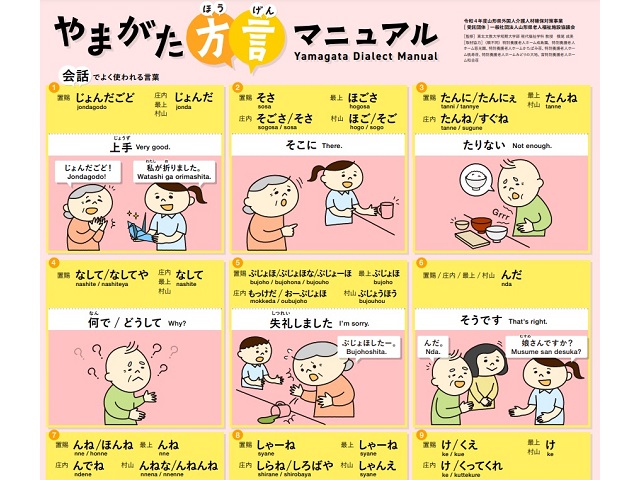
Yamagata dialect can be very different from the Japanese you learned in school, but this illustrated guide will have people telling you “Jondagodo!” in no time.
Today’s the big day! You’ve finally made it to Japan and starting your new life in Yamagata Prefecture. After months, or maybe years, of studying Japanese, you show up for work, excited to put your language skills to use.
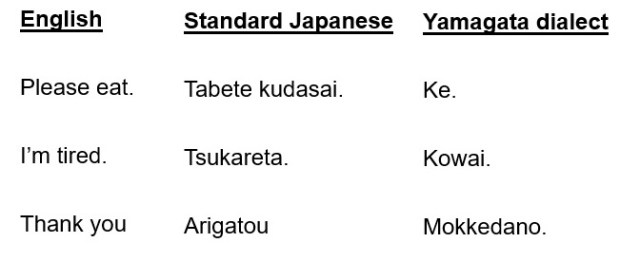
However, while self-study and classroom instruction are great ways to build up a foundation of knowledge in a foreign language, they can’t prepare you for every possible scenario and vocabulary word. At one point during the day, someone comes up to you holding a box of sweet dumplings and saying “Ke,” which, as far as you know, is the word for “hair.” Did they find a hair in the box? Do they think it’s one of yours? Then, at the end of the day, someone lets out a long sigh and mutters “Kowai,” which most people studying Japanese learn means “Scary.” Did you commit some cultural blunder that made you seem intimidating and belligerent? As you clock out of your shift, you try to apologize, even though you’re not sure what you did, and the other person responds with “Mokkedano.” That’s one you’ve never heard before, and it’s not in your dictionary either…so did you just get fired?
Relax. That ke? The person was offering you something to eat. Kowai, in this case, actually just meant “I’m tired,” And mokkedano? That’s just “thank you.” But while those phrases are easily understood among Yamagata natives, they’ll quickly confuse native Japanese speakers from other parts of the country, let alone a new arrival from overseas.
Thankfully, the Yamagata Prefectural government realizes that the local dialect can be tricky for newcomers to understand, so they’ve created an official Yamagata Dialect Manual, posted to the government’s website, to clear up some of the biggest potential confusions.
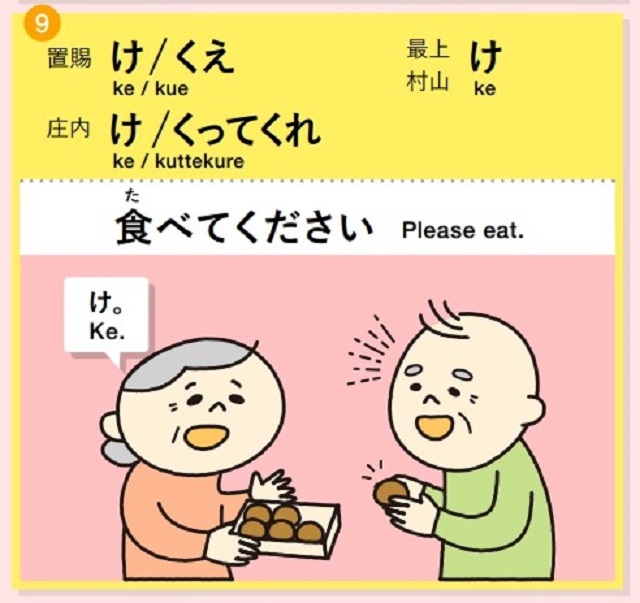
You’ll notice a lot of senior citizens in the guide’s illustrations. That’s because the guide’s creation was prompted by talks with some of the 124 foreign-born workers at nursing homes in Yamagata, who said that one of the biggest challenges they faced was understanding patients and residents when they were speaking in the local dialect.
Even among native Japanese speakers, the way of speaking in the country’s northeastern Tohoku region, of which Yamagata is a part, is considered especially difficult to understand. The especially mountainous topography kept Tohoku communities comparatively isolated while more southern parts of Japan became more rapidly connected by modern transportation infrastructure. Tohoku’s bitterly cold winters are thought to have influenced language too, by subconsciously conditioning people living in the region to shorten words and blend syllables so as to cut down how much they have to move their chilled mouth muscles when talking.
▼ Usually mama means “current condition” or is the English mama (i.e. mother) being used as a loanword, but in Yamagata it can also mean “meal” or “food,” (gohan in standard Japanese).
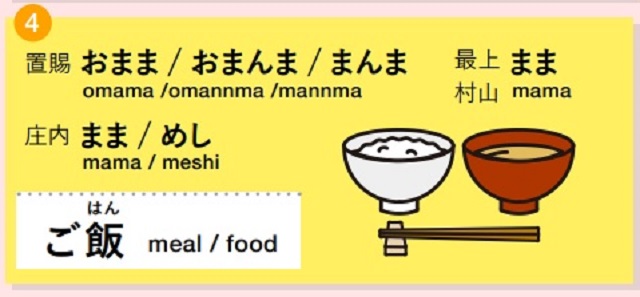
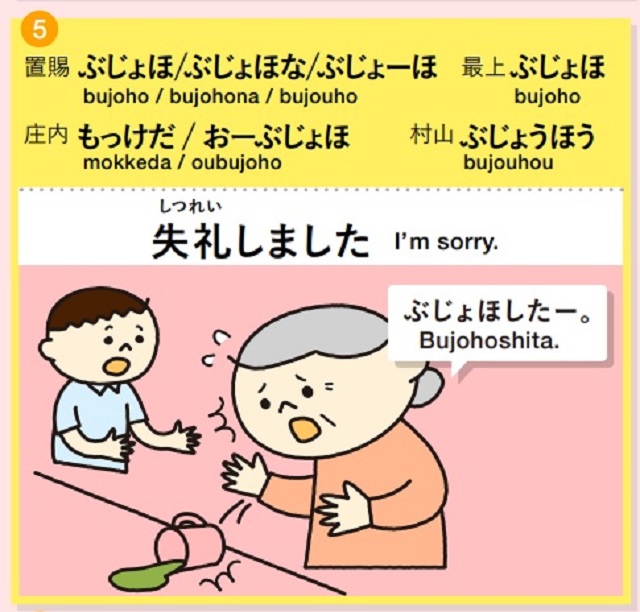
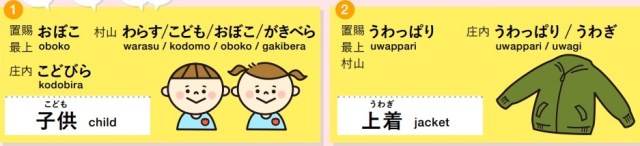
Even within Yamagata, different parts of the prefecture sometimes speak differently, so the guide features notations for whether a phrase is primarily associated with the Okitama (置賜), Mogami (最上), Shonai (庄内), or Murayama (村山) districts.
▼ Just spilled a cup of green tea in Mogami? A quick “Bujoho,” will help smooth things over, but that same spill in Shonai would more likely warrant a “Mokkeda.”
Between the extension of rapid rail lines into Tohoku and the increase in nationwide media outlets, younger Yamagata generations’ Japanese is getting closer to standard Japanese, and a thick Yamagata dialect is something you’re more likely to encounter when speaking with elderly people, which is another reason why the topic came up when speaking with nursing care workers.
▼ Yamagata granny is likely to worry about the neighborhood oboko going outside to play without taking an uwappari with them.
The full guide can be found online, for free, here, and its designers say “We hope this will be a way of showing that Yamagata thinks kindly of people from other countries.” It’s worth noting that as unique as the dialect is, people in Yamagata still understand standard Japanese, so you won’t run into any problems using textbook vocabulary when you’re speaking. The alternate versions are things you’re likely to hear, though, so knowing what they mean will make foreign residents’ and visitors’ time in the prefecture easier and more enjoyable. Plus few things make Japanese people happier than a foreigner showing an interest in the community culture by trying out the local dialect themselves, so give it a try and you might just get a smile and a “Jondagodo!” (“Very good!”) for your efforts.
Source: Yamagata Prefectural Government via Kahoku Shimpo via Yahoo! Japan News
Top image: Yamagata Prefectural Government
Insert images: SoraNews24, Yamagata Prefectural Government
● Want to hear about SoraNews24’s latest articles as soon as they’re published? Follow us on Facebook and Twitter!
Follow Casey on Twitter, where Southern Calfornia dialect compels him to say “dude” as often as possible.
 Foreign shop clerk and Japanese customer fail to communicate because of Japanese language quirk
 Record number of foreign children in Japan need help understanding Japanese in school
 Only one out of five Japanese people can pronounce these hiragana — can you?
 Japanese ad promoting Miyazaki Prefecture shows how foreign its own dialects can be 【Video】
 Foreign English teachers in Japan pick their favorite Japanese-language phrases【Survey】
 Starbucks Japan closing only Shinkansen platform branch for popularity-triggered renovations
 You can assemble a well-balanced team of Pokémon, them eat them, thanks to Japanese cake chain
 Can a downtown Tokyo super sento bathhouse beat a hotel for a one-night stay?
 Two food hacks take Japan’s convenience store fried chicken to amazing new sandwich heights
 Pokémon and Ikea Japan cross over into each other’s worlds with collaboration events
 Beautiful Ghibli earrings allow you to finally reunite two of the studio’s star-crossed lovers
 Poop is in full bloom at the Unko Museums for cherry blossom season
 Studio Ghibli releases Catbus pullback keychain that runs like the anime character
 A Kyoto factory vending machine sells gourmet mystery meals at bargain prices
 The best Japanese cosplayers from Day 4 of Summer Comiket 2019【Photos】
 Tokyo’s best museum for foreign travelers finally reopens after being closed for four years
 Pokémon lacquerware series expands for Year of the Horse with new handcrafted design[Video]
 Tokyo subway and almost all Tokyo train lines now accepting credit card tap payments
 Totoro Fund line of beautiful artwork and apparel lets you help the real-world Totoro Forest
 Fading Tokyo – Searching for signs of the Showa era as local neighborhoods evolve[Photos]
 Famous Tokyo cherry blossom spot installs view-blocking screens to fight overcrowding[Video]
 Tokyo turns its phone booths into free Wi-Fi hotspots, and here’s how to use them
 Studio Ghibli adds new My Neighbour Totoro 2026 Corn Gift to its anime store for Mother’s Day
 Japan now has a special desk for people who work at home with a pet cat[Photos]
 Uniqlo announces new T-shirts for One Piece, Naruto and more for manga publisher’s 100th birthday
 Train station platform ramen store closes its doors on half a century of history in Tokyo
 Starbucks Japan releases new My Fruit³ Frappuccino at only 34 stores around the country
 Krispy Kreme releases Super Mario doughnuts in Japan for a limited time
 Japanese onsen egg maker from 100-yen store Daiso needs to be on your shopping list
 Nine great places to see spring flowers in Japan, as chosen by travelers (with almost no sakura)
 Survey asks foreign tourists what bothered them in Japan, more than half gave same answer
 Japan’s human washing machines will go on sale to general public, demos to be held in Tokyo
 Starbucks Japan releases new drinkware and goods for Valentine’s Day
 We deeply regret going into this tunnel on our walk in the mountains of Japan
 Studio Ghibli releases Kodama forest spirits from Princess Mononoke to light up your home
 Starbucks Japan releases new sakura goods and drinkware for cherry blossom season 2026
 Japan’s newest Shinkansen has no seats…or passengers [Video]
 Major Japanese hotel chain says reservations via overseas booking sites may not be valid
 Put sesame oil in your coffee? Japanese maker says it’s the best way to start your day【Taste test】
 No more using real katana for tourism activities, Japan’s National Police Agency says
 Japan’s second-largest convenience store chain changes service policy for sake of foreign workers
 Japanese man says “I’m a Vietnamese” while pointing knife at convenience store worker to rob her
 New book teaches Japanese people English to help out foreign travelers
 Number of foreigners studying Japanese in Japan hits record high, but are there enough teachers?
 Kyoto study finds nearly 500 translation errors for foreign tourists, new guidelines released
 There’s no need to care about our staff, because they’re foreigners, says Japanese maid service
 New English textbook published for anime industry’s Animator Skill Test