
Multi-country study has one element in every nation’s top five emoji, but not Japan’s.
In Japan, yearly observances such as Wagashi Day, Good Bath Day, and Boobs Day are always a source of fun for aficionados of their particular themes. However, Japan isn’t the only country with such quasi-holidays. In fact, some such celebrations are global affairs, such as World Emoji Day, which falls on July 17.
In observance of World Emoji Day, Baidu Japan, the Japanese division of Chinese tech firm Baidu, maker of the Simeji emoji keyboard app, conducted a tally of the most-used emoji among Simeji users across 16 different countries, Japan, the U.S., the U.K., France, Russia, Spain, Italy, Turkey, Argentina, Mexico, Iraq, Egypt, Vietnam, Indonesia, Thailand, and India, during the first half of 2025.
When everything was added up, the most-used emoji across that entire user base was…

…this specific crying face. Those twin tear cascades were the most commonly used emoji in 12 of the 16 countries, including Japan, the U.S., and the U.K. What’s more, out of the four remaining countries, three of them, France, Iraq, and Egypt, had different crying faces as their favorites, with Russia the only country with no tears in its number-one emoji.
▼ Top five emoji for Japan, U.S., U.K., and France (first row), Russia, Spain, Italy, and Turkey (second row), Argentina, Mexico, Iraq, and Egypt (third row), and Vietnam, Indonesia, Thailand, and India (fourth row)
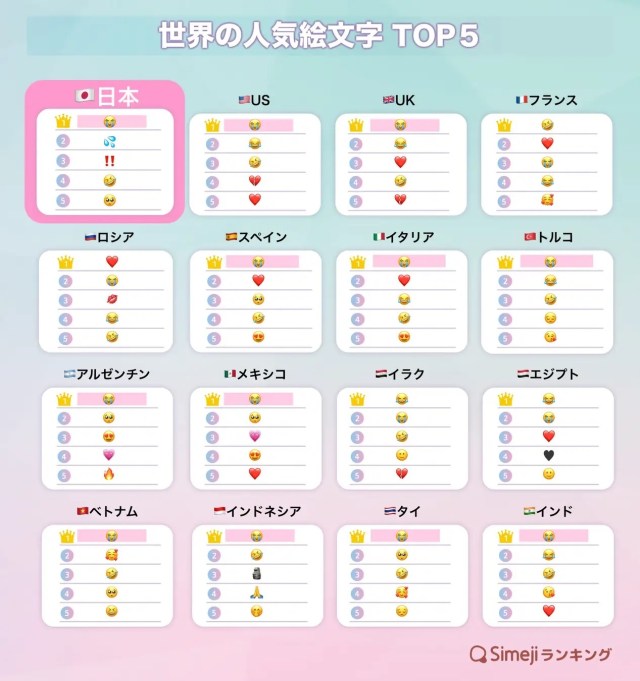
So why is the 😭 so widely used across different regions, languages, and communication cultures? Baidu Japan thinks it’s because of how versatile that exact emoji is. The free-flowing tears are a strong show of emotion, but the overall expression (the shape and position of the eyebrows, eyes, and mouth) and pretty noncommittal. Those could be tears of joy, laughter, gratitude, empathy, or sadness, depending on the context, or even some mix of those that’s hard to convey in words, making an emoji an especially effective and appealing way to send those sentiments to somebody on the other end of a text chat. Some of that also applies to the crying faces that were the top picks for France, Iraq, and Egypt, but the expressions on their number-one emoji seem to be either smiling or wincing, which sort of limits how useful they are for expressing more tender or sympathetic feelings.
As further proof of how versatile crying emoji are, aside from Argentina and Mexico every country had at least two in their top five, and some had three. But while crying faces showed up across the board, Japan’s top five results were unique in the three different ways.
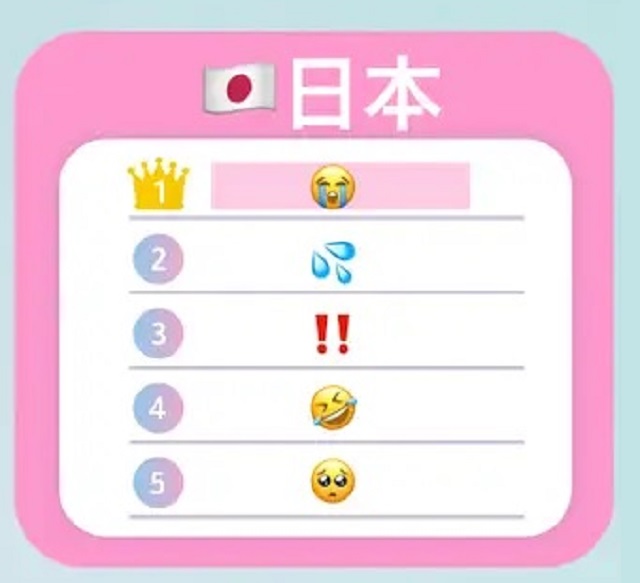
Japan’s number two and three emoji didn’t show up in any other country’s top five. It’s not hard to imagine the reason for the disparity with 💦. In Japan, stylized sweat drops have been used as a symbol for hurried, panicked, or emphatic action in manga/anime and graphic art for several decades, but it’s not uncommon for the emoji to be used/seen as a symbol of a different sort of bodily fluid among online communities in other countries, one with much narrower situational applicability. As for the double exclamation points, they don’t have any unique significance in Japan, but their popularity could be related to how one of the most common ways to show surprise in Japanese is to let out an elongated “E—-eeeee,” with a rising intonation. However, that same sound, but with a dropping intonation, instead indicates disapproval or doubt that what the other person said is true, and since intonation isn’t something that can be conveyed in Japanese writing, using an emoji to show that you’re surprised is sometimes a safer choice.
And the third way Japan’s results are unique? It’s the only country with no hearts, either as stand-alone emoji or as elements (such as a face with hearts for eyes) in its top five.
The easy explanation here is that Japanese people are less likely to directly say “I love you” than people in many other cultures, but there’s a little more to it than that. While people in some countries may use heart emoji to express familial love, in Japan they’re almost exclusively used to express romantic love. A Japanese grandma, for example, isn’t likely to send her out-of-prefecture grandchild a text that says “Happy birthday, sweetie! Grandma misses you ❤,” nor would said grandkid respond with, “Thanks, Grandma! I miss you too ❤.” With a narrower range of usable situations, it’s not surprising that Japan uses fewer heart emoji, but it doesn’t necessarily mean that Japanese people don’t care about love (after all, they’ve got multiple words for it).
Source: PR Times
Top image: Pakutaso
Insert images: PR Times
● Want to hear about SoraNews24’s latest articles as soon as they’re published? Follow us on Facebook and Twitter!
 Keyboard app shares most common emoji by country, Japan’s are completely different from others
 Japan’s 10 favorite emoji for Twitter, and how they compare to the rest of the world
 What’s the real meaning of Japan’s “burning tofu” emoji?
 Japan’s passport is the strongest in the world, study shows
 Japan reopens to international tourists June 10, no vaccinations required for 98 countries
 Lawson convenience store at popular tourist site is one of the most unusual in Japan
 Mt. Fuji decorated with a 500,000-flower pink carpet is Japan’s ultimate spring view
 Howl’s Moving Castle’s scene-stealing dog is here to clean your home as a plushie mop
 30 Pikachus want to share a Tokyo hotel room with you that has separate Grass, Water, Fire spaces
 Studio Ghibli celebrates the magic of movie theaters with short video, Hayao Miyazaki illustration
 Nephew receives SD card after his uncle passes away, finds treasure trove of gems from the past
 This beautiful, heartwarming winter anime is also a McDonald’s Japan commercial【Video】
 Put it on and look like Donkey Kong! Nintendo releases DK jackets, more for new merch line【Pics】
 Pringles Chocolate, but with a Japanese twist, is the snack hack you should be trying right now
 New Travelling Bento pouches turn your luggage into a Japanese lunch box
 Japan reportedly adding Japanese language skill requirement to most common foreigner work visa
 Pokémon and Ikea Japan cross over into each other’s worlds with collaboration events
 Starbucks Japan closing only Shinkansen platform branch for popularity-triggered renovations
 You can assemble a well-balanced team of Pokémon, them eat them, thanks to Japanese cake chain
 Two food hacks take Japan’s convenience store fried chicken to amazing new sandwich heights
 7-Eleven Japan’s new baked-in-store sweet treat is only available in three parts of the country
 Man bites woman at cherry blossom park in Japan, dies shortly after
 Peanuts and Coke becomes a viral hit in Japan, but is it a trend worth joining?
 Japan now has a special desk for people who work at home with a pet cat[Photos]
 Famous Tokyo cherry blossom spot installs view-blocking screens to fight overcrowding[Video]
 Uniqlo announces new T-shirts for One Piece, Naruto and more for manga publisher’s 100th birthday
 Train station platform ramen store closes its doors on half a century of history in Tokyo
 Starbucks Japan releases new My Fruit³ Frappuccino at only 34 stores around the country
 Krispy Kreme releases Super Mario doughnuts in Japan for a limited time
 Japanese onsen egg maker from 100-yen store Daiso needs to be on your shopping list
 Studio Ghibli releases Catbus pullback keychain that runs like the anime character
 Survey asks foreign tourists what bothered them in Japan, more than half gave same answer
 Japan’s human washing machines will go on sale to general public, demos to be held in Tokyo
 Starbucks Japan releases new drinkware and goods for Valentine’s Day
 We deeply regret going into this tunnel on our walk in the mountains of Japan
 Starbucks Japan releases new sakura goods and drinkware for cherry blossom season 2026
 Studio Ghibli releases Kodama forest spirits from Princess Mononoke to light up your home
 Japan’s newest Shinkansen has no seats…or passengers [Video]
 Major Japanese hotel chain says reservations via overseas booking sites may not be valid
 Put sesame oil in your coffee? Japanese maker says it’s the best way to start your day【Taste test】
 No more using real katana for tourism activities, Japan’s National Police Agency says
 Japanese passport ranks yet again as the most mobile in the world in 2023
 Out of 144 countries, Japan ranks 142nd in the world for helping strangers
 Japanese city makes list of world’s top 10 most livable cities, but not one most people expected
 Meow’s that? 2022’s ranking of the top cat names in Japan
 Survey picks Japan’s most attractive prefectures – Familiar spots at top and bottom of rankings
 Japanese baby name app releases 2021 ranking of top ten most intriguing boy and girl baby names
 Japan’s Kanji of the Year announced, shows the bright and dark spots of 2024【Video】
 Why do Japan’s noisy-gulp drink commercials exist, and are they gross?【SN24 reader survey】
 Giri? Tomo? Gyaku? A guide to Japan’s many different kinds of Valentine’s Day chocolate