Most of my early trips to Japan involved visiting my brother, back when he was living in Iwakuni, Yamaguchi Prefecture. One day while waiting for a train at the station, I passed the time by staring out at one of the many lotus farms the town is known for.
“Ah, Japan!” I thought as the plants swayed almost hypnotically in the hot summer breeze. “So appreciative of the beauty of nature!” The lotus must be so highly prized that it’s economically worthwhile to use large tracts of what little arable land the country has to cultivate and sell the flowers, I concluded.
I found out later that I was only half right. While it is true that Japan tends to get more excited about blossoming flora than other nations, all those lotuses weren’t being grown for aesthetic reasons. Lotus root, called renkon in Japanese, is edible, and not only is it delicious, it can also help you cope with one of the absolute worst parts of life in Japan: hay fever.
Hay fever wasn’t always a national-level crisis in Japan, and up until a generation ago it was a pretty minor problem. To find out why things started changing then, we have to go back even farther.
▼ Not that far, though.

Following Word War II, Japan was in dire need of building materials, as is typically the case when you end up on the losing side of history’s most massive armed conflict. As part of the post-war reconstruction and reforestation initiatives, the government planted swaths of Japanese cedar and Cyprus trees across the country.
Both trees produce large amounts of pollen, but initially this wasn’t a concern, since most of the trees were harvested by the lumber industry well before their pollen production kicks into overdrive at the 30-year mark. Unfortunately, due to a variety of economic, geographic, and political reasons, Japan has never had a particularly good track record at producing agricultural or forestry products at an attractive price. As the economy really started to pick up, a growing number of construction firms starting sourcing their raw materials from less expensive overseas suppliers, meaning that a lot of those trees planted by the government weren’t getting cut down from about the 1980s on.
Hey, that’s just about 30 years ago!
▼ Exactly.

Fast forward to today, and hay fever is such a problem that TV stations forecast pollen levels nightly like the weather, engineers devise crazy anti-hay fever helmets, and even charming, nice-smelling Internet writers are forced to wear surgical masks whenever they go out in public during the month of March.
Thankfully, there’s something else hay fever sufferers can do to cope that’s less extreme than using duct tape to seal up every outside air source and staying indoors until May. Apparently, renkon is great at lessening hay fever symptoms.
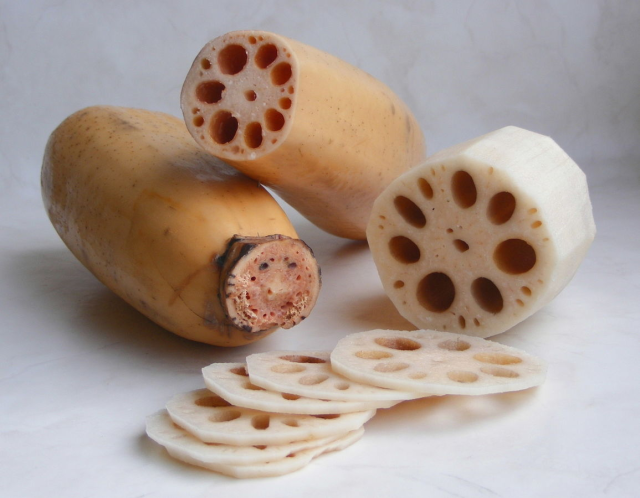
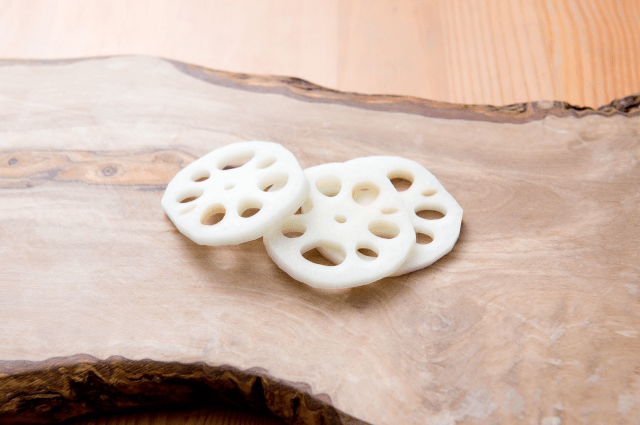
If you’ve ever eaten renkon, you might be looking at that photo and thinking, “Ugh, whoever sliced that should have really washed the dirt off first.” The dark speckles and patches aren’t grime, though, nor are they bruises or blemishes. Those discolorations are a naturally occurring result of all the tannins, of polyphenols, contained in lotus root.
Data has shown that polyphenols can be effective in hay fever relief. Saitama Medical University decided to test the effectiveness of lotus root by observing its effect on a group of allergy sufferers who ate renkon for two months. At the end of the period, blood samples taken from the participants showed them to be less susceptible to pollen allergies.
Renkon is easy to find in Japanese grocery stores, and we’ve seen it at Asian markets in the United States, too. But once you’ve got your hands on it, what are you supposed to do with it? For starters, renkon is commonly put into stews and hot pots, and it’s also a great salad ingredient. Even if you don’t have any other vegetables in the house, you can thin-slice it and pan-fry it with a little salt, garlic, and red pepper, which I can personally attest tastes fantastic (for best results, I highly also recommend obtaining a spouse who’s a great cook).
Honestly, renkon is versatile enough that many people think it goes with anything. “I mix it with ground meat, or put in in okonomiyaki or tamagoyaki,” shared one chef online, referring to traditional Japanese crepes and omelets. “Or I dice it and mix it with sesame seeds and white rice. Any time I find empty space in my food, I cram some renkon in there…I even have it as a snack when I’m drinking,” which could be a double-dose of tannins, since they’re found in red wine too.
Even more succinct advice came from a woman whose husband’s hay fever symptoms went from “so bad he was almost dying” to “similar to a light cold” after started eating lotus root every day.
“Pay attention, everybody. Just shut up and eat your renkon.”
We think we can remember that.
Source: Hamster Sokuho, Twitter/@uni223
Top image: Pakutaso
Insert images: Pakutaso (1, 2), Wikipedia/Flickr upload bot