Over the years, Japan has earned a reputation for its awkward command of English, with results ranging from the perplexing to downright hilarious. The country’s translation screw-ups are so common that they’ve even earned their own collective name, “Engrish.”
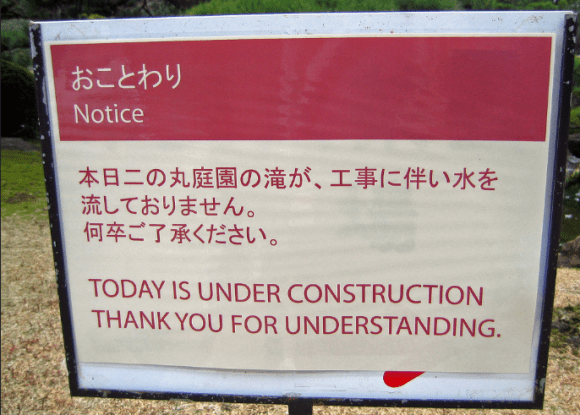
But for all the sites that poke fun at Engrish, it’s almost impossible to find one that talks about why it happens. So today we’re offering a bit of explanation along with the laughs, as we look at a sign in Japan that informs English-reading passersby that “Today is under construction.”
The photo of the sign has actually been floating around online for some time now, but it’s recently caught the attention of Japanese Internet users who are linguistically savvy enough to appreciate the humor. The snapshot was originally taken by a foreign visitor to Kyoto’s Nijo Castle, one of the most popular tourist destinations in a city packed with sightseeing wonders.
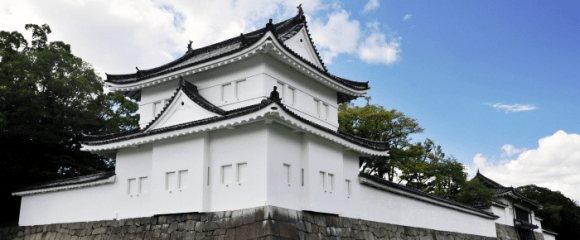
As one of the few castles built in a rare period of peace during Japan’s feudal era, Nijo Castle is surrounded by extensive gardens, and in one you’ll find a waterfall.
The castle receives thousands of visitors every year, and rather than deny travelers a chance to see the historic site by regularly shutting it down, maintenance and gardening often take place even as guests mill about. So when workmen had to temporarily stop the garden waterfall, they put up a sign, the Japanese on which means:
“Please understand that, due to maintenance, the waterfall in the outer garden is not flowing today.”
For the sake of international travelers, there was also an English explanation. It was kind of the castle’s curators to consider those who don’t speak Japanese, but sadly the English translation didn’t come out quite right.
So how exactly did things end up like this? Well, most sightseeing spots in Japan don’t keep an in-house translator on the payroll, and if you’ve ever read an English tourism pamphlet that sounded natural, it was probably the work of a contracted freelance translator.
While translation isn’t on the same lucrative level as fields such as finance, law, and medicine, trying to find a qualified translator willing to accept an offer for a one-sentence project is pretty hard to do. So in the case of these super-short translations, they’re usually done by whichever Japanese staff member has the best command of English and also has time to spare, which in routinely overworked, understandably sleepy Japan really cuts down the candidate pool.
Okay, so we see how the translation probably got passed off to someone who was less than an ideal match for the job, but how did it get so off course? The person who decided on “Today is under construction” has got to be a real moron, right?
▼ “Tanaka, get over here! I’ve got a job for you.”

Not really. For example, imagine if I asked you to translate the sentence, “Due to maintenance, the waterfall in the outer garden is not flowing today” into a foreign language that’s not really your forte. Being eloquent becomes a secondary goal, and the main purpose is just to get the point across. So maybe you cut “Due to maintenance, the waterfall in the outer garden is not flowing today” down to “Today, the waterfall is under maintenance.”
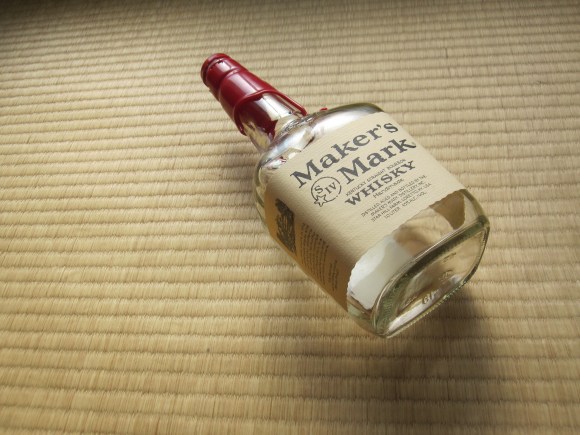
That’s probably what whomever wrote the sign’s English version was going for. The problem is, Japanese and English grammar sometimes work very differently from one another. In Japanese, you can often cut the subject out of a sentence completely and it still makes perfect sense. For example, when my wife comes home tonight and I tell her, “I’ve been drinking bourbon since noon,” I can omit ore/I from the sentence, and just tell her “Hiru kara baabon wo nondeiru.” As long as I haven’t mentioned anyone else who I could possibly be talking about in the conversation, the “I” is implied by context.
▼ Plus the smell of hard liquor on my breath
Knowing that, it’s not too difficult to see how “Today, the waterfall is under maintenance” got chopped down once again (losing its comma in the process) and became “Today is under maintenance.”
But it’s not just grammar where English and Japanese are different, but sometimes in how vocabulary works, too.
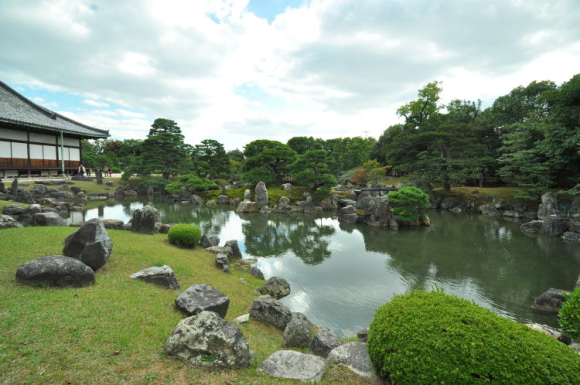
In English, we usually use “maintenance” for fixing something that already exists, and “construction” for building something new. Sometimes in Japanese, though, the word kouji, which is used on the top half of the sign from Nijo Castle, can mean either “construction” or “maintenance,” particularly if you’re talking about something like a building or its fixtures, for which a manmade garden waterfall applies.
▼ A garden with this much rockwork requires a lot of kouji.
Again, bearing in mind that the intended message of the sign’s English version has been simplified from the Japanese original, we’re not dealing with someone who’s truly bilingual here. Crack open a Japanese-to-English dictionary, and 99 times out of 100 the first definition for kouji that jumps out is going to be “construction.”
So if we track the translation process from start to finish, it ends up like this:
Due to maintenance, the waterfall in the outer garden is not flowing today
↓
Today, the waterfall is under maintenance.
↓
Today is under maintenance.
↓
Today is under construction.
And hey, let’s not overlook that whoever wrote the English version knew that the literal translation of the Japanese phrase Douzo go-ryoushou kudasai, “Please consent,” sounded too heavy-handed in English and instead rendered it as the much more hospitable “Thank you for understanding.”
So the next time you come across some Engrish, go ahead and chuckle, because a lot of it is legitimately funny. But at the same time, take a second to remember that the cause might be someone pulling double duty outside their comfort zone.
In any case, if you need to read the translation in the first place, this…

…is probably still a lot more intelligible to you than this…
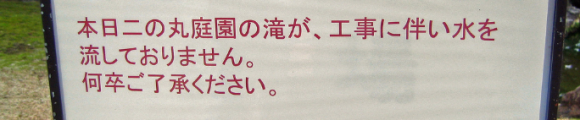
…so you may as well be happy for what you’ve got.
Photo source: J Town Net, Flickr
Top image: Flickr
Insert images: Nijo Castle, Blogspot, RocketNews24, Zaq