
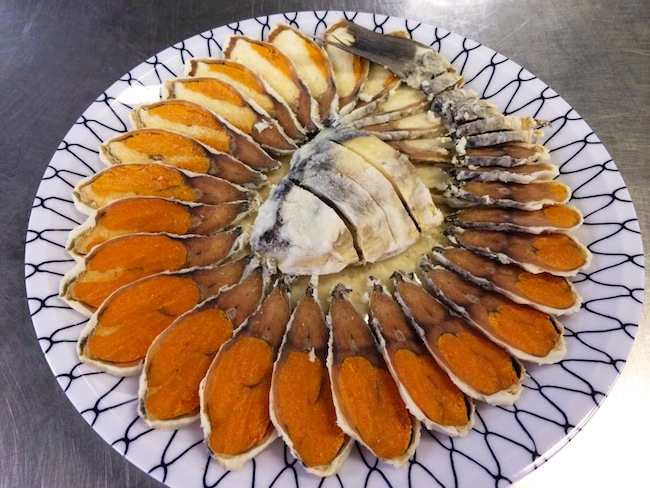
Have you heard of funazushi? It’s a kind of fermented sushi, and despite its strong smell and flavor, some people think it could be a hit in Southeast Asia!
Funazushi is a traditional food of Shiga Prefecture, located in the central region of Japan’s main island of Honshu, and it’s no ordinary sushi. Because of the unique way funazushi is prepared, it’s a sushi that sparks passionate debate even among Japanese diners– you either really love or hate the strong-smelling dish. But now, after a series of successful business meetings and promotions hosted by Shiga Prefecture in Malaysia and Thailand, funazushi proponents believe there may be a market for the unique sushi in Southeast Asia.
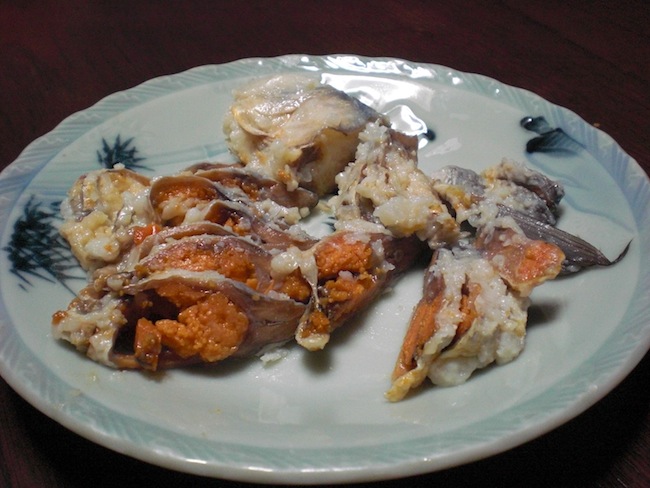
The tradition of funazushi is thought to have originated in China and Southeast Asia and then been introduced to Japan nearly 15 centuries ago. The dish is quite different from the edo-mae type sushi we’re used to seeing today (which didn’t develop until around the 19th century), and it involves curing and fermenting a freshwater fish known as nigorobuna, a subspecies of goldfish found only in Lake Biwa in Shiga Prefecture.
To make funazushi, the nigorobuna is cleaned of its scales, gills and innards (except the ovaries) and first cured in salt. Once the curing is complete, the fish is washed with water to remove the salt and is then stuffed with rice, after which it is further covered in layers of rice in a bucket and left to ferment for several months, sometimes for a year or longer, during which time the rice turns into the consistency of mush. It’s a time-consuming process, but it’s said that the tradition may have started as a way to preserve the nigorobuna, which could be caught in large quantities during the rainy period when the rice paddies would flood, so that they could be eaten later.
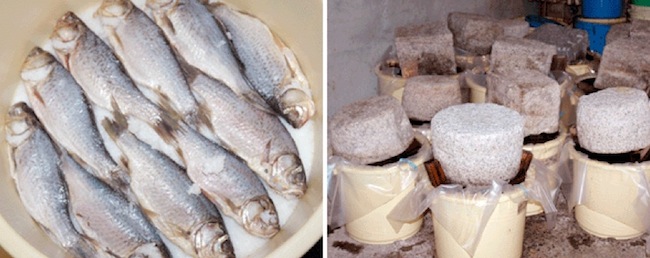
In recent times, due to the decreasing nigorobuna population, the local fishing industry has voluntarily decided not to fish for nigorobuna during the period from June to December, and production of funazushi has been going down correspondingly. That, combined with changing modern tastes, could be making funazushi a waning tradition, as there are fewer and fewer households in Shiga Prefecture now making the dish.
▼ Here’s a video of a restaurant owner in Shiga demonstrating how she prepares the nigogobuna for the salting and fermentation process (Note: Some graphic fish gutting is shown).
▼ These two videos are in Japanese, but the images give an idea of how funazushi is made.
▼ This video shows the process of slicing and arranging funazushi on a plate.
So how does this delicacy taste? It’s very sour and quite unlike any other food, so it’s certainly an acquired taste. And as can be expected with the long fermentation process, it has a powerful smell which some people compare to very strong cheese (or old socks). It’s powerful enough that people trying it for the first time are advised to have a few small slices, one at a time, just to see if they can handle it or not.
If you find that funazushi suits your palate, you can have it as it is, just sliced, which some people think goes really well with sake. If the smell is a bit strong for you, then having it as ochazuke, on top of rice with tea poured over it along with maybe some leeks or ginger, should make it easier to enjoy the flavor.
Interestingly, when Shiga Prefecture officials promoted some of their local foods, including funazishi, in Malaysia and Thailand earlier this year, the fermented sushi was incredibly well-received, with comments that funazushi had a nice sour flavor that seemed to go well with alcoholic drinks. The response was so positive, in fact, that there are now plans to invite travel agencies from these countries to Shiga next year to have them see how the sushi is made and actually try the product. But then, considering that funazushi is believed to have its roots in China and Southeast Asia, perhaps it’s not too surprising that the fermented sushi seems to be a hit with people in those regions.
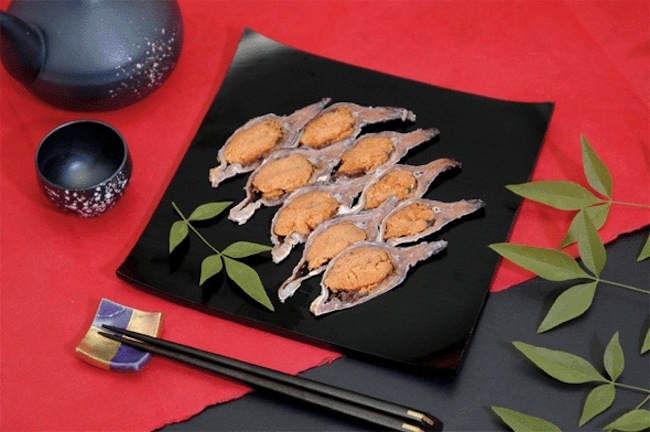
While the extreme fermentation may no longer be necessary with modern refrigeration, funazushi is still a well-known dish with sentimental value to the people of Shiga, and it’s exciting to think that it may now be introduced abroad. Some are even hopeful that funazushi may eventually do well not just in Southeast Asia, but in countries with a strong cheese culture as well. Now, that should be interesting, to be able to choose between cheese and funazushi to have with a drink!
So, would you try fermented sushi?
Source: Sankei West, Biwako Okishima Tomitaya website
Top image: Biwako Okishima Tomitaya website
Insert images: Biwako Okishima Tomitaya website, Biwako no Sachi Uosan website
 Stinkiest sushi in the world is now an ice cream flavour in Japan
 Smelliest sushi in Japan to become potato chip flavor
 Fermented sushi? Two restaurants where you can get a same-day seat to try this gourmet treat
 Japan reportedly adding Japanese language skill requirement to most common foreigner work visa
 You can assemble a well-balanced team of Pokémon, them eat them, thanks to Japanese cake chain
 7-Eleven Japan’s new baked-in-store sweet treat is only available in three parts of the country
 Starbucks Japan closing only Shinkansen platform branch for popularity-triggered renovations
 Pokémon and Ikea Japan cross over into each other’s worlds with collaboration events
 Sailor Moon’s Artemis is part of the Artemis II NASA mission control team[Video]
 Nephew receives SD card after his uncle passes away, finds treasure trove of gems from the past
 Perfectly recreated 1960s Japanese apartment lets museum visitors go back to mid-Showa era【Pics】
 Sanrio brings some smiles to Evangelion with new collaboration merch line【Photos】
 Smash Bros. director Sakurai shares secret to smash through your procrastination habits【Video】
 Tokyo’s best museum for foreign travelers finally reopens after being closed for four years
 Pokémon lacquerware series expands for Year of the Horse with new handcrafted design[Video]
 Two food hacks take Japan’s convenience store fried chicken to amazing new sandwich heights
 Tokyo subway and almost all Tokyo train lines now accepting credit card tap payments
 Totoro Fund line of beautiful artwork and apparel lets you help the real-world Totoro Forest
 Fading Tokyo – Searching for signs of the Showa era as local neighborhoods evolve[Photos]
 Famous Tokyo cherry blossom spot installs view-blocking screens to fight overcrowding[Video]
 Tokyo turns its phone booths into free Wi-Fi hotspots, and here’s how to use them
 Studio Ghibli adds new My Neighbour Totoro 2026 Corn Gift to its anime store for Mother’s Day
 Japan now has a special desk for people who work at home with a pet cat[Photos]
 Uniqlo announces new T-shirts for One Piece, Naruto and more for manga publisher’s 100th birthday
 Train station platform ramen store closes its doors on half a century of history in Tokyo
 Starbucks Japan releases new My Fruit³ Frappuccino at only 34 stores around the country
 Studio Ghibli releases Catbus pullback keychain that runs like the anime character
 Krispy Kreme releases Super Mario doughnuts in Japan for a limited time
 Japanese onsen egg maker from 100-yen store Daiso needs to be on your shopping list
 Nine great places to see spring flowers in Japan, as chosen by travelers (with almost no sakura)
 Survey asks foreign tourists what bothered them in Japan, more than half gave same answer
 Japan’s human washing machines will go on sale to general public, demos to be held in Tokyo
 Starbucks Japan releases new drinkware and goods for Valentine’s Day
 We deeply regret going into this tunnel on our walk in the mountains of Japan
 Studio Ghibli releases Kodama forest spirits from Princess Mononoke to light up your home
 Starbucks Japan releases new sakura goods and drinkware for cherry blossom season 2026
 Japan’s newest Shinkansen has no seats…or passengers [Video]
 Major Japanese hotel chain says reservations via overseas booking sites may not be valid
 Put sesame oil in your coffee? Japanese maker says it’s the best way to start your day【Taste test】
 No more using real katana for tourism activities, Japan’s National Police Agency says