
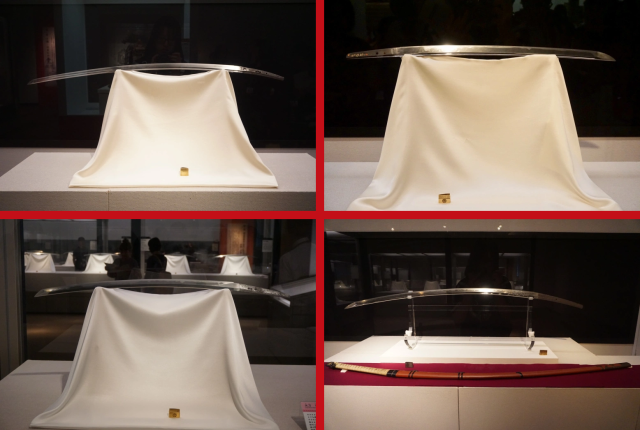
We’re back for another look at how the arms and armor of samurai developed, and this time we learn why they ditched their otachi for uchigatana.
Last week, we took a trip through samurai history, examining how the armor worn by Japan’s warriors changed through different eras of Japan’s past. Of course, it wasn’t just the defensive nature of warfare that shifted over time, and Japan’s samurai swords also evolved.
Once again, our guide on this journey is the Fukuoka City Museum’s ongoing Samurai: The Beauty and Pedigree of Warriors exhibit. With nearly 150 pieces on display, there’s a lot to look at, but let’s start in the late years of the Heian period (which lasted from 794 to 1185).
▼ A blade from swordsmith Tomonari of Bizen (present-day Okayama Prefecture), with a protracted curve that starts almost immediately after the hilt.
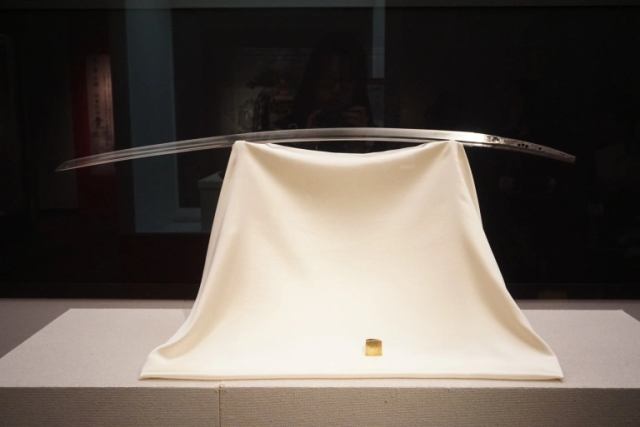
Despite all the dramatic martial arts movie narration you may have heard about the sword being the soul of the samurai, it wasn’t always their most useful weapon. For several centuries, archery was what set a samurai apart on the battlefield, as conflicts were often fought by well-funded warriors firing arrows at each other from horseback. Eventually, though, commanders started looking for ways for foot soldiers to take down mounted foes, which led to long, slender-curved swords meant to be used to cut the legs of a rider’s horse out from under him. This continued into the early years of the Kamakura period (1185-1333), during which polearms such as the naginata and nagamaki also rose in prominence.
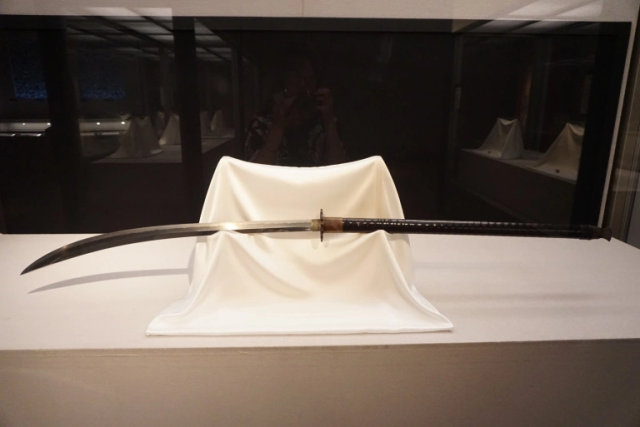
But as you might remember from our discussion of samurai armor evolution, samurai lords began building more and more castles in the years following the Kamakura era. With cavalry ineffective for either side in a siege, foot soldiers became increasingly important, and hand-to-hand fighting became a more prevalent part of military conflicts. Armor became lighter and more form-fitting, since it no longer needed the large gaps between plates that horseback archers required to ride and shoot. In response, swords became larger and heavier, characterized by the weapons called otachi in the Nanbokucho period (1336-1392).
With their curve shifted to the mid-point of the blade, otachi were designed to hack and slash with, since you had to cut through armor and were trying to outright kill your opponent, not simply hurt his horse’s bare shin and render it unable to run.
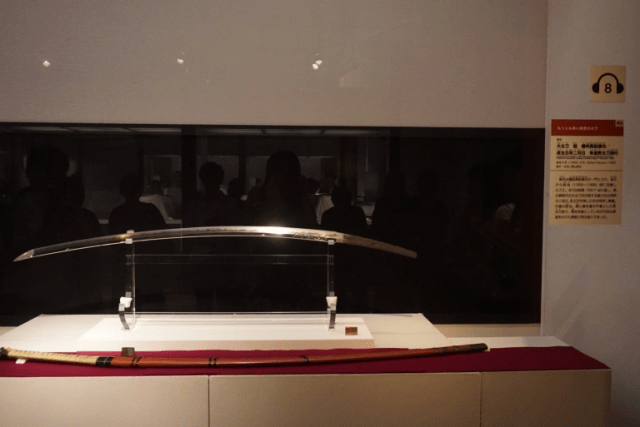
However, fighting on foot also meant that samurai had to conserve their stamina, and running around swinging bulky otachi for an entire battle wasn’t always the best strategy. So in the Muromachi and Sengoku periods (1336-1600), preferences changed again, with samurai now favoring the shorter, straighter uchigatana. These katana were particularly suited to close combat, with a balance between swiftness and cutting ability. They were also easier to quickly draw from a sheath, enabling them to remain popular even as Japan’s age of armored combat came to a close.
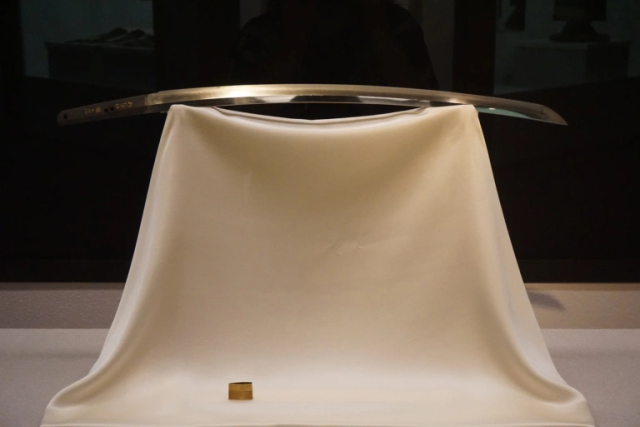
Some otachi which had been forged in earlier times were even modified by their Sengoku period owners. For example, the Heshikiri Hasebe was forged roughly 200 years before it was wielded by warlord Oda Nobunaga, who had its tang (the metal protrusion that extends into the sword’s handle) shortened, brining its size closer to that of an uchigatana.
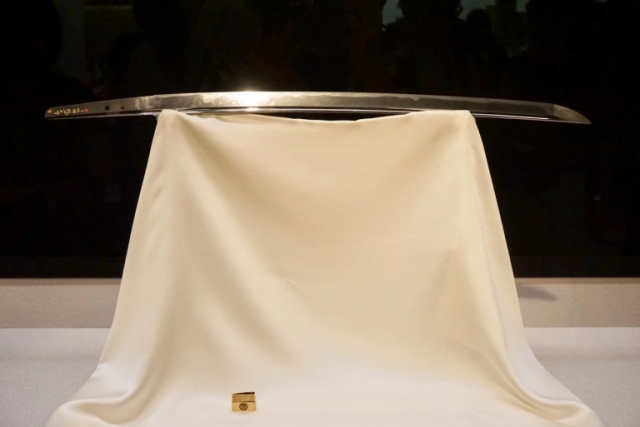
Another unique aspect of the Heshikiri Hasebe is that the entire blade was quenched when it was forged, resulting in dramatic tempering lines across its entire face.
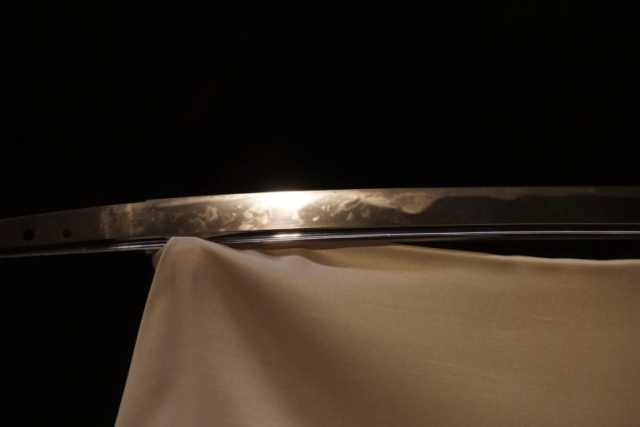
Speaking of tempering marks, the Nikko Ichimonji. A certified Japanese national treasure from the Kamakura period, the Nikko Ichimonji’s has a series of flower petal-shaped temper colorings near its tip.
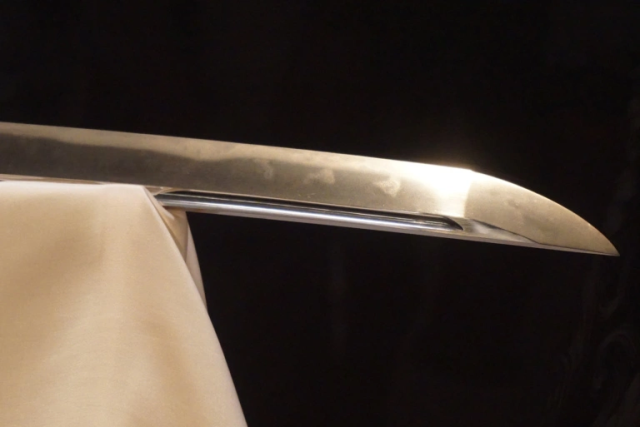
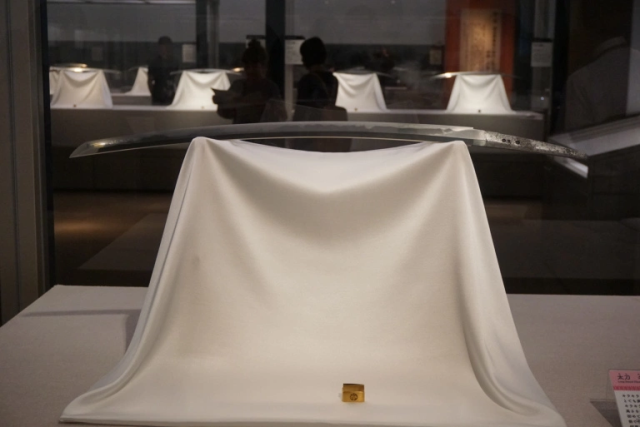
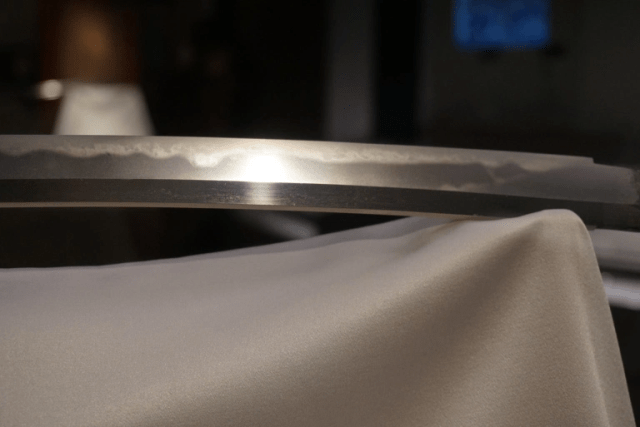
Also part of the exhibit and another national treasure, at just 54 centimeters (21.3 inches) long the Raikunitoshi is the shortest sword in Japan to bear that distinction.
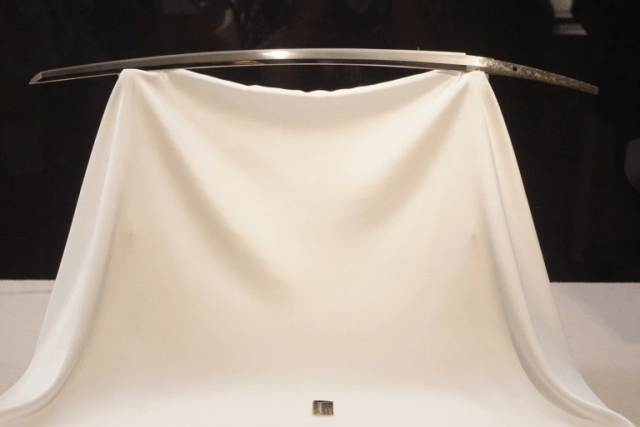
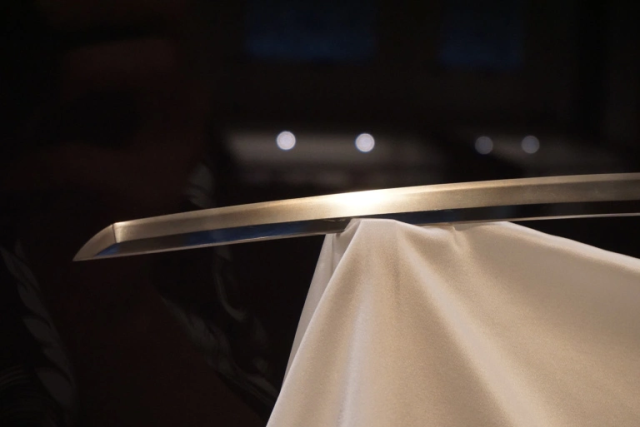
But if you’re of the mind that bigger is always better, the museum is also showing the longest national treasure sword, the 159-centimeter Bishu Osafune Tomomitsu, an intimidating blade forged sometime around 1360, when otachi influences were still being felt.
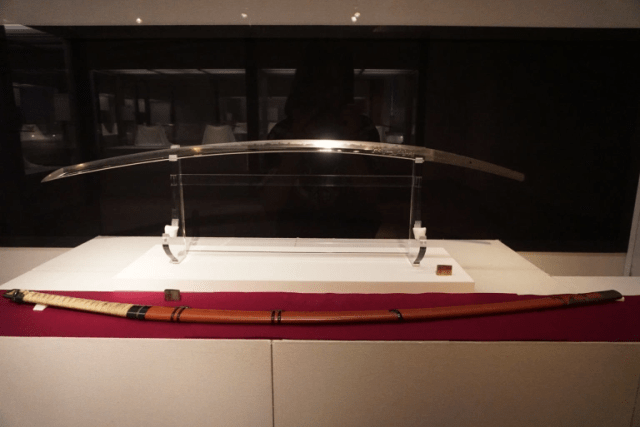
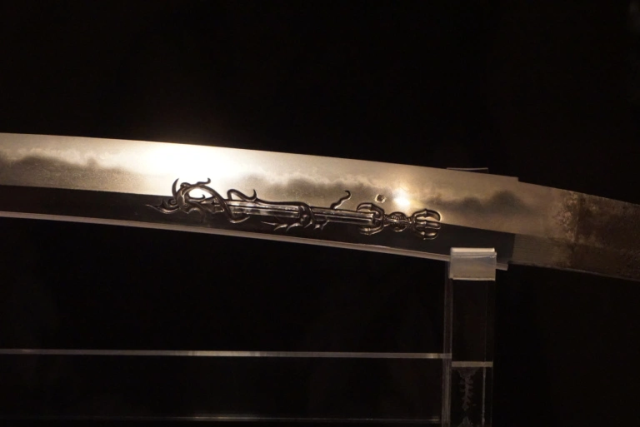
The exhibit also includes a number of tanto (daggers), with the Taiko Samonji, once again a national treasure, with a crystal-like sparkle historians call jinie.
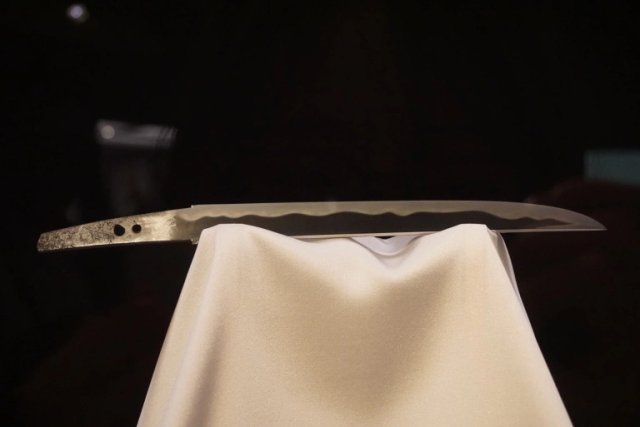
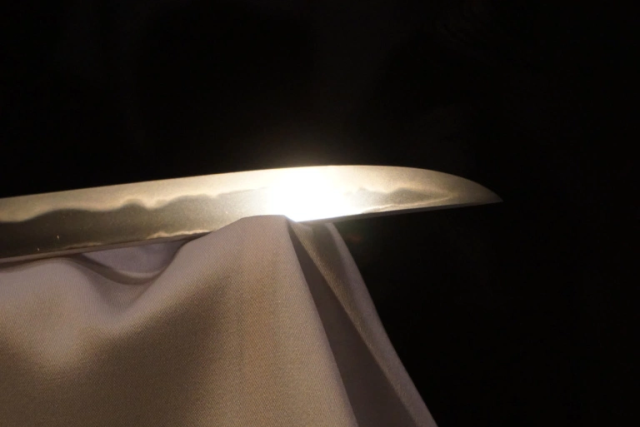
We also had a chance to look at another piece from master smith Samonji Genkei, who worked during the mid-1300s, in the form of his Yoshimoto Samonji.
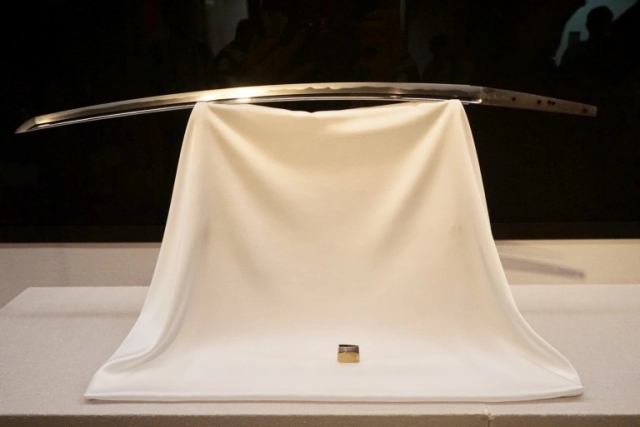
However, while the tang bears Samonji’s mark, the blade itself has temper lines quite unlike the jagged patterns regularly associated with his work, leading some to speculate that the sword was retempered by another smith at some point in time.
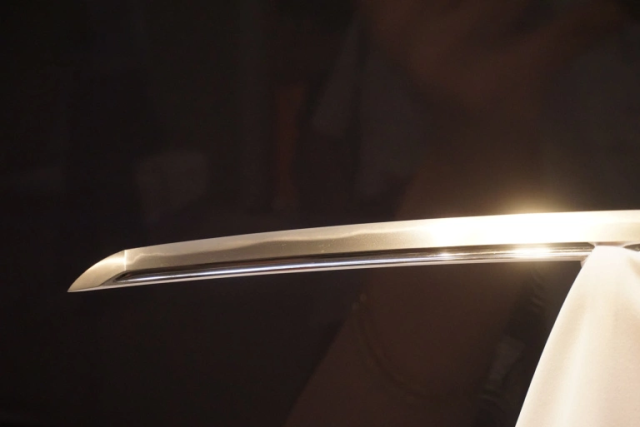
While the Yoshimoto Samoji was only on display until October 6, there’s still plenty to see in the exhibit, which runs until November 4.
Museum information
Fukuoka City Museum / 福岡市博物館
Address: Fukuoka-ken, Fukuoka-shi, Sawara-ku, Momochihama 3-1-1
福岡県福岡市早良区百道浜3丁目1-1
Open 9:30 a.m.-5:30 p.m.
Closed Mondays
Admission 1,500 yen (US$14)
Museum website
Exhibition website
Photos ©SoraNews24
● Want to hear about SoraNews24’s latest articles as soon as they’re published? Follow us on Facebook and Twitter!
[ Read in Japanese ]
 How did samurai swords and armor change over time?【Part 1】【Photos】
 An up-close look at one of Japan’s five Ryuseito swords, forged from meteorites【Photos】
 Amazing exhibition of Japan’s legendary “cursed katana” is going on right now【Photos】
 This hotel has one of the coolest katana collections in Japan, and admission is totally free【Pics】
 Dojigiri, the millennium-old katana said to have slain a demon, is now on display in Tokyo【Pics】
 Two food hacks take Japan’s convenience store fried chicken to amazing new sandwich heights
 Can a downtown Tokyo super sento bathhouse beat a hotel for a one-night stay?
 Pokémon and Ikea Japan cross over into each other’s worlds with collaboration events
 Tokyo’s best museum for foreign travelers finally reopens after being closed for four years
 Japanese kindness restores our faith in humanity after a highway bus accident in Tokyo
 Beautiful Starbucks in Kyoto blends into its traditional landscape in more ways than one
 Famous Tokyo cherry blossom spot installs view-blocking screens to fight overcrowding[Video]
 Krispy Kreme adds doughnut burgers to its menu in Japan
 Japan now has stricter requirements for foreigners applying for citizenship
 Hinamatsuri Pikachu kimono couple plushie on the way to celebrate Japan’s Doll Festival【Photos】
 Pokémon lacquerware series expands for Year of the Horse with new handcrafted design[Video]
 Tokyo subway and almost all Tokyo train lines now accepting credit card tap payments
 Fading Tokyo – Searching for signs of the Showa era as local neighborhoods evolve[Photos]
 Totoro Fund line of beautiful artwork and apparel lets you help the real-world Totoro Forest
 Tokyo turns its phone booths into free Wi-Fi hotspots, and here’s how to use them
 Studio Ghibli adds new My Neighbour Totoro 2026 Corn Gift to its anime store for Mother’s Day
 Japan now has a special desk for people who work at home with a pet cat[Photos]
 Uniqlo announces new T-shirts for One Piece, Naruto and more for manga publisher’s 100th birthday
 Train station platform ramen store closes its doors on half a century of history in Tokyo
 Starbucks Japan releases new My Fruit³ Frappuccino at only 34 stores around the country
 Studio Ghibli releases Catbus pullback keychain that runs like the anime character
 Krispy Kreme releases Super Mario doughnuts in Japan for a limited time
 Japanese onsen egg maker from 100-yen store Daiso needs to be on your shopping list
 Nine great places to see spring flowers in Japan, as chosen by travelers (with almost no sakura)
 Survey asks foreign tourists what bothered them in Japan, more than half gave same answer
 Japan’s human washing machines will go on sale to general public, demos to be held in Tokyo
 Starbucks Japan releases new drinkware and goods for Valentine’s Day
 We deeply regret going into this tunnel on our walk in the mountains of Japan
 Studio Ghibli releases Kodama forest spirits from Princess Mononoke to light up your home
 Starbucks Japan releases new sakura goods and drinkware for cherry blossom season 2026
 Japan’s newest Shinkansen has no seats…or passengers [Video]
 Major Japanese hotel chain says reservations via overseas booking sites may not be valid
 Put sesame oil in your coffee? Japanese maker says it’s the best way to start your day【Taste test】
 No more using real katana for tourism activities, Japan’s National Police Agency says
 Real-life Rurouni Kenshin katana forged based on sword of series’ most merciless villain【Photos】
 Swords of famous samurai reborn as beautiful kitchen knives from Japan’s number-one katana town
 Scholars confirm first discovery of Japanese sword from master bladesmith Masamune in 150 years
 Samurai fashion guide – Should you wear your sword blade-up or blade-down?
 The City of Angels is now the City of Samurai with Los Angeles museum’s awesome armor exhibition
 Demon-slaying Dojigiri, one of Japan’s Five Swords Under Heaven, now on display at Kasuga Shrine
 Legendary crescent moon katana, one of Japan’s Five Swords Under Heaven, now on display in Tokyo
 Japan is running out of swordsmiths, and a strict apprenticeship requirement is a big reason why
 Japan’s legendary Brother Katana might not be brothers after all? Investigating the mystery【Pics】
 Real-life Rurouni Kenshin reverse-blade katana now on display in Tokyo【Photos】
 Real-life Rurouni Kenshin reverse-blade katana, forged by master swordsmith, now on display【Pics】
 Samurai Ninja Museum Tokyo With Experience is true to its name, lets you slice with real katana
 Historical katana dessert knives turn your sweet snacks into a delicious duel【Photos】
 Samurai Studio: Tokyo’s new photo studio where you can get your picture taken in samurai armor
 Chop up paperwork with katana scissors inspired by the swords of Oda Nobunaga and other samurai
 Slice into a traditional sweet range with some of Japan’s most famous swords