
We have it all? Keep your mouth shut about our poor selection? It could go either way, because of a Japanese language quirk.
The idea behind giving your store a slogan is that people will have some sort of idea of what to expect even before they walk through the entrance. So right above its front door, the Matsuzaki branch of Japanese supermarket Sun Fresh in Shizuoka Prefecture proudly declares “Nai mono wa nai.”
▼ Zoom in and you’ll see “Nai mono wa nai” (ないものはない) written underneath the Sun logo.
The problem is that no one is quite sure what that slogan is supposed to mean. The Japanese Internet is divided over two possible interpretations, and those interpretations are complete opposites in terms of tone. Some people think the store is confidently promising it has anything you could ever want, while others say the slogan is preemptively telling customers not only to not expect much from Sun Fresh, but also to keep their complaints to themselves if/when they’re disappointed.
First, let’s try working off of the conventional wisdom that a store is most likely to choose a slogan that makes itself look good. If that’s the case, and Sun Fresh is bragging about the wide selection of products it stocks, nai mono wa nai is probably supposed to mean “There’s nothing we don’t have”/”We have everything.”
Let’s take a look at the linguistics. First, in Japanese there’s a word aru which means “there is.” For example, “Ramen ga aru,” means “There is ramen.” The opposite would be “Ramen ga nai,” or “There is no ramen.” Swap in “wa” for “ga” and you get “Ramen wa nai,” which also means “There is no ramen,” but sounds more emphatic than “Ramen ga nai.”
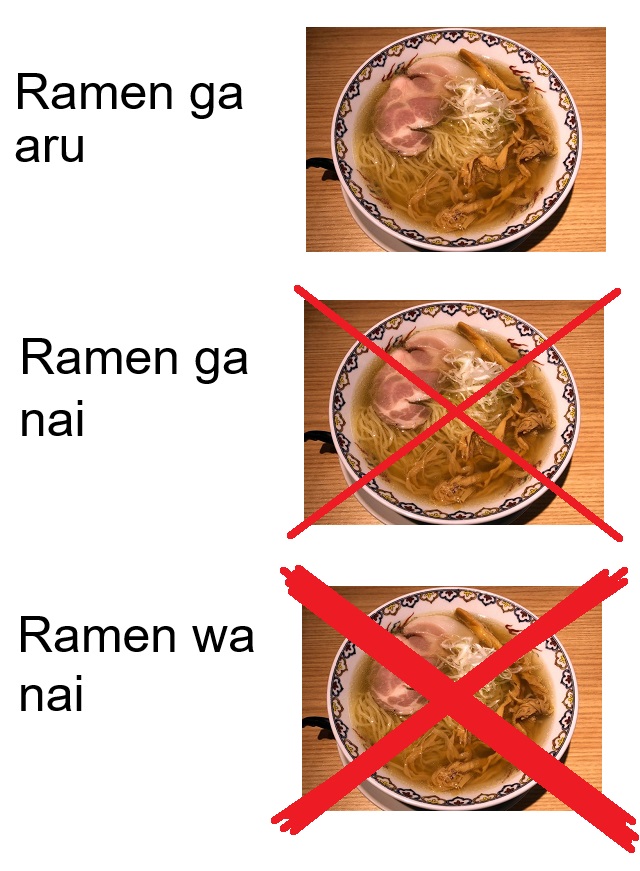
You can replace “ramen” with any other verb and the grammar stays the same. “Sushi ga aru” means “There is sushi.” At the most basic level, using mono, the Japanese word for “thing,” you could say “Mono ga aru,” meaning “There is a thing,” or “Mono wa nai,” meaning “There isn’t a thing.”
Alternatively, instead of “there is”/”there isn’t,” you could also translate aru/nai as “have”/”not have.” There’s a lot of overlap between those concepts, after all. If you’re inside a supermarket and “there isn’t” any ramen, you could just as accurately say that the store “doesn’t have” ramen, right?
Getting back to mono/thing, you can put an adjective or other descriptor in front of it. For example, a kawaii mono is a “cute thing.” You can use aru/nai like this too, with aru mono meaning “a thing that there is” or “a thing we have.” And once again, we can do the opposite too, with nai mono, which would mean “a thing that there isn’t,” or “a thing we don’t have.”
Put all of those concepts together and “Nai mono wa nai” sounds, to many people, like it means “There isn’t a thing we don’t have,” i.e. our store’s selection is so big that we have everything customers could be looking for.
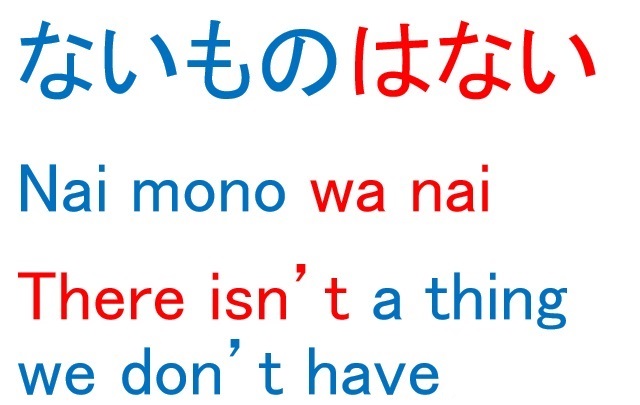
But now let’s go back and look at one other aspect of the word mono. We said it means “thing,” but in Japanese, there’s generally no difference between singular and plural nouns, so mono can also mean “things.” And remember how we said nai can be thought of as either “there isn’t” or “not have?” Because of all that, this too becomes a possible interpretation of Sun Fresh’s slogan:
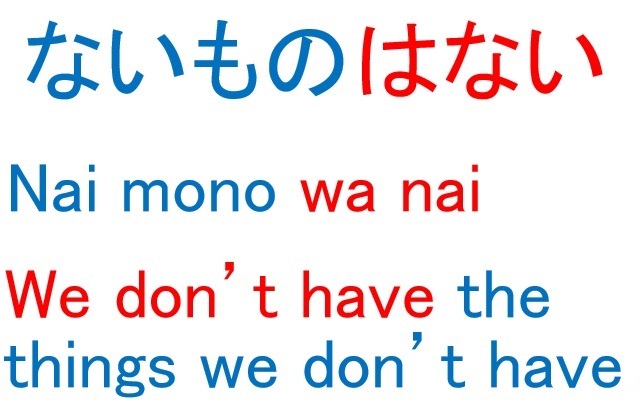
Now instead of a reliable “We’ve got everything!”, it sounds like Sun Fresh is emphatically telling shoppers “Hey, if we aint got it, we aint got it, pal!” preemptively cutting off any negative reactions to a lackluster variety in its product lineup.
Though Sun Fresh has been using this slogan for quite some time, its ambiguous meaning has been generating a lot of discussion on the Japanese Internet this week. This isn’t the first time the debate over the two interpretations has cropped up, though, and back in 2019 Sun Fresh’s president himself was asked which is the true meaning, to which he replied:
“The slogan is a half joke…There’s not really a ‘correct’ way to interpret it, so people are free to take it as whichever meaning they like.”
Before starting Sun Fresh, the chain’s owner managed a smaller market, and that store’s unofficial slogan was also “Nai mono wa nai.” The mystery surrounding the equally viable interpretations of “We have everything!” and “We don’t have very much” made the slogan stick in people’s heads, and so when the larger Sun Fresh supermarket chain opened, they officially put Nai mono wa nai on some of their storefronts, like at the Matsuzaki branch in the Shizuoka town of Kamo on the west side of the Izu Peninsula.
▼ The Nai mono wa nai / ないものはない slogan can also be seen here at Sun Fresh’s Tago branch, also in Kamo.
So while it might not be the most informative, Nai mono wa nai is definitely the most intriguing slogan I’ve ever heard for a grocery store, and the next time I’m in that part of Japan I’m definitely going to have to stop by Sun Fresh to see what they do, and don’t, have.
Source: J-Town Net
Top image: Pakutaso (edited by SoraNews4)
Insert images © SoraNews24
● Want to hear about SoraNews24’s latest articles as soon as they’re published? Follow us on Facebook and Twitter!
Follow Casey on Twitter, where it’s only a matter of time until he spends a whole day again thinking about Japanese grammar.
 How to enjoy Japanese idol music if you hate its sweetness: Pretend they’re not singing about YOU
 Sega’s Like a Dragon yakuza teaches “useless” English, let’s use it to learn some useful Japanese
 Japanese government now officially allowed to use question marks and exclamation points
 Five different ways to say “children” in Japanese
 The three ways to say “love” in Japanese, and when to use them
 Japan’s best conveyor belt sushi restaurant of seven years ago has now, finally, come to Tokyo
 Japanese trains in Sapporo might be better than those in Tokyo, thanks to one special feature
 Lawson convenience store at popular tourist site is one of the most unusual in Japan
 Starbucks Japan releases FIVE new Frappuccinos in a day, and we try them all in 90 minutes
 Drink vending machines disappearing in Japan as number drops to lowest in 30 years
 Downtown Tokyo’s meaty monster Kaibutsu ramen will challenge your stomach, thrill your taste buds
 Mr. Sato discovers his inner beaver with a 16-inch chocolate “twig” at Tokyo Station
 Studio Ghibli celebrates the magic of movie theaters with short video, Hayao Miyazaki illustration
 Haunted hospital near Mt Fuji re-opens after renovation at Fuji-Q Highland, and it’s terrifying
 Japanese toilet sweets put a new twist on tradition
 Japan reportedly adding Japanese language skill requirement to most common foreigner work visa
 Mt. Fuji decorated with a 500,000-flower pink carpet is Japan’s ultimate spring view
 Pokémon and Ikea Japan cross over into each other’s worlds with collaboration events
 Starbucks Japan closing only Shinkansen platform branch for popularity-triggered renovations
 You can assemble a well-balanced team of Pokémon, them eat them, thanks to Japanese cake chain
 30 Pikachus want to share a Tokyo hotel room with you that has separate Grass, Water, Fire spaces
 Man bites woman at cherry blossom park in Japan, dies shortly after
 7-Eleven Japan’s new baked-in-store sweet treat is only available in three parts of the country
 Peanuts and Coke becomes a viral hit in Japan, but is it a trend worth joining?
 Japan now has a special desk for people who work at home with a pet cat[Photos]
 Famous Tokyo cherry blossom spot installs view-blocking screens to fight overcrowding[Video]
 Uniqlo announces new T-shirts for One Piece, Naruto and more for manga publisher’s 100th birthday
 Train station platform ramen store closes its doors on half a century of history in Tokyo
 Starbucks Japan releases new My Fruit³ Frappuccino at only 34 stores around the country
 Krispy Kreme releases Super Mario doughnuts in Japan for a limited time
 Japanese onsen egg maker from 100-yen store Daiso needs to be on your shopping list
 Survey asks foreign tourists what bothered them in Japan, more than half gave same answer
 Japan’s human washing machines will go on sale to general public, demos to be held in Tokyo
 Starbucks Japan releases new drinkware and goods for Valentine’s Day
 We deeply regret going into this tunnel on our walk in the mountains of Japan
 Starbucks Japan releases new sakura goods and drinkware for cherry blossom season 2026
 Studio Ghibli releases Kodama forest spirits from Princess Mononoke to light up your home
 Japan’s newest Shinkansen has no seats…or passengers [Video]
 Major Japanese hotel chain says reservations via overseas booking sites may not be valid
 Put sesame oil in your coffee? Japanese maker says it’s the best way to start your day【Taste test】
 No more using real katana for tourism activities, Japan’s National Police Agency says
 One simple kanji character in super-simple Japanese sentence has five different pronunciations
 Hachiji juppun mae – A Japanese phrase that even Japanese people can’t agree on the meaning of
 All you need to know about Japan’s unasked-for restaurant appetizers that you have to pay for
 Ridiculous Japanese TV program says English pronunciation is to blame for coronavirus spread【Vid】
 Tokyo hotel asks guests to take their used toilet paper with them【Why Does Engrish Happen?】
 Japanese company puts up signs banning one specific style of intercourse, for coronavirus safety
 Japanese park’s English dog turd warning minces no words【Why does Engrish happen?】
 Arrest proves a common Japanese saying about apologies and police
 Restaurant in Indonesia’s bizarrely translated Japanese menu commands customers to get stabbed
 YouTube’s AI Japanese translation calls for Jimmy Kimmel’s death on his own show【Video】
 Japan’s new “Cunte” contact lenses aren’t pronounced like you’re probably thinking they are