A three-way showdown between a Japanese housewares brand, an international icon, and the king of 100 yen shops.
If you’re setting up an apartment in Japan, one of the first things you need to buy is a rice cooker. Actually, a rice cooker is a great investment no matter what country you live in, but it’s especially essential in Japan, where every grocery store is packed with ingredients and pre-made side dishes that go great with rice.
But while a rice cooker makes it easy to prepare a full pot of Japan’s favorite grain, what do you do with the leftover rice? White rice becomes hard and dry if you refrigerate it, so the better option is to freeze it, and the even better option is to freeze it using a special container that you can heat back up in the microwave, all the while keeping the rice’s flavor, moistness, and fluffy texture.
Which brand of rice freezing container should you use, though? That’s the question we asked ourselves, and our search for the answer led us to a comparison test of three different models, one from Japanese housewares brand Marna, one from Ziploc, and one from 100 yen store Daiso.
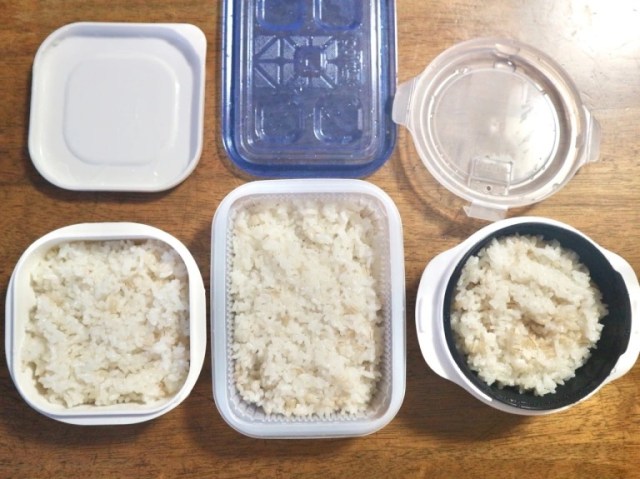
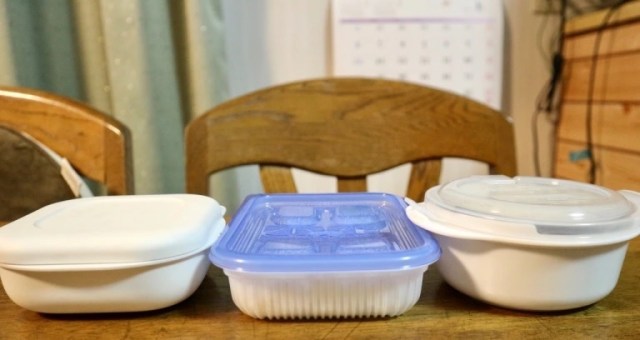
▼ Left to right: the frozen rice containers from Marna, Ziploc, and Daiso
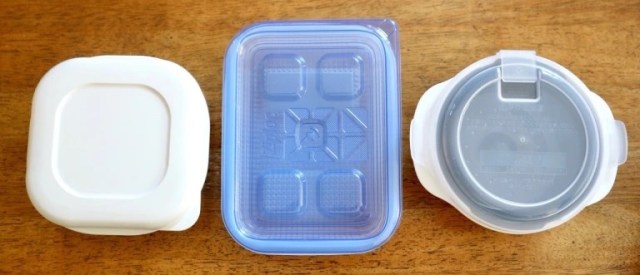
Let’s start with a closer look at the Marna Kiwami Rice-Freezing Container. It’s more or less square in shape, just with rounded corners, and holds 180 grams (6.3 ounces) of cooked rice.
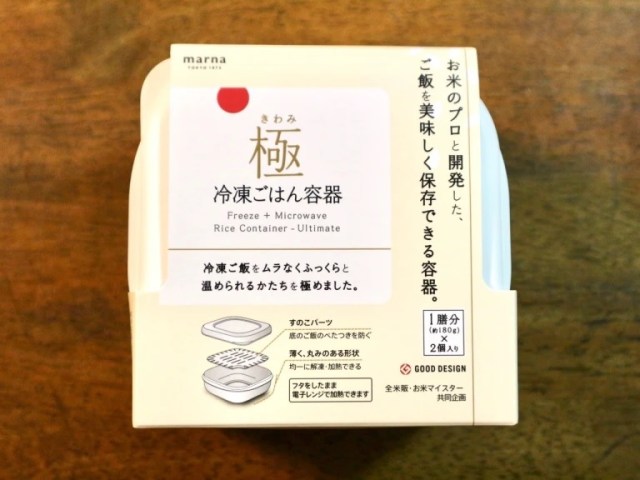
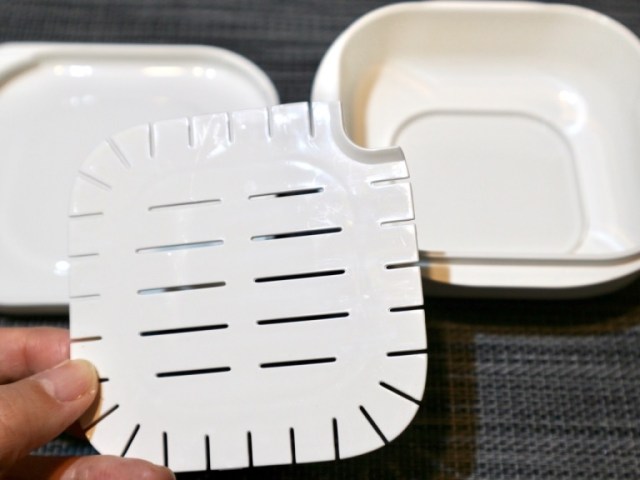
In addition to the lid, there’s also a grate-like piece that goes inside the bowl. This is to keep moisture from accumulating where the rice is sitting and turning it into a soggy mess when you reheat it. Speaking of the lid, it’s designed so that you can leave it in place while microwaving the frozen rice, which is a nice, convenient touch.
Next we have the Ziploc Rice-Storage Container.
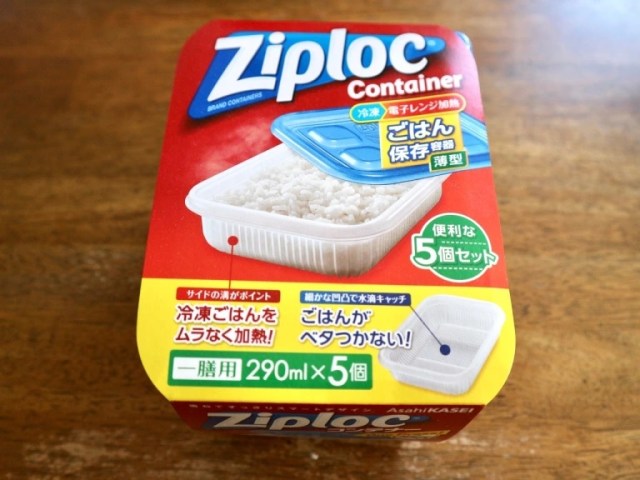
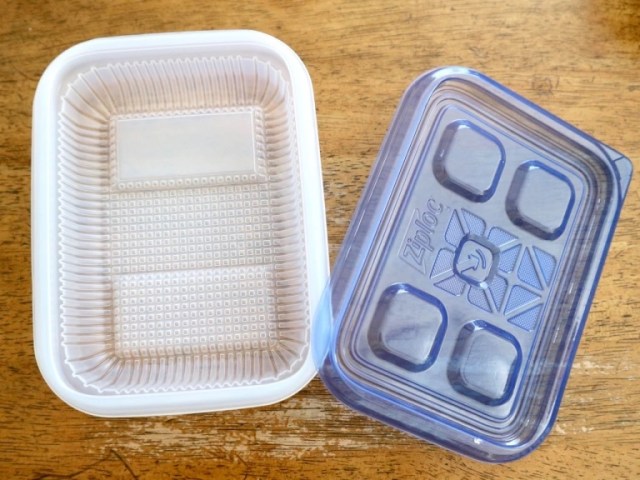
This one has a rectangular shape, and the bowl has an embossed bottom and grooved sides to keep the rice from sitting in water and to help steam dissipate as you microwave it. Like the Marna Kiwami, it holds 180 grams of rice. It’s also the most colorful, with a blue-tinted top that matches the rest of Ziploc’s storage container lineup, if you’re going for a consistent aesthetic. Unlike the Marna Kiwami, though, you have to pop open the lid when microwaving (although you can leave it sitting loosely atop the rice).
And last, the Daiso Frozen Storage Container.
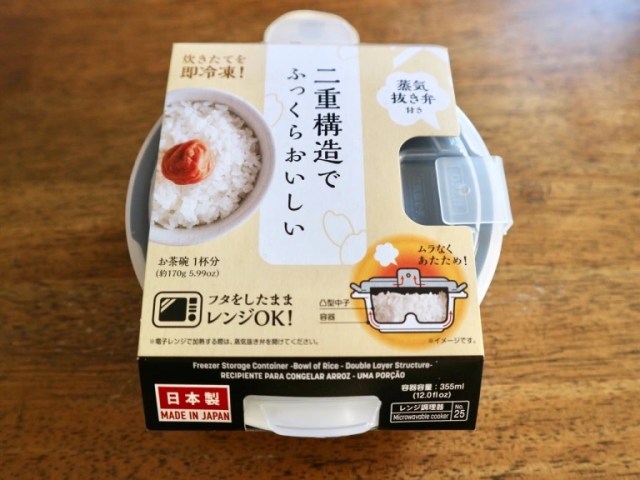
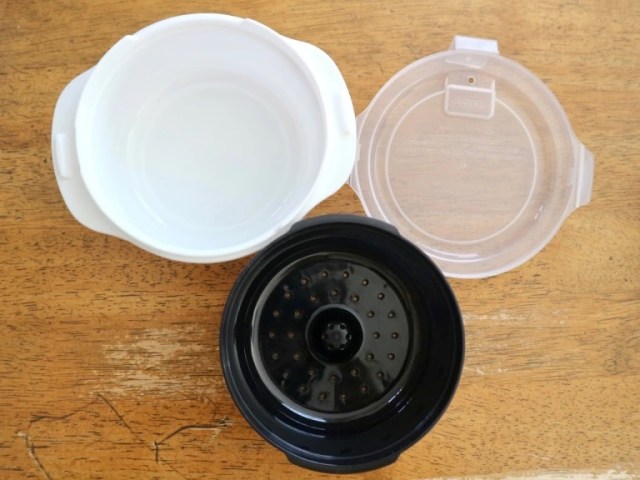
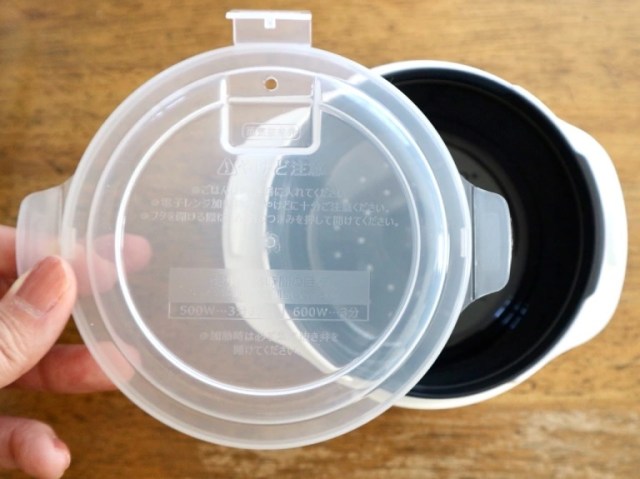
Daiso’s circular container is a three-piece unit, with the bowl, lid, and grate with deeper sides than the Marna Kiwami’s. With a capacity of 170 grams, it’s just a little more compact than the other two. The lid here has a flip-up section that you open before microwaving for the steam to escape through.
About the time we were done with our visual inspections, the pot of rice we’d been making in our rice cooker was ready, so we packed each container full.
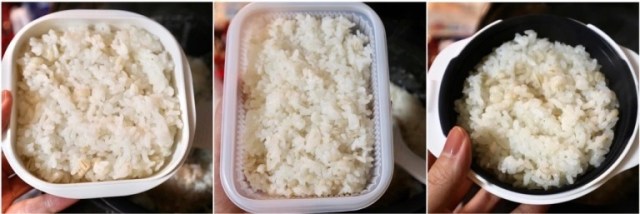
The instructions for the Marna Kiwami and Ziploc say to wait until the rice has cooled off before scooping it into the container, while Daiso’s says you can go ahead and fill it while the grains are still piping hot. However, heat still transfers through the containers to whatever is around it, and if you toss a Daiso container of hot rice into your freezer, you’ll probably melt some of the other stuff that’s in there. So in practice, you’ll want to let the rice cool first before it goes in the freezer, regardless of which container you’re using.
After letting them all chill, we came back the next day and took out our three containers of frozen rice. The difference in suggested heating times is negligible (three and a half minutes at 500 watts for the Marna Kiwami and Daiso, three minutes at 500 watts for the Ziploc), and after heating them up it was time for the taste test, the result of which was…
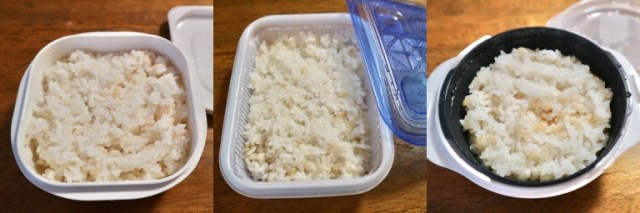
…a three-way tie. In terms of taste, they all came out great, moist and full of flavor just like they’d been freshly scooped from the rice cooker, with no clumping, scorching, or sogginess to speak of. Blindfolded, we don’t think we’d have been able to tell which rice was which from the flavor alone.
That doesn’t mean that the three containers are equal in every way, though. Texture-wise, the rice we stored in the Ziploc container was the softest after reheating, while the Daiso rice was the firmest and the Marna Kiwami somewhere in between.
In terms of practicality, the Marna Kiwami and Ziploc have a bit of an edge, since their shapes are the easiest to make stacks of in the freezer if you’ve got more than 180 grams of leftover rice and are using multiple packs. The Daiso container’s circular shape makes it the least space-efficient, though it’s also arguably the easiest to eat directly out of, which is a plus if you’re taking your frozen rice to the office as part of your lunch.
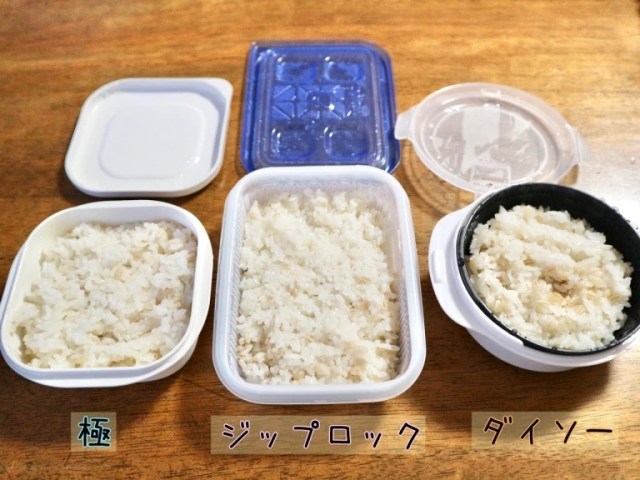
And last, there’s a difference in their prices. We got our Marna Kiwami on Rakuten here as part of a two-container set for 1,078 yen (US$8.20), which works out to 539 yen each. Rakuten was also where we got our Ziploc container (here) as part of a five-pack for 990 yen, making them 198 yen each. Finally, the Daiso container was, naturally, 110 yen after tax, making it the most affordable by far.
So ultimately, the best container for you is going to be a matter of personal preference and finances, but the good news is that there’s not a bad one in the bunch.
Photos ©SoraNews24
● Want to hear about SoraNews24’s latest articles as soon as they’re published? Follow us on Facebook and Twitter!
[ Read in Japanese ]