Our Nagasaki-born reporter, the grandchild of A-bomb victims, gives her thoughts on the series.
August 6 and 9 respectively marked 83 years since the atomic bombings of Hiroshima and Nagasaki in World War II. The bombing of Hiroshima is the subject of Japan’s most notable anti-war manga, Barefoot Gen, which our Nagasaki-born Japanese-language reporter Mariko Ohanabatake had never read until now. Her thoughts on the manga are below.
I was born in Nagasaki, and my grandparents were living there when the atomic bomb was dropped. In school, my classmates and I were repeatedly taught about the destruction caused by war and atomic weapons, but until recently I’d never actually read Barefoot Gen.
This summer, something unexpected happened that made me think about the atomic bomb, and so I decided to read Barefoot Gen for the first time.That unexpected impetus was the online uproar about the “Barbenheimer” meme. Overseas fans of the Barbie and Oppenheimer movies started making images of the two films’ main characters connected by mushroom clouds. The official Barbie Twitter account happily got onboard with the memes, which led to Warner Bros. Japan asking the American division of the company to “take appropriate action.”
In response, I saw people on Japanese Twitter posting scenes of the atomic bombing from the Barefoot Gen anime. Looking at them, I really felt like the mushroom cloud, part of something that caused the deaths of hundreds of thousands of people, shouldn’t be used as the basis for jokes.
Not long before all this, I’d also heard the news about Barefoot Gen being removed from school curriculums in Hiroshima.
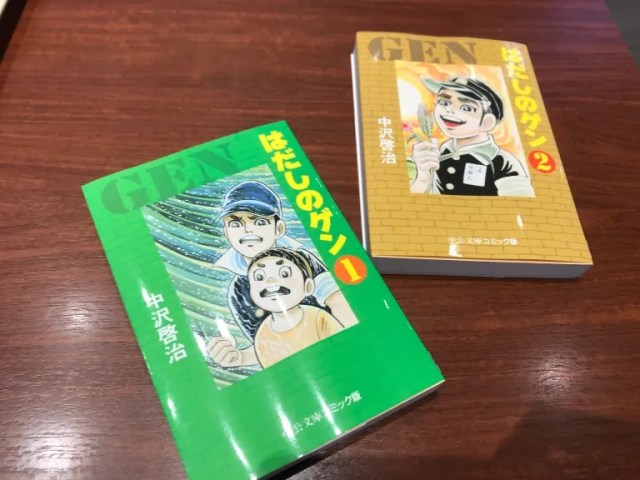
Barefoot Gen is a story about Gen Nakaoka, a young boy who loses his father, older sister, and younger brother in the atomic bombing of Hiroshima, and how he tries to live bravely after that. It’s a long story, and the creator, Keiji Nakazawa, used many of his own experiences from being a boy in Hiroshima when the bomb was dropped in writing the story.
Barefoot Gen is often part of peace-focused educational materials, and it’s the only manga in many school libraries. Because of that, I think a lot of people read it growing up. I’ve heard many people say “The pictures gave me trauma.” I don’t like frightening things, though. Every year from elementary through high school, peace education was part of our summer homework, but I never chose to read Barefoot Gen, thinking “I don’t want to have to read about war in a manga too.” Actually, I’d never liked “educational manga,” since I thought they were preachy. I was a cynical kid, and my attitude was that if adults were acting like I should read a certain manga, I wasn’t going to. I’d convinced myself that if it was in our school library, Barefoot Gen must be a boring “educational manga.”

But now that I’m 40 years old and know a little more about the world, I decided to read Barefoot Gen for the first time. It’s a long series, with 10 collected volumes, and my initial intention was just to read the first one, which depicts the bombing of Hiroshima. I’ve read enough of the great manga series in my life to think of myself as something of a connoisseur, and I’ve built up a resistance to scary scenes, so I wasn’t going to get suckered in by some simplistic story.
And then after I finished the first volume, I immediately read the second, and then the third, and then the fourth…and kept going until I’d read the entire series in one night. Saying this about a mana about war might give the wrong impression, but…Barefoot Gen is an extremely compelling manga series. My old assumption that it was a “boring educational manga” was completely wrong. I seriously regret not reading it until now, and I think it is, without question, a masterpiece.
The manga starts before the atomic bomb is dropped, but the atmosphere already shows that Japan is losing the war. Gen’s family is poor, but close-knit. Because the manga takes the time to show the life they had, you can see what they lost in the bombing, making the tragedy really hit home.
The depictions of the aftermath of the bombing are unimaginably gruesome. The elderly woman who had been standing next to Gen and talking to him has her flesh burn away in an instant. The entire town becomes a field of fire, with a man, covered in burns pleading “Give me water,” and another whose body has been pierced by countless shards of glass. As Gen runs home, he’s stepping on the bodies of corpses along the way. On the way, Gen saves the life of an unfriendly man from the neighborhood, but that same man refuses to help Gen when he finds his family trapped under a collapsed building. He’s so despicable. All Gen and his mother can do is watch as Gen’s father, older sister, and younger brother burn to death. The sight drives his mother to madness, and she starts to laugh.
What else surprised me was that the atomic bombing is just the start of the tragedies the characters face. Even after Japan formally announces its surrender, the tragedies of war and the atomic bomb continue. Some of the other storylines include:
● A mother feeling a sense of adoration for a fly that comes out of the corpse of her dead son
● A young man, who’d dreamed of becoming a painter, being treated like a monster by his family after having both of his hands and feet blown off
● A family feeling not even a twinge of remorse or sadness as a young boy dies
● A woman resisting the urge to kill herself because of the burns on her face, but still being discriminated against by people who think she’ll spread radiation sickness to them
● War orphans being exploited by the yakuza
● Poor people not being able to get medical treatment and dying
● Everyone being underfed and suffering from malnutrition
● The police stealing black market rice from the townspeople and eating it themselves
● The police being in cahoots with the yakuza and taking advantage of people
● A doctor colluding with the U.S. military to use victims of the bombing as guinea pigs
● Gen’s older brother having to leave home to earn money to send back to his family, but falling into depression and alcoholism, then cutting off ties with them
● A woman prostituting herself to American soldiers to support herself and her younger sister
● The man who refused to help save Gen’s family becoming a member of parliament
● Several major characters who survived the bombing later dying of radiation sickness
One after another, I found myself saying “And now this? And this too?” as the hardships piled up. But at the same time, the world starts recovering. Maybe this is the real terror, the real sadness, of war, of the atomic bomb. There are also many scenes of people doing terrible things to try to survive poverty or discrimination. The extreme conditions make you rethink what’s right and what’s wrong.
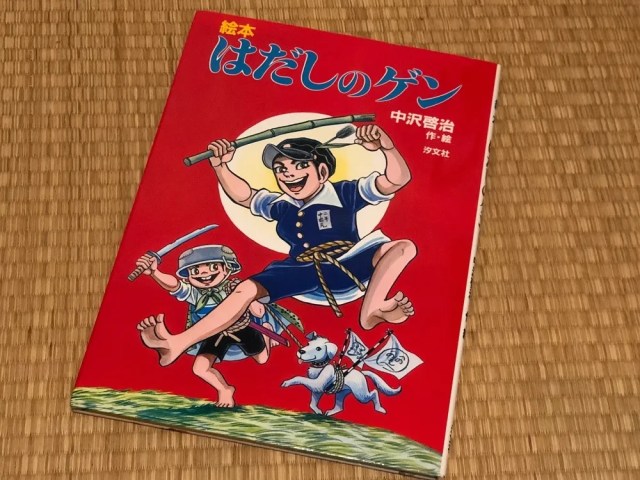
The dark and shocking developments continue to a traumatic extent, but I think another thing that makes Barefoot Gen worth reading is that the mood isn’t constantly heavy. There are any scenes of Gen singing and telling dirty jokes. He does things like saying “It tastes so good I think I’m gonna piss myself!” when eating a bowl of white rice, and there’s a part where he pees on an old lady who’s been tormenting him, and he makes up songs about things like “udon noodles with worms.” I think these gross gag parts, happening in the midst of so many dark developments, lighten the mood, though there are some words used that are no longer considered appropriate.
This combination of intense horror and vulgar comedy makes Barefoot Gen stay with you long after you’ve read it. As a kid, you might just laugh at the naughty jokes or things the characters say, but reading it as an adult, you can feel the misery caused by war, and how people’s behavior, in terms of good and evil, can become so unpredictable in desperate situations. You also see how poverty can change people, which I think is something that is pertinent in our current society as well.
I’ve heard people say that in recent years, exhibitions related to the atomic bombings include fewer frightful images. As a kid, I didn’t like going to those exhibits, but the reality that people went through was even worse. Without such traumatic imagery, the tragedy of war can’t be conveyed, and so I hope that Barefoot Gen will continue to be read.
Photos © SoraNews24
● Want to hear about SoraNews24’s latest articles as soon as they’re published? Follow us on Facebook and Twitter!
[ Read in Japanese ]