”Please tell me your smartphone.”
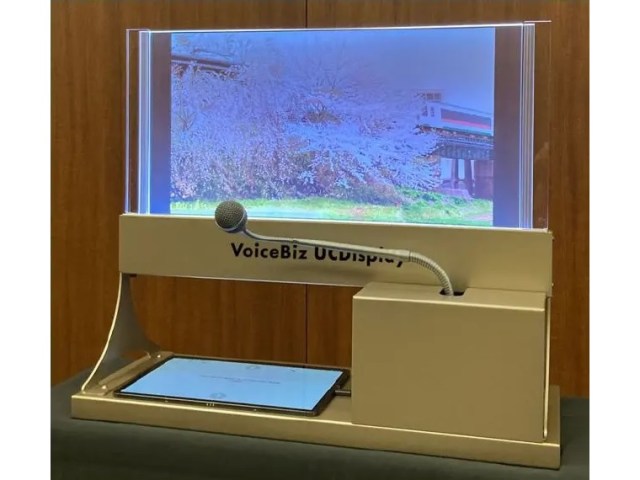
This week, Japan Airlines and Tokyo-based tech firm Toppan began demonstrating a new system designed to help foreign travelers on their way into or out of Japan. Beginning with Tokyo’s Haneda Airport, JAL will be using Toppan’s VoiceBiz UCDisplay panel to provide what it hopes will be smooth, stress-free communication between JAL staff who speak Japanese and travelers who don’t.
The transparent color displays provide text translations based on either keyboard or voice inputs. The screen displays both the original and translated version of the message to make it easy for both parties to follow along, and the see-through design of the panel also lets JAL staff and travelers communicate face-to-face, providing a more personal touch than some other translation formats. JAL began using the system on July 2 at Haneda, where the trial will run until July 8, and next month it’ll be in operation at Osaka’s Itami from August 20 to 26.
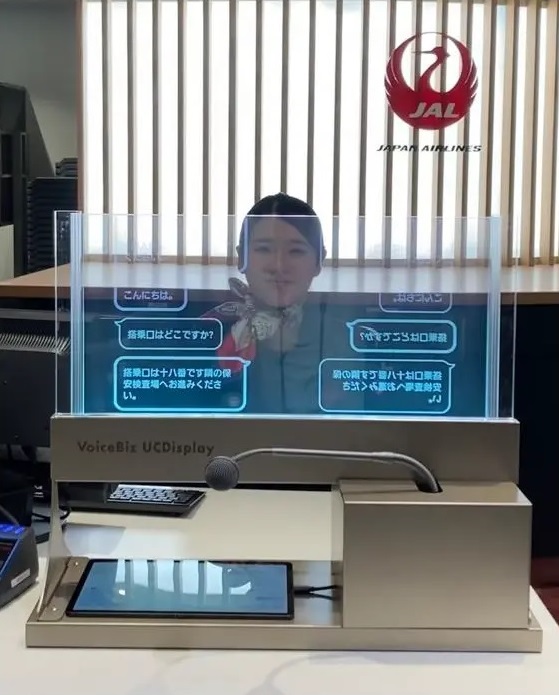
Considering that travelers are often tired and pressed for time at the airport, it makes sense for JAL to be interested in anything to help bridge the additional difficulties of a language barrier. However, it looks like the system isn’t exactly perfect, as a photo of the system in action has already shown it stumbling over how to intelligently render a request in English.
羽田空港カウンターに翻訳ディスプレー、JALとTOPPANが実験…英語や中国語など13言語https://t.co/xp48GSdpxz#経済
— 読売新聞オンライン (@Yomiuri_Online) July 2, 2024
Zoom in, and you’ll see three sentences on the screen in the above photo. The first, translated as “I have a smartphone,” is fine. The third sentence is a little bumpier, saying “You are Ms. Hanako Ozora on flight number nine hundred nineteen to Okinawa at fourteen forty five,” but it’s not too bad. Sure, something like “I see that you’re Ms. Hanako Ozora” would feel more natural, as would rendering the departure time in numerals, or maybe converting it to a 12-hour-clock format. Still, it’s understandable.
The problem, though, comes with the second sentence, which the system has rendered in English as:
“Please tell me your smart phone.”
This one doesn’t make any sense, and there’s a good chance that if you told someone “Please tell me your smart phone,” they’d have no idea what you wanted them to do.
Sometimes when Japanese-to-English translation hiccups happen in Japan, it’s possible to work backwards and diagnose what the speaker was actually trying to say, using a basic understanding of fundamental differences between the two language’s vocabulary and grammar. Oftentimes the problem stems from the propensity in Japanese to condense or omit words if the message can still be understood from context. For example, when asking someone for their contact information on popular messaging app Line, it’s most common to just say “Line wo oshiete,” literally “Tell me [your] Line,” and omit any mention of “contact info,” “profile,” “username,” etc. However, “Tell me your smart phone” isn’t a common way for asking for someone’s phone number in Japan, nor is “Tell me your phone.” Even in Japanese, the standard phrase is “Tell me your phone number.”
So if “Please tell me your smartphone” isn’t the JAL attendant asking the traveler to provide their phone number, what is it asking for? Flipping the photo around and looking at the display’s Japanese-language version of the sentence, unfortunately, doesn’t definitively solve the mystery, as the Japanese text is less than immediately intelligible too, though we’ll have to wade a bit into the linguistic reeds to explain why.
▼ Yes, of course the Japanese linguistic reeds have a samurai lurking in them.

We’ve got to zoom in pretty close to see the Japanese text, but it appears to say “スマートフォンをこちらにお●ください,” with the character between お and く being illegibly blurry. The first part, スマートフォンをこちらに (sumaatofon wo kochira ni), translates to “your smartphone here,” and ください (kudasai is “please”). お is an honorific marker used in polite speech to make humble requests, and is commonly used when a customer service worker is asking someone to do something.
String all those together, and we’ve got “Please ● your smartphone here,” so ● has to be some sort of verb/action, but the on-screen English translation’s “tell” doesn’t mesh with the location-denoting “here” of the Japanese version. There’s another problem too, which is that when using お to make requests, the necessary following conjugation of the verb generally requires at least two characters to write, not a single character like shown on the display.
▼ So long, Linguistic Reeds Samurai! We’ll see you the next time we wade all the way out here!

So it looks like both “Please tell me your smartphone” and its on-screen Japanese equivalent are both confusing. That suggests this might not only be a translation error, but an input one too, which raises the question of whether the system was attempting to translate from English to Japanese or from Japanese to English. It’s a safe bet that it’s the latter, since it’s much more likely that airline staff will need to confirm a traveler’s identity or access their account via their phone number than it is that a traveler would be asking the JAL staff for info regarding her personal phone.
As mentioned above, VoiceBiz UCDisplay can work with both keyboard and voice inputs, so the problem could be something as simple as an errant keystroke triggering a typo that the system then forced an imperfect translation of, which you could say is a case of user error. It could also be, though, that the system’s voice sensors incorrectly transcribed something the attendant said. That would be a bigger issue, since you’d hope that a system developed and being used in Japan would be at its most accurate when transcribing Japanese.
It’s especially concerning that a problem has cropped up so soon into the demonstration, when ostensibly it’s getting pitched easy topics to translate, and also that the above photo doesn’t indicate that anyone involved in the demonstration caught or corrected the error. Yes, it’s always nice to see travel providers doing what they can to make international travel easier, even for those who don’t speak the language of the country they’re visiting. At the same time, with Haneda and Itami being two of Japan’s largest entry points for international tourists, staffing qualified multilingual ground staff for frontline customer interaction positions doesn’t seem like it should be outside the realm of suitable expenditures for JAL, one of Japan’s largest airlines.
It’s worth reiterating that the system is currently only in a trial state, and it’s only being used at the special assistance counters in Haneda’s Terminal 1 South Wing and Itami’s North Terminal, plus a few other places in the facilities, so it’s not like the translation panels are the only option for communicating with JAL staff. Still, this is all a reminder that there’s really no substitute for a human being who knows what they’re talking about.
Source: PR Times
Top image: PR Times
Insert images: Pakutaso (1, 2)
● Want to hear about SoraNews24’s latest articles as soon as they’re published? Follow us on Facebook and Twitter!