
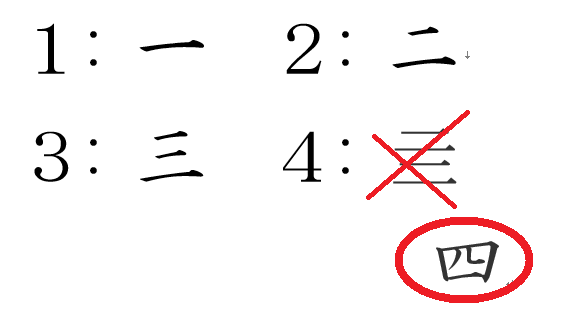
The history of the first kanji that makes many learners of Japanese want to pull their hair out, and why their initial guess isn’t entirely wrong.
One of the most intimidating things about learning Japanese is the writing system. There are three different sets of characters you’ll need to become proficient in, and while two of them, hiragana and katakana, aren’t too difficult to master, kanji, the set originally imported from China, is a high hurdle.
Japan’s Ministry of Education has designated 2,136 characters as “general-use kanji,” and while you may not need to know each and every one to function in Japanese society, you’ll need a firm mental grip on several hundred if you really want to integrate yourself into the cultural or professional spheres. With so many to learn, most structured courses, and self-studiers as well, start with the easiest kanji, ichi, which means one.
▼ Ichi

While you could possibly interpret a horizontal line in a few different ways, it’s not too hard to wrap your head around the fact that in Japan, a single sideways stroke represents the concept, and thus the word for, “one.” After inputting that in their brains, most learners will turn the page of their textbook and find the kanji for ni, or “two.”

This seems like a pretty logical progression, right? One horizontal line means one, two horizontal lines means two. The next on the kanji study list is generally san, or “three,” and you can probably guess where this is going.
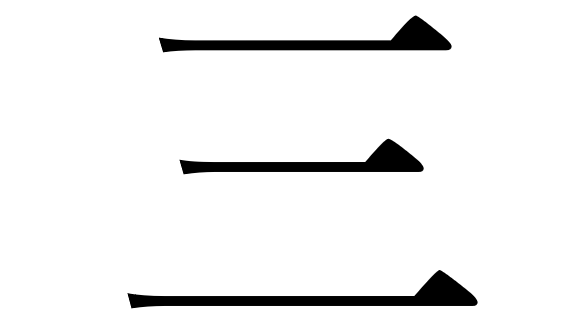
Wow, if all kanji are this straightforward, you’ll have those 2,136 general-use ones memorized in no time, right? Okay, let’s move on to yon, or “four,” although at this point it seems like just a formality, since in keeping with the established pattern it’ll probably be-
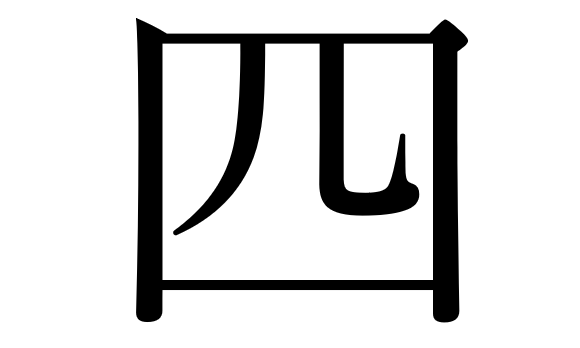
Whoa, hold up there. Is this some kind of joke? And if it is, don’t the people who developed kanji know that comedy is supposed to follow the rule of three, not the rule of four?
If there were any justice in the world, the kanji for “four” should be written like this, right?

But try writing that on your kanji test, and your teacher is likely to strain a forehead muscle from cocking an eyebrow harder than he would if you referred to yourself with the macho pronoun ore when speaking in class. However, history would be on your side, even if your instructor probably wouldn’t, since long, long ago the kanji 亖 actually was an acceptable way of writing “four.”
▼ Take that, Teach!

However, 亖 never shows up in contemporary usage, and it takes a fair bit of wrangling to even get it to appear when typing in Japanese (it’s literally easier to summon a dragon with a Japanese word processor than to produce the kanji 亖). So how did it get replaced, and why?
Let’s start with the “how” part of that question. As mentioned above, while Japan has developed some kanji of its own over the years, the writing system originally came from China. There, too, 亖 was once an acceptable way of writing “four.” However, somewhere along the line, people started using the kanji 四 to represent “four” as well.
四 seems like a strange choice at first. Originally, it meant “breath” and was meant to be a visual representation of teeth or a tongue inside a mouth (“mouth” by itself being written with the kanji 口). However, the Chinese pronunciations of 四 and 亖 were identical, and so some people started using 四 to represent “four.” Eventually, 四 became the preferred rendering for “four,” which then prompted the development of a new kanji for “breath,” 息 (a compound of the kanji for “self,” 自, and “heart,” 心).
But what turned popular opinion, and eventually society as a whole, against 亖? There was no official changeover decree, owing to language’s nature as a gradually and constantly evolving thing. However, the common-sense explanation is that while 一, 二, and 三 are all pretty easy to identify with a momentary glance, 亖 had moved beyond, or at least approached, the tipping point where the eye and mind can instantaneously process the information without requiring conscious counting.
From a practical standpoint, a line had to be drawn somewhere in stacking horizontal lines increasingly higher. After all, while the meaning of 八, the kanji for “eight,” may not be intrinsically understandable, it saves people from having to squint at small-font text to see if there are eight or nine strokes crammed together in a small vertical space. Others have pointed out that this concept that four repeating visual elements is too many appears in Roman numerals as well, which capped its vertical lines at three after Ⅰ, Ⅱ, and Ⅲ and then started mixing things up with Ⅳ.
So once again, yes, Japanese can be a difficult language to learn, sometimes frustratingly so. However, there’s often a reason for things being done the way they are.
Sources: IT Media, Okijiten (1, 2)
Top image ©SoraNews24
Insert images: SoraNews24, Pakutaso
Follow Casey on Twitter, where he’d like to thank Sakamoto-sensei for not getting too upset when he used “ore” during a heated in-class debate with another student.
 Japanese teacher shares surprising reason why the kanji for crow has one less line than bird
 Sweet high-school anime shows how learning kanji can be the key to getting a girlfriend【Videos】
 10 badass four-character phrases to add to your Japanese language toolkit
 Japanese government tells teachers not to be so strict, at least about some kanji radicals
 Why does Japanese writing need three different sets of characters? (Part 2)
 Pokémon and Ikea Japan cross over into each other’s worlds with collaboration events
 Two food hacks take Japan’s convenience store fried chicken to amazing new sandwich heights
 A Kyoto factory vending machine sells gourmet mystery meals at bargain prices
 Never been into a girl’s room before? Then this reference photo book is for you
 Is Daiso’s microwave Japanese rolled omelet maker worth your time and money? [Taste test]
 Create a tiny Ghibli anime world on your bookshelf with new miniature papercraft art kits
 We eat at three Japanese family restaurants to find the one with the best-value breakfast
 Japan Extreme Budget Travel! A trip from Tokyo to Izumo for just 30,000 yen [Part 2]
 Senkoji: The Japanese temple that’s more like a theme park to heaven and hell
 Rumors say Tokyo’s Sensoji Temple sticks you with bad fortunes, so we bought 100 to find out
 Famous Tokyo cherry blossom spot installs view-blocking screens to fight overcrowding[Video]
 Tokyo’s best museum for foreign travelers finally reopens after being closed for four years
 Pokémon lacquerware series expands for Year of the Horse with new handcrafted design[Video]
 Japan now has a special desk for people who work at home with a pet cat[Photos]
 Uniqlo announces new T-shirts for One Piece, Naruto and more for manga publisher’s 100th birthday
 Picturesque Tokyo park plays host to millions of flowers and soap bubbles this spring
 Tokyo subway and almost all Tokyo train lines now accepting credit card tap payments
 Totoro and Calcifer become little light-up lanterns for Ghibli-style excursions or at-home decor
 Fading Tokyo – Searching for signs of the Showa era as local neighborhoods evolve[Photos]
 Train station platform ramen store closes its doors on half a century of history in Tokyo
 Starbucks Japan releases new My Fruit³ Frappuccino at only 34 stores around the country
 Studio Ghibli releases Catbus pullback keychain that runs like the anime character
 Krispy Kreme releases Super Mario doughnuts in Japan for a limited time
 Japanese onsen egg maker from 100-yen store Daiso needs to be on your shopping list
 Starbucks Japan unveils new sakura cherry blossom collection for hanami season 2026
 Survey asks foreign tourists what bothered them in Japan, more than half gave same answer
 Japan’s human washing machines will go on sale to general public, demos to be held in Tokyo
 Starbucks Japan releases new drinkware and goods for Valentine’s Day
 We deeply regret going into this tunnel on our walk in the mountains of Japan
 Studio Ghibli releases Kodama forest spirits from Princess Mononoke to light up your home
 Starbucks Japan releases new sakura goods and drinkware for cherry blossom season 2026
 Japan’s newest Shinkansen has no seats…or passengers [Video]
 Major Japanese hotel chain says reservations via overseas booking sites may not be valid
 Put sesame oil in your coffee? Japanese maker says it’s the best way to start your day【Taste test】
 No more using real katana for tourism activities, Japan’s National Police Agency says
 Why does Japanese writing need three different sets of characters? (Part 1)
 W.T.F. Japan: Top 5 kanji with ironic meanings【Weird Top Five】
 Busty Japanese brushstroke calligraphy artist shares visual appeal in video series【Videos】
 What does a kanji with 12 “kuchi” radicals mean? A look at weird, forgotten Japanese characters
 One simple kanji character in super-simple Japanese sentence has five different pronunciations
 How to write “sakura” in Japanese (and why it’s written that way)
 Japan’s Kanji of the Year announced for 2021, and it’s a familiar choice
 Japan announces Kanji of the Year for 2019, and it was really the only logical choice
 Japan’s Kanji of the Year announced, shows the bright and dark spots of 2024【Video】
 Foreigners misreading Japanese kanji of “two men one woman” is too pure for Japanese Internet
 W.T.F. Japan: Top 5 strangest kanji ever 【Weird Top Five】
 Awesome Japanese elementary school teacher rewards kids who use independent learning on his tests
 Flipping the kanji for “husband” upside-down reveals slightly worrying double meaning
 The extremely violent backstory of how to write the word “take” in Japanese