
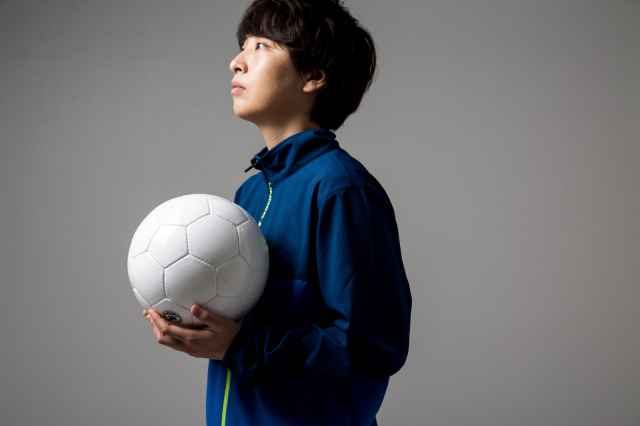
Soccer star wants more fans to mind their manners and remember to use it.
Even people with only the bare minimum of interest in Japan (or 1984 karate cinema) know that in Japanese society it’s customary to add -san after a person’s name to show respect. Language learners and Japanophiles quickly pick up three additional commonly used suffixes: -sama (even more polite than -san), -chan (to show affection), and -kun (a bit less formal than -san, and often used when talking to young males). Not using any suffix at all is referred to as yobisute, and implies either such intimate friendship or complete disdain that no social niceties are required.
There’s also a special suffix used specifically for talking to or about athletes: -senshu. For example, if you were talking about baseball star Ichiro in Japanese, he’d be Ichiro-senshu.
Senshu can also be used by itself to mean “athelete/sports player,” and the kanji for the word, 選手, literally translate to “selected hand,” with “person” being an associated meaning for the second character. As such, it carries a bit of an aura of being a “chosen one,” whose skill at sports has set him apart from the pack of rivals who also were trying out for a position on the team or a spot in the sport. The use of -senshu is a definite sign of respect, and one that professional soccer player and Japanese national team member Tomoaki Makino wants people to remember to use when speaking to him and his colleagues.
スポーツ選手に対して街中や、
— 槙野智章 (@tonji5) October 22, 2018
練習場で声を掛ける時は選手の事を、
呼び捨てじゃなくて「○○選手」と付けた方がいいね。
そうすると選手自身も気持ちよく手を振ったりファン対応出来るから。
みんな、気を付けてな!
In a recent tweet, Makino said:
“When you see an athlete out in town or on the practice field, and you want to call out to him, don’t do yobisute. Instead, you should put -senshu after his name.
If you do that, the athlete can wave and respond cordially.
Watch yourselves, everybody!”
As mentioned above, yobisute in Japan gets used only in certain relationships, such as between very close friends. Even among officemates or neighbors who’ve worked or lived next to each other for years, the honorifics stay in place, and speaking to someone with the familiarity of yobisute if you don’t have any sort of personal connection can be startling and, in many people’s opinion, rude.
▼ Tomoaki Makino
10/4、公益財団法人 日本サッカー協会から、10/12(金)と10/16(火)に行われるキリンチャレンジカップ2018の日本代表メンバーが発表され、浦和レッズから槙野智章が選出されました。
— 浦和レッズオフィシャル (@REDSOFFICIAL) October 4, 2018
■詳しくは→https://t.co/waERR0kdB1#urawareds #浦和レッズ #槙野智章 #daihyo pic.twitter.com/GTAxIuxqfD
But there’s a bit of a gray area when it comes to people like professional athletes and entertainers who live their entire lives in the public eye. After spending countless hours watching their heroes on the field through their TVs, passionate sports fans might feel something akin to kinship to them, as they cheer their victories and agonize over their defeats. So when they finally see them in person, it’s not entirely unthinkable that some may excitedly call out to them and forget to stick an honorific suffix on the end of their name.
Still, traditional Japanese etiquette holds that doing yobisute for someone you’ve never even been formally introduced to is por form, and Makino’s tweet produced a wide variety of reactions. In the first group are those who share his frustration:
“What he’s saying should just be plain common sense.”
“Using -senshu is just basic manners, really.”
“You should refer to athletes with -senshu, or at least -san.”
“For almost all fans, it would be their first time actually talking to the athlete face-to-face, so they should use -senshu.”
皆さんお待ちかねのこのジェル。
— 槙野智章 (@tonji5) September 18, 2018
その名もHALTEN(ハルテン)
発売まであと、3日。
詳しくはホームページを要チェック! pic.twitter.com/5cNFJscZ5Z
On the other end of the spectrum, though, were those who think the 31-year-old center-back is being unreasonable, or even hypocritical, in his insistence in standing on ceremony.
“Is people not using -senshu really something to get worked up about?”
“He’s being pretty petty.”
“Weird sense of pride he’s got there.”
“I don’t think all athlete share his opinion.”
“It’s fine, and even necessary, for fans to respect athletes, but athletes should respect fans too! ‘Watch yourselves?’ That should be ‘Please be careful.’”
And finally, some couldn’t resist the urge to let some snark fly with a flurry of yobisute comments.
“I hear ya, MAKINO!”
“MAAAAAKINO!”
“Well, MAKINO, your name is MAKINO, after all.”
“I’ll make sure to use -senshu when talking to other athletes, MAKINO.”
Sarcasm aside, if you’re looking to make a good impression on people in Japan, it’s probably best to avoid yobisute in, at the bare minimum, your first conversation. That said, if you go online to complain about people not using your preferred form of honorific address when talking to you, you’re probably not going to change many minds.
Source: Twitter/@tonji5
Top image: Pakutaso
[ Read in Japanese ]
Follow Casey on Twitter, where his Japanese nieces have been yobisute-ing him since they first met.
 To –san or not to –san? Should you use the Japanese honorific suffix when speaking English?
 Japanese schools banning nicknames, mandating use of -san divides opinions
 Survey finds more than half of Japanese women’s nieces don’t call them “aunt”
 11 different ways to say “father” in Japanese
 Reports that using -chan in Japan constitutes sexual harassment are at least a little exaggerated
 Yakuzen ramen restaurant in Tokyo is very different to a yakuza ramen restaurant
 Tokyo Skytree turns pink for the cherry blossom season
 Adorable Totoro acorn key holders come with a special guest hidden inside[Photos]
 Osaka establishes first designated smoking area in Dotonbori canal district to fight “overtourism”
 The 10 most annoying things foreign tourists do on Japanese trains, according to locals
 We stuff our faces with Wednesday night all-you-can-eat fried chicken from KFC Japan
 Daiso’s 100-yen ramen egg makers even better in smaller sizes
 Cherry blossom mochi lattes arrive at Japan’s Pronto cafe chain to start sakura sweets season
 Visit the mythical cave that hid the Sun Goddess in Japanese mythology
 Our reporter eats the new “apple pie” flavor yakisoba noodles, so no one else has to
 Starbucks Japan releases new sakura goods and drinkware for cherry blossom season 2026
 Naruto and Converse team up for new line of shinobi sneakers[Photos]
 Now is the time to visit one of Tokyo’s best off-the-beaten-path plum blossom gardens
 Starbucks Japan unveils new sakura Frappuccino for cherry blossom season 2026
 Is Sapporio’s Snow Festival awesome enough to be worth visiting even if you hate the snow? [Pics]
 Japan has trams that say “sorry” while they ride around town…but why?
 Sakura Totoro is here to get spring started early with adorable pouches and plushies
 Foreign tourists in Japan will get free Shinkansen tickets to promote regional tourism
 Poop is in full bloom at the Unko Museums for cherry blossom season
 Japan’s newest Shinkansen has no seats…or passengers [Video]
 Foreigners accounting for over 80 percent of off-course skiers needing rescue in Japan’s Hokkaido
 Super-salty pizza sends six kids to the hospital in Japan, linguistics blamed
 Archfiend Hello Kitty appears as Sanrio launches new team-up with Yu-Gi-Oh【Pics】
 Take a trip to Japan’s Dododo Land, the most irritating place on Earth
 China’s don’t-go-to-Japan warning looks to be affecting tourist crowds on Miyajima
 Survey asks foreign tourists what bothered them in Japan, more than half gave same answer
 Japan’s human washing machines will go on sale to general public, demos to be held in Tokyo
 Starbucks Japan releases new drinkware and goods for Valentine’s Day
 We deeply regret going into this tunnel on our walk in the mountains of Japan
 Studio Ghibli releases Kodama forest spirits from Princess Mononoke to light up your home
 Major Japanese hotel chain says reservations via overseas booking sites may not be valid
 Put sesame oil in your coffee? Japanese maker says it’s the best way to start your day【Taste test】
 No more using real katana for tourism activities, Japan’s National Police Agency says
 Japan has a set phrase for the crazy busy feeling we all get at the start of the year
 How should a guy say “I” in Japanese? Japanese women give their opinions【Survey】
 Japanese World Cup team’s manners awesome as usual, locker room pics after unexpected win show
 How should you respond when a Japanese person gives you a compliment?
 Hachiji juppun mae – A Japanese phrase that even Japanese people can’t agree on the meaning of
 How to respond to Japanese people saying “I don’t speak English” when you’re speaking Japanese?
 Laugh and learn! Japanese language school for foreigners teaches real Japanese with manzai comedy