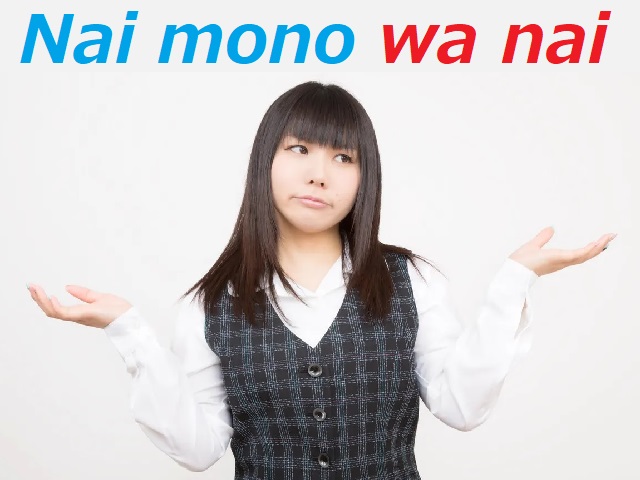
We have it all? Keep your mouth shut about our poor selection? It could go either way, because of a Japanese language quirk.
The idea behind giving your store a slogan is that people will have some sort of idea of what to expect even before they walk through the entrance. So right above its front door, the Matsuzaki branch of Japanese supermarket Sun Fresh in Shizuoka Prefecture proudly declares “Nai mono wa nai.”
▼ Zoom in and you’ll see “Nai mono wa nai” (ないものはない) written underneath the Sun logo.
The problem is that no one is quite sure what that slogan is supposed to mean. The Japanese Internet is divided over two possible interpretations, and those interpretations are complete opposites in terms of tone. Some people think the store is confidently promising it has anything you could ever want, while others say the slogan is preemptively telling customers not only to not expect much from Sun Fresh, but also to keep their complaints to themselves if/when they’re disappointed.
First, let’s try working off of the conventional wisdom that a store is most likely to choose a slogan that makes itself look good. If that’s the case, and Sun Fresh is bragging about the wide selection of products it stocks, nai mono wa nai is probably supposed to mean “There’s nothing we don’t have”/”We have everything.”
Let’s take a look at the linguistics. First, in Japanese there’s a word aru which means “there is.” For example, “Ramen ga aru,” means “There is ramen.” The opposite would be “Ramen ga nai,” or “There is no ramen.” Swap in “wa” for “ga” and you get “Ramen wa nai,” which also means “There is no ramen,” but sounds more emphatic than “Ramen ga nai.”
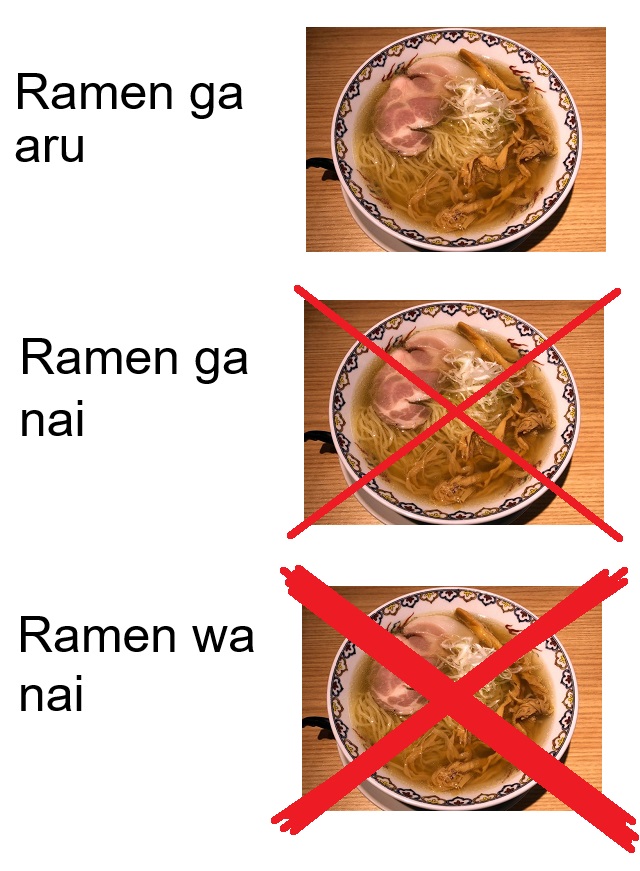
You can replace “ramen” with any other verb and the grammar stays the same. “Sushi ga aru” means “There is sushi.” At the most basic level, using mono, the Japanese word for “thing,” you could say “Mono ga aru,” meaning “There is a thing,” or “Mono wa nai,” meaning “There isn’t a thing.”
Alternatively, instead of “there is”/”there isn’t,” you could also translate aru/nai as “have”/”not have.” There’s a lot of overlap between those concepts, after all. If you’re inside a supermarket and “there isn’t” any ramen, you could just as accurately say that the store “doesn’t have” ramen, right?
Getting back to mono/thing, you can put an adjective or other descriptor in front of it. For example, a kawaii mono is a “cute thing.” You can use aru/nai like this too, with aru mono meaning “a thing that there is” or “a thing we have.” And once again, we can do the opposite too, with nai mono, which would mean “a thing that there isn’t,” or “a thing we don’t have.”
Put all of those concepts together and “Nai mono wa nai” sounds, to many people, like it means “There isn’t a thing we don’t have,” i.e. our store’s selection is so big that we have everything customers could be looking for.
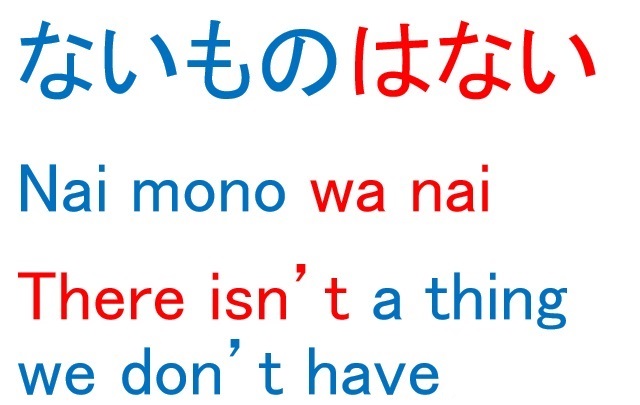
But now let’s go back and look at one other aspect of the word mono. We said it means “thing,” but in Japanese, there’s generally no difference between singular and plural nouns, so mono can also mean “things.” And remember how we said nai can be thought of as either “there isn’t” or “not have?” Because of all that, this too becomes a possible interpretation of Sun Fresh’s slogan:
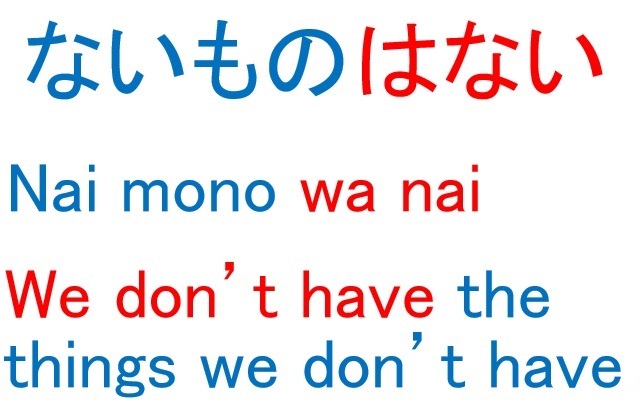
Now instead of a reliable “We’ve got everything!”, it sounds like Sun Fresh is emphatically telling shoppers “Hey, if we aint got it, we aint got it, pal!” preemptively cutting off any negative reactions to a lackluster variety in its product lineup.
Though Sun Fresh has been using this slogan for quite some time, its ambiguous meaning has been generating a lot of discussion on the Japanese Internet this week. This isn’t the first time the debate over the two interpretations has cropped up, though, and back in 2019 Sun Fresh’s president himself was asked which is the true meaning, to which he replied:
“The slogan is a half joke…There’s not really a ‘correct’ way to interpret it, so people are free to take it as whichever meaning they like.”
Before starting Sun Fresh, the chain’s owner managed a smaller market, and that store’s unofficial slogan was also “Nai mono wa nai.” The mystery surrounding the equally viable interpretations of “We have everything!” and “We don’t have very much” made the slogan stick in people’s heads, and so when the larger Sun Fresh supermarket chain opened, they officially put Nai mono wa nai on some of their storefronts, like at the Matsuzaki branch in the Shizuoka town of Kamo on the west side of the Izu Peninsula.
▼ The Nai mono wa nai / ないものはない slogan can also be seen here at Sun Fresh’s Tago branch, also in Kamo.
So while it might not be the most informative, Nai mono wa nai is definitely the most intriguing slogan I’ve ever heard for a grocery store, and the next time I’m in that part of Japan I’m definitely going to have to stop by Sun Fresh to see what they do, and don’t, have.
Source: J-Town Net
Top image: Pakutaso (edited by SoraNews4)
Insert images © SoraNews24
● Want to hear about SoraNews24’s latest articles as soon as they’re published? Follow us on Facebook and Twitter!
Follow Casey on Twitter, where it’s only a matter of time until he spends a whole day again thinking about Japanese grammar.