
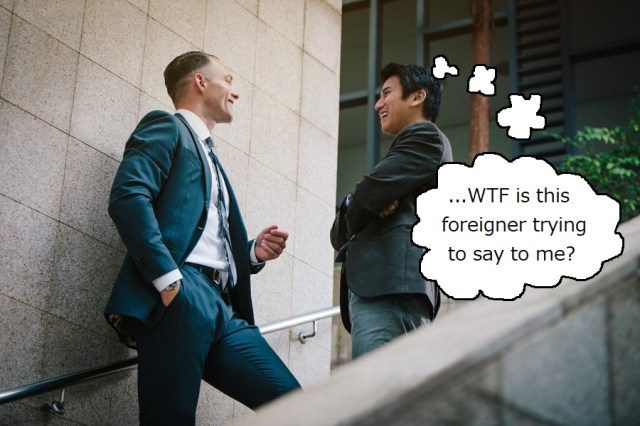
Engrish may be funny, but language mistakes go both ways!
When I was a Japanese tutor, students often asked me if memorizing kanji was the hardest part of learning Japanese. My reply was usually something along the lines of: “I wish that was the hardest part.”
In my opinion, the hardest part was the different ways that Japanese and English express things. Unlike more closely-related languages like French or Spanish, it’s much rarer to have an expression in Japanese with a 100-percent English equivalent.
Case in point, Japanese Twitter user @hashishi_ recently posted a list of some of the most “mysterious” Japanese they’d heard from foreigners. While the expressions mostly make sense in English, they’re downright bizarre in Japanese.
▼ “I love the mysterious Japanese that foreigners create,
and I added one to my collection today.” (Translations below)
僕は外国人が生み出す謎日本語が大好きで集めてるのですが
— はしし (@hashishi_) September 13, 2018
・気持ち良くないので今日は休む
・ハピバスデ!加齢を楽しんで
・なるほど!一本失いました
・頼んでもないチャンス嬉しいです
・とてもじゃないが楽しい
・分かった途端に教えて
に今日
・とても適当な服ですね!←褒めてる
が加わりました
Let’s go ahead and break down the “mysterious Japanese” phrases one by one:
#1. Kimochi yokunai node kyō wa yasumu
Intended meaning: “I don’t feel well so I’m staying home today.”
Actual meaning: “That doesn’t feel good so I’m staying home today.”
This one is a fairly simple mistake. The word kimochi ii means “feels good,” as in something physically feels nice (like a massage).
The opposite of kimochi ii is kimochi yokunai, “feels bad,” which similarly has the same meaning of physically feeling bad (like being awkwardly massaged by someone who doesn’t know what they’re doing). Neither phrase is used when talking about your health.
This is a perfect example of getting too caught up in the English definition of a Japanese word, and using it where the English word would make sense, but the Japanese word doesn’t.
How to actually say it: Guai ga warui node kyō wa yasumu
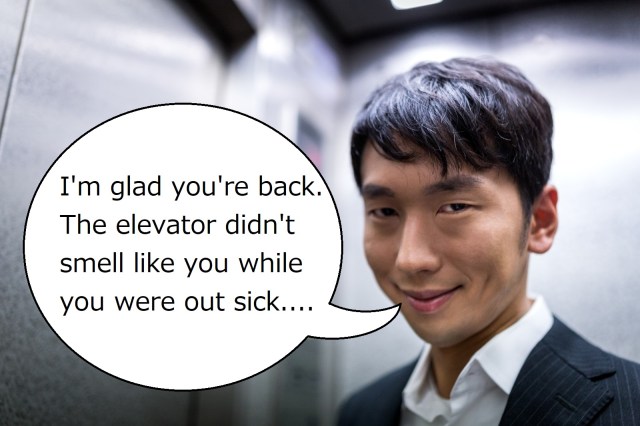
▼ Unless, of course, it was this creepy guy giving you unwanted massages at work.
Then feel free to use the original when you need to call out sick!
#2. Hapi basude! Karei wo tanoshinde
Intended meaning: “Happy birthday! Best wishes for your new year!”
Actual meaning: “Happy birthday! Enjoy aging!”
I’m not exactly sure what happened here, but it seems like an example of trying to be too fancy. The person probably learned a new word (karei meaning “aging”) and then decided to go ahead and use it in a situation where it doesn’t quite fit.
Just another reason why it’s always good to learn words in the context of a whole sentence, not just by themselves!
How to actually say it: Hapi basude! Ii ichinen wo!
#3. Naruhodo! Ippon ushinaimashita
Intended meaning: “I see! Can’t argue with that.”
Actual meaning: “I see! I lost a long cylindrical object.”
This one is a classic case of messing up a word in an idiom. The phrase here should be ippon toraremashita, which means something like “can’t argue with that.” It literally means “one match was taken from me,” as if the person you’re speaking to is an opponent in a duel and they’ve won this round.
However, the speaker here replaced toraremashita (“was taken”) with ushinaimashita (“lost”). With the second half of the idiom changed, the first part suddenly makes no sense either. Ippon can mean anything from “one bottle” to “one home run,” so without the second part of the idiom to give it meaning, it’s just kind of floating there awkwardly with a generic meaning.
It’s kind of like the English phrase “kick the bucket.” As a whole idiom, it means “to die,” but if you change it to “punch the bucket,” suddenly it doesn’t make much sense.
How to actually say it: Naruhodo! Ippon toraremashita.
#4. Tanondemonai chansu ureshii desu
Intended meaning: “I’m happy to have this chance that I didn’t even ask for.”
Actual meaning: “I’m happy to have this chance that I didn’t even want.”
Tanondemonai means “didn’t ask for,” but it usually has a negative connotation, as in “I didn’t ask for this to happen!”
So for them to say that they were happy about this chance that they “didn’t ask for,” it sounds like they’re happy for a chance that they didn’t even want in the first place… which would probably just make the Japanese listener cock their head in confusion.
How to actually say it: Negattemonai chansu usreshii desu
▼ The average Japanese reaction when trying to decode these phrases so far.
#5. Totemo janai ga tanoshii
Intended meaning: “It’s fun in its own way.”
Actual meaning: “Not very, but fun.”
I’m not exactly sure what happened here, but it might just be that the speaker isn’t very experienced in the language, or they had a bit of a brain-fart. Hey, it happens to everyone sometimes!
At least they can rest assured that while their sentence might not be pretty, it at least likely conveyed what they wanted it to.
How to actually say it: Sorenari ni tanoshii.
#6. Wakatta totan ni oshiete
Intended meaning: “Let me know as soon as you find out.”
Actual meaning: “Let me know as soon as the thought enters your brain.”
Totan is a word that is often translated into English as “as soon as.” Usually that’s fine, you can say things like: “As soon as I saw him, I started waving.”
But the thing is that with totan, it literally means “as soon as.” So rather than letting any amount of time pass between “finding out” and “letting me know,” rather this speaker made it sound like they wanted the person to tell them as soon as “the thought came into their brain.”
How to actually say it: Wakattara sugu ni oshiete.
#7. Totemo tekitō na fuku desu ne!
Intended meaning: “Those clothes are very suitable for you!”
Actual meaning: “Those clothes are very whatever!”
Tekitō is a word that throws off a lot of Japanese learners. Its meaning is “suitable,” but often it’s closer to “adequate/good enough/whatever.” It’s can be used in sentences like “I just made whatever for dinner, but it was surprisingly good.” So it’s not the greatest compliment for someone’s clothes.
Yet again, we see how relying too much on English definitions can cause misunderstandings in Japanese.
How to actually say it: Totemo niatteiru fuku desu ne!
▼ Consider this a PSA to learn your words in context, everyone!

At the end of the day, it’s important to make mistakes when learning a foreign language. Making mistakes is the first step toward not making mistakes, and it’s impossible to get good at something without kind of sucking at it first.
And on the plus side, while most of these mistakes were funny or awkward, sometimes the language mistakes that foreigners make can be downright inspiring.
Source: Twitter/@hashishi_ via Hachima Kiko
Top image: GAHAG (Edited by SoraNews24)
Insert images: Pakutaso (1, 2, 3) (Edited by SoraNews24)
 Japanese Twitterers share entertaining anecdotes of their experiences with foreigners
 “Good on the floor?” Five funny times Google Translate drops the ball with Japanese idioms
 Fake police phone scam also highlights dumb stereotype about how foreigners speak Japanese[Video]
 U.S. college student learns the hard way to get your Japanese kanji tattoo checked by an expert
 Foreigners misreading Japanese kanji of “two men one woman” is too pure for Japanese Internet
 Mt. Fuji decorated with a 500,000-flower pink carpet is Japan’s ultimate spring view
 30 Pikachus want to share a Tokyo hotel room with you that has separate Grass, Water, Fire spaces
 New Travelling Bento pouches turn your luggage into a Japanese lunch box
 Japan’s prime minister exchanges Dragon Ball kamehamehas with president of France[Video]
 How a samurai’s quest for revenge created one of Tokyo’s best cafes, and it’s still open
 Totoro ocarinas on sale from Ghibli Museum online shop, and no two are exactly alike【Video】
 Popular Japanese ramen restaurant Ichiran’s lucky bags are great value for money
 The 5 best entry-level roadside stations in Japan’s Kanto Region, according to experts
 Crafting an easy hands-free umbrella with a few ordinary household items
 McDonald’s and Gundam team up for customized anime mecha and fried chicken sandwiches[Video]
 Japan reportedly adding Japanese language skill requirement to most common foreigner work visa
 Pokémon and Ikea Japan cross over into each other’s worlds with collaboration events
 Starbucks Japan closing only Shinkansen platform branch for popularity-triggered renovations
 You can assemble a well-balanced team of Pokémon, them eat them, thanks to Japanese cake chain
 Two food hacks take Japan’s convenience store fried chicken to amazing new sandwich heights
 7-Eleven Japan’s new baked-in-store sweet treat is only available in three parts of the country
 Man bites woman at cherry blossom park in Japan, dies shortly after
 Peanuts and Coke becomes a viral hit in Japan, but is it a trend worth joining?
 Can a downtown Tokyo super sento bathhouse beat a hotel for a one-night stay?
 New Japanese KitKats come in sakura flavour, with poetic symbolism for success
 Japan now has a special desk for people who work at home with a pet cat[Photos]
 Famous Tokyo cherry blossom spot installs view-blocking screens to fight overcrowding[Video]
 Uniqlo announces new T-shirts for One Piece, Naruto and more for manga publisher’s 100th birthday
 Train station platform ramen store closes its doors on half a century of history in Tokyo
 Starbucks Japan releases new My Fruit³ Frappuccino at only 34 stores around the country
 Krispy Kreme releases Super Mario doughnuts in Japan for a limited time
 Studio Ghibli releases Catbus pullback keychain that runs like the anime character
 Japanese onsen egg maker from 100-yen store Daiso needs to be on your shopping list
 Survey asks foreign tourists what bothered them in Japan, more than half gave same answer
 Japan’s human washing machines will go on sale to general public, demos to be held in Tokyo
 Starbucks Japan releases new drinkware and goods for Valentine’s Day
 We deeply regret going into this tunnel on our walk in the mountains of Japan
 Starbucks Japan releases new sakura goods and drinkware for cherry blossom season 2026
 Studio Ghibli releases Kodama forest spirits from Princess Mononoke to light up your home
 Japan’s newest Shinkansen has no seats…or passengers [Video]
 Major Japanese hotel chain says reservations via overseas booking sites may not be valid
 Put sesame oil in your coffee? Japanese maker says it’s the best way to start your day【Taste test】
 No more using real katana for tourism activities, Japan’s National Police Agency says
 The thin line between asking a woman why she likes bags and why she likes doggy style in Japanese
 English conversation school in Japan has clever reminder that students don’t have to be perfect
 10 things foreigners do that Japanese people find amusing
 Mistaking “vertical” for “horizontal” readings in Japanese can have hilarious consequences
 12 strange Japanese names for Western sports, from “fighting ball” to “reject ball”
 Japanese Twitter user embarrassed to learn why American friend is studying Japanese, not Chinese
 Genius shares the magic phrase to instantly shut down sales pitches in Japan
 Busty Japanese brushstroke calligraphy artist shares visual appeal in video series【Videos】
 The Japanese you learn at school vs the Japanese used in Japan【Video】
 Foreign shop clerk and Japanese customer fail to communicate because of Japanese language quirk
 Kanji Tetris is the coolest way to practice and play with Japanese that we’ve ever seen【Video】
 Why Does Engrish Happen in Japan? 30-year-old fart-related signage mistake edition
 Japanese student’s “drug dealer” English gaffe confuses foreign ALT
 Wait, the Japanese word daijoubu can mean both “yes” and “no?” Why? HOW?!?
 W.T.F. Japan: Top 5 most confusing Japanese counter words【Weird Top Five】