
Ah, the wonders of learning a second language. There’s much to be said for the sense of satisfaction and achievement that comes from communicating effectively in another tongue. There’s also much to be said about the head-scratching and sense of humility that comes from tripping up and sounding like a buffoon.
We’ve found 10 tweeted tales of confusion from Japanese people who’ve had amusing encounters with foreigners in Japan. Some strike such a chord with Japanese that they’ve been retweeted and shared hundreds, sometimes even thousands of times.
So what is it that we foreigners do that’s so amusing?
1. We still run into trouble even if we speak Japanese
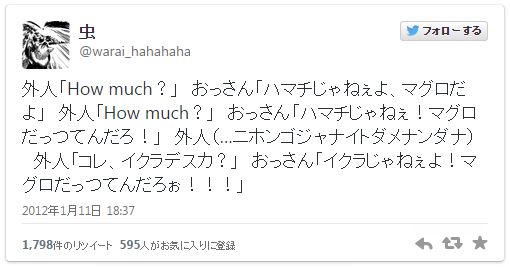
The following conversation was overheard by a Japanese Twitter user at the fish shop:
Foreigner [speaking English]: “How much?” Fish Monger [speaking Japanese]: “That’s not hamachi (Japanese amberjack), that’s maguro (tuna)“. Foreigner: “How much?” Fish Monger: “I told you, that’s not hamachi, that’s maguro“. Foreigner [switching to Japanese]: “Ikura desu ka?” Fish Monger: “That’s not ikura (red caviar), that’s maguro!!”
Point! ☞´◔‿ゝ◔`)☞: “How much?” sounds like hamachi, the Japanese word for amberjack, while “ikura desu ka?” can mean both “How much is it?” and “Is it red caviar?” in Japanese. Who knew that fish lingo could be so confusing?
2. We use sensitive Japanese words with careless abandon
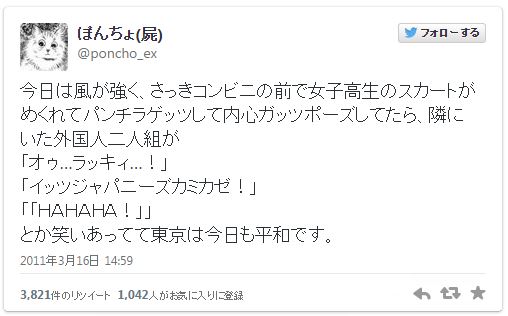
The below tweet reads: “I was outside a convenience store and a strong wind blew up the skirt of a Japanese high school girl, momentarily exposing her underwear. A couple of foreigners standing next to her said, ‘Wow, lucky!’ to which the other foreigner replied ‘It’s the Japanese kamikaze!’ They laughed and Tokyo is still at peace.”
Point! ☞´◔‿ゝ◔`)☞: Foreigners today might use the word Kamikaze in the literal sense of Divine Wind, particularly in situations when the wind blows to our benefit. Of course, the kamikaze were originally suicide attacks by Japanese on foreigners and something that neither side of the Pacific would have taken so lightly.
3. We’re very affectionate, even from a young age
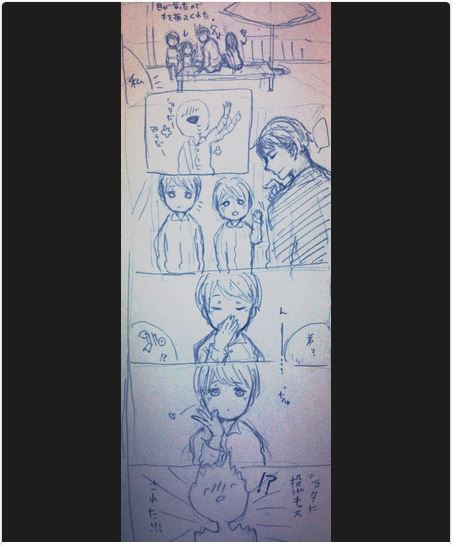
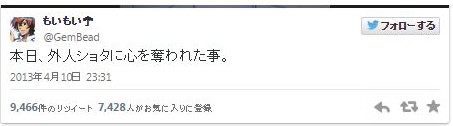
This Twitter user was so shocked by an affectionate gesture he witnessed, he recreated the moment in manga form. A small child, with his parents, looked over and locked eyes with him so he waved at the cute kid. The child responded by blowing him a big kiss.
Point! ☞´◔‿ゝ◔`)☞: While it’s quite natural for westerners to blow kisses and playfully “catch” kisses from children as a fond farewell, in Japan this type of gesture would only be between lovers, which made for an awkwardly romantic moment for this Japanese passer-by.
4. We wear t-shirts with hugely inappropriate messages on them
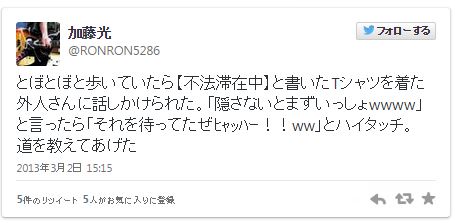
“I was walking down the street and saw a foreigner wearing a shirt that said 【不法滞在中】. I stopped and told him it was bad taste to advertise the fact that he’s staying here illegally. He said ‘That’s what I’ve been waiting for!’ and gave me a high five.”
Point! ☞´◔‿ゝ◔`)☞: Fuhoutaizaichuu means “[I’m] staying here illegally”. While we might think a funny shirt like this would get a giggle from passers-by, sarcasm isn’t a common form of humour in Japan so be prepared for things to be taken seriously. That being said, Japanese TV presenters have been caught wearing some shocking English expressions on their own T-shirts recently, so let’s not be too quick to judge!
5. We get upset when people assume we don’t speak Japanese
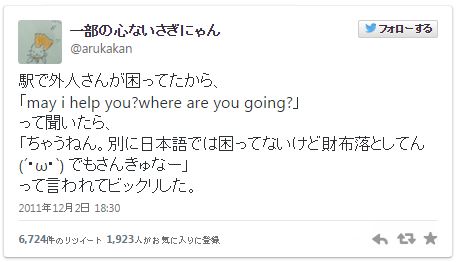
“I saw a foreigner who looked perplexed at the station, so I asked him, ‘May I help you? Where are you going?’. I was shocked by the reply: ‘No I don’t have any problem with Japanese but I’ve lost my wallet. Thank you, though’.”
Point! ☞´◔‿ゝ◔`)☞: Japanese English-speakers aren’t always shy when it comes to using English to help confused-looking foreigners. In fact, they’re often thrilled to have a chance to use it. The only problem is, they won’t know if they’re speaking to a lost tourist who’s just arrived in the country or a resident who’s lived here for decades and has a chip on their shoulder!
6. For native speakers, sometimes we’re not so hot at the English
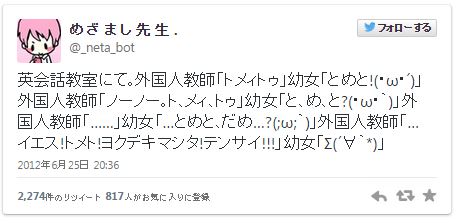
“At an English conversation class, the foreign instructor said ‘to-mei-to’ when pronouncing the word “tomato”. A young female student repeated enthusiastically, ‘to-me-to!’ To which the foreign instructor said, ‘No, no – it’s “to-mei-to”.’ The girl repeated ‘to-me-to?’ The foreigner was silent and then the girl asked, ‘Is to-me-to incorrect?’ The foreigner replied, ‘Yes, it’s to-me-to! Well done! Correct!’ And the girl was confused but relieved.”
Point! ☞´◔‿ゝ◔`)☞: While there are clearly defined pronunciations in the Japanese language, English is a whole different ball-game, where Americans say “to-mei-to”, the British say “to-ma-to” and the Japanese often say “to-me-to” when affecting an American accent, but “to-ma-to” in Japanese. Is one of them incorrect? Let’s call the whole thing off.
7. We all love ninja (or so the Japanese think)
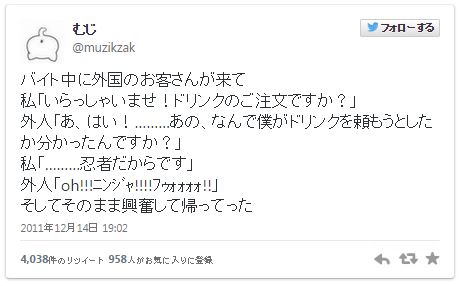
“At my part-time job, a foreign customer came in so I said, ‘Welcome! Would you like to order a drink?’ The foreigner said ‘Oh, yes! Umm, how did you know I wanted to order a drink?’ I replied, ‘Because I’m a ninja.’ He said, ‘Oh ninja! Hahahaha’ and then walked out.”
Point! ☞´◔‿ゝ◔`)☞: Capable of extraordinary feats of strength and armed with gadgets James Bond couldn’t have even dreamed of, is it any wonder we’re fascinated with the legend of the ninja? Just don’t put us in a pigeon-hole and make it the first thing you talk to us about. Or else we’ll make like a ninja and disappear.
8. We think the Japanese will eat anything
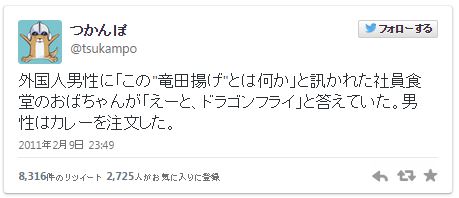
“A foreigner asked the canteen lady ‘What’s in the Tatsuta-age?’ She replied, ‘Um, dragonfly.’ He ordered the curry instead.”
Point! ☞´◔‿ゝ◔`)☞: Tatsuta-age is a deep-fried dish containing fish or meat. It also contains the character for tatsu, meaning dragon, in its reading. Chances are, this canteen lady looked at the kanji characters and offered a literal translation of the dish, which, due to the difficulty most Japanese people have differentiating between L and R, probably came out sounding like “dragon fly” rather than “dragon fry”. It’s OK, everyone; the Japanese do eat some pretty funky stuff from time to time, but they don’t eat dragonflies.
9. We have bottomless stomachs
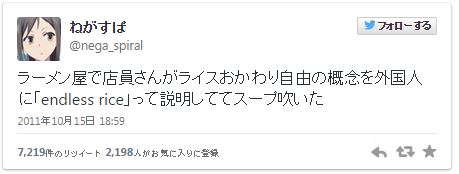
“A worker at the ramen shop explained the concept of okawari jiyuu to foreigners as ‘endless rice’.”
Point! ☞´◔‿ゝ◔`)☞: okawari jiyuu means free refill, but that doesn’t mean it’s an endless supply! Foreigners are known for their hearty appetites so promising an endless supply could be an unwise business decision.
10. We have a weird sense of humour
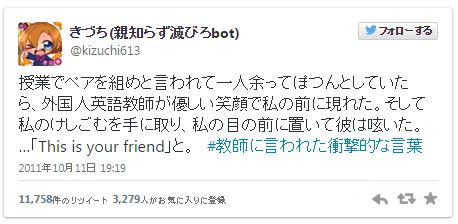
“During class, when our teacher asked us to make pairs, I was left standing there alone without a partner. The foreign instructor appeared in front of me with a kind smile. He picked up my eraser and put it in front of me. ‘This is your friend’, he said.”
Point! ☞´◔‿ゝ◔`)☞: It’s not uncommon to use humour to cope with awkward situations, but sometimes that’s when we start digging a hole for ourselves that we can’t get out of, and our jokes don’t always translate well for non-native speakers.
While our quirks and idiosyncrasies might amuse our Japanese counterparts, it’s all a necessary part of negotiating difference in the often treacherous world of cross-cultural communication. While we might be different, the goal is communication and as long as we continue to do that, we might all just be able to get along!
If you’ve ever had any funny or awkward language-related experiences in Japan, share your story in the comments section below!
Source: Curazy
Top image: Nicosasso Photobucket