

Linguistics professor explains the centuries-old background of the omnipresent anime and manga verbal tic.
If you’re studying Japanese, three of the first words you’ll learn are arimasu, imasu, and desu. While they all more or less translate into English as “be,” they’re used for different situations in Japanese.
Arimasu is for showing the existence or location of inanimate objects. For example, if you wanted to say “Mt. Fuji is in Japan,” you’d say “Fujisan ha Nihon ni arimasu.” Imasu, on the other hand, is for the existence/location of people and animals. So for “I am in Japan,” it’d be Watashi ha Nihon ni imasu.” And finally, desu is used with adjectives that describe the condition of things or people. “Mt. Fuji is beautiful” is “Fujisan ha kirei desu,” and, if you’re confident enough to make the same boast about your own fetching good looks, it’d be Watashi ha kirei desu.”
But in the world of anime and manga, if the scriptwriter or author is creating dialogue for a Chinese character who’s supposed to be less than fluent, there’s a better-than-even chance the character will completely bypass imasu and desu and just use arimasu, or it’s more casual version, aru, for everything. Instead of the grammatically correct “Watashi ha Chugokujin desu” (“I am Chinese”), you’ll often hear Chinese characters saying “Watashi ha Chugokujin arimasu.”
The weird thing, though, is that you’ll rarely, if ever, hear actual Chinese learners of Japanese putting arimasu at the end of everything like this. So where does this stock speaking style for anime and manga come from? According to Satoshi Kinsui, a linguistics professor at Osaka University, it comes from history.
Manga artist Hebizo and author Umino Nagiko asked Kinsui about the “Chinese people say arimasu” stereotype as part of the research for their new book, Nihonjin no Shiranai Nihongo 3 (“Japanese Language that Japanese People Don’t Know 3”). Kinsui says this overreaching use of arimasu has its roots in the mid-19th century, as Japan’s feudal Edo period was coming to an end and the modernization of the Meiji period was beginning.
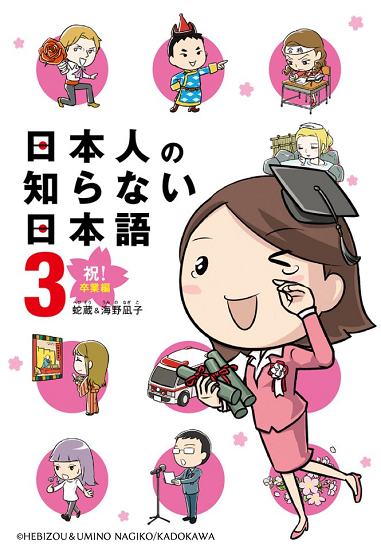
▼ Cover of Nihonjin no Shiranai Nihongo 3
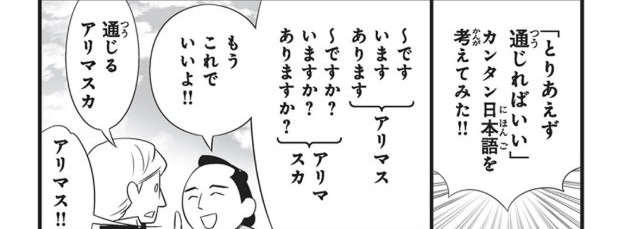
With Japan finally opening up to international trade and relations after centuries of government-mandated isolation, there was a sudden influx of foreigners coming into the country. However, this was long before online dictionaries, budget-priced phrasebooks, or other easy ways to bridge low-to-moderate language barriers. So instead, a simplified, pidgin-like version of Japanese came about, in which arimasu, imasu, and desu all got lumped together as arimasu.
▼ One of Hebizo’s illustrations for the book, showing a topknotted Japanese local explaining to a light-haired Westerner that he can still make himself understood even if he lumps desu (です), imasu (います), and arimasu (あります) all together as just arimasu.
But as the caricatured Kinsui himself points out, this form of simplified Japanese was used by foreigners of many different nationalities, not just those who spoke Chinese as their native language. So why has the verbal tick been attached so firmly to Chinese anime characters?
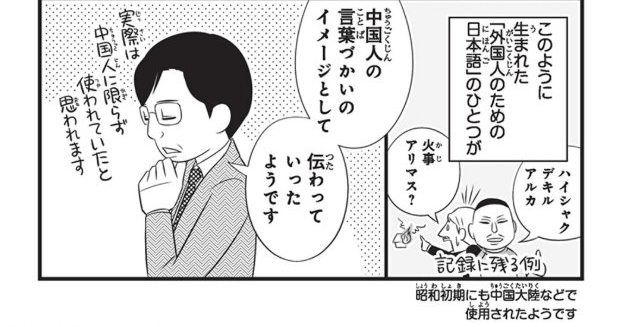
Kinsui himself doesn’t address the question, but a couple of possibilities come to mind. First, Kinsui mentions that the “everything is arimasu” style of pidgin also seems to have been used in Japanese-occupied China, with the Imperial Japanese Army holding on to those territories until the end of World War II. On the other hand, few foreigners were coming into Japan during its era of military aggression. Once the war was over many of the foreigners in the country were part of the occupying Allied Forces, and the balance of power became such that Japanese businessmen and politicians were now expected to be able to communicate in English for international affairs. That would make the era of arimasu-style pidgin a few decades more recent among native speakers of Chinese than other languages, and could be why Chinese anime characters are so much more likely than any other ethnicity to speak that way.
▼ A selection of pages from Nihonjin no Shiranai Nihongo 3
アニメの博士はなぜ「~じゃ」と話すのか。謎の中国風キャラはなぜ「アルヨ」と話すのか。実際にそんな人見たことないのに!
— 蛇蔵@天地創造デザイン部8巻発売中 (@nyorozo) November 3, 2018
という疑問に答える漫画を描いたことがあるのでどうぞ。https://t.co/hXaliIfPXc pic.twitter.com/XrMg1MvHqV
There’s also the practice that when looking for dialogue-based ways to emphasize a character’s foreignness, if said character is from a Western background, anime creators often just have the character speak English, or pepper their Japanese dialogue with English vocabulary that Japanese audiences will be at least somewhat familiar with. English is a required subject in Japanese schools, and loanword-loving Japanese has adopted a large number of English terms, so it’s a simple matter to have, for example, an American character suddenly say “Great!” instead of “Ii na! or “Me ha very happy desu,” instead of “Watashi ha totemo shiawase desu.”
Doing that makes the character still sound foreign, but also leaves the dialogue understandable to a Japanese audience (even if the English isn’t being used like an actual English-speaker would use it). But with the average Japanese person far less familiar with basic Chinese vocabulary, that’s not a viable dialogue-writing option, leaving many creators falling back on just slapping arimasu at the end of Chinese characters sentences.
▼ English being a required subject also no doubt makes it easier to ask anime voice actors to power through a few lines of English dialogue than to do the same with Chinese.
Granted, anime and manga are first and foremost entertainment media, and having a simple way of telling he audience “This person isn’t a Japanese national” lets creators quickly move on to what they want to focus their storytelling on. Still, the fact that real world Chinese natives who’re learning Japanese don’t put arimasu at the end of all their sentences can be irksome and distracting for anyone who’s spent much time around learners of Japanese as a second language.
Source: Nihonjin no Shiranai Nihongo 3, Twitter/@nyorozo
Top image: Pakutaso
Insert images: Nihonjin no Shiranai Nihongo 3, Twitter/@nyorozo
[ Read in Japanese ]
Follow Casey on Twitter, where he has to admit he is fond of using the word “GET!” when speaking Japanese.
 Why does Japanese writing need three different sets of characters? (Part 2)
 How to respond to Japanese people saying “I don’t speak English” when you’re speaking Japanese?
 Why does Japanese writing need three different sets of characters? (Part 1)
 Some thoughts on Netflix’s Evangelion anime translation controversy, like, and love
 What’s the best Rumiko Takahashi anime of all time? Fans decide, pick best characters too【Survey】
 Lawson convenience store at popular tourist site is one of the most unusual in Japan
 Krispy Kreme Japan giving free donuts with morning drink purchases at all branches, maybe forever
 Häagen-Dazs brings back its popular mochi ice cream line with two classic, luxurious flavors
 Train station platform ramen store closes its doors on half a century of history in Tokyo
 Regular cup noodle bowls not enough for you? Try this 2000+ calorie instant yakisoba instead!
 We slide down Osaka’s most famous tower and get free curry for it
 New Japanese KitKats come in sakura flavour, with poetic symbolism for success
 Foreign man arrested for walking on Shinkansen tracks, claims he was on the run from yakuza
 New 7-Eleven sandwich goes viral in Japan, but is it everything it’s cracked up to be?
 Is there a busty schoolgirl hiding in Japan’s bullet train symbol?
 Japan reportedly adding Japanese language skill requirement to most common foreigner work visa
 Pokémon and Ikea Japan cross over into each other’s worlds with collaboration events
 Mt. Fuji decorated with a 500,000-flower pink carpet is Japan’s ultimate spring view
 Starbucks Japan closing only Shinkansen platform branch for popularity-triggered renovations
 You can assemble a well-balanced team of Pokémon, them eat them, thanks to Japanese cake chain
 Two food hacks take Japan’s convenience store fried chicken to amazing new sandwich heights
 30 Pikachus want to share a Tokyo hotel room with you that has separate Grass, Water, Fire spaces
 7-Eleven Japan’s new baked-in-store sweet treat is only available in three parts of the country
 Man bites woman at cherry blossom park in Japan, dies shortly after
 Peanuts and Coke becomes a viral hit in Japan, but is it a trend worth joining?
 Japan now has a special desk for people who work at home with a pet cat[Photos]
 Famous Tokyo cherry blossom spot installs view-blocking screens to fight overcrowding[Video]
 Uniqlo announces new T-shirts for One Piece, Naruto and more for manga publisher’s 100th birthday
 Starbucks Japan releases new My Fruit³ Frappuccino at only 34 stores around the country
 Krispy Kreme releases Super Mario doughnuts in Japan for a limited time
 Japanese onsen egg maker from 100-yen store Daiso needs to be on your shopping list
 Studio Ghibli releases Catbus pullback keychain that runs like the anime character
 Survey asks foreign tourists what bothered them in Japan, more than half gave same answer
 Japan’s human washing machines will go on sale to general public, demos to be held in Tokyo
 Starbucks Japan releases new drinkware and goods for Valentine’s Day
 We deeply regret going into this tunnel on our walk in the mountains of Japan
 Starbucks Japan releases new sakura goods and drinkware for cherry blossom season 2026
 Studio Ghibli releases Kodama forest spirits from Princess Mononoke to light up your home
 Japan’s newest Shinkansen has no seats…or passengers [Video]
 Major Japanese hotel chain says reservations via overseas booking sites may not be valid
 Put sesame oil in your coffee? Japanese maker says it’s the best way to start your day【Taste test】
 No more using real katana for tourism activities, Japan’s National Police Agency says