
Three dragons and three clouds…A straight line…An upside-down “child”…What could they mean?
The Japanese language is written using three different systems: hiragana and katakana, which are phonetic, and kanji, which is made up of individual characters, each with its own meaning and a pronunciation that changes depending on the context. If you have studied Japanese, you’ll know that kanji is one of the most difficult parts of learning the language.
That’s true for Japanese people as well. In fact, did you know that there are kanji so old or so bizarre that no one can recognize them? Take, for example, this character:
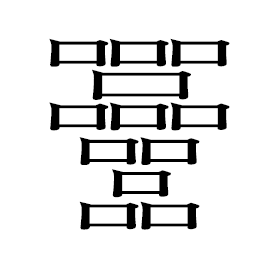
Though it looks like some kind of work of abstract art, this is a Japanese kanji that uses twelve of the “kuchi” radicals. “Radicals” are the individual parts of a character that each have meaning, and “kuchi” means “mouth.” Many people would say that this character, made up of 12 “mouth” radicals, is not a real character, but it is–it’s even listed in Japanese dictionaries!
You can find an example of its use in Uso Jidzukushi, a work by Edo-era novelist Shikitei Sanba. Have you figured out what it means? It’s read as “oshaberi,” which means “chatterbox” or “talkative”. How appropriate!
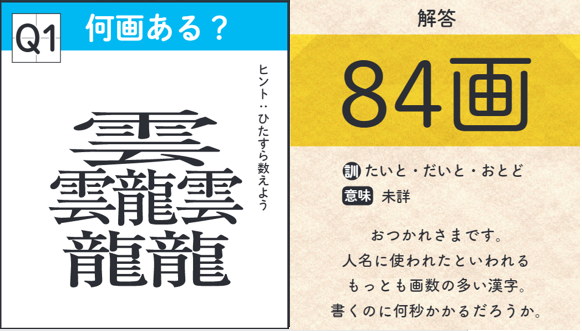
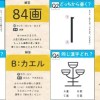
There are lots of other bizarre kanji out there. For example, the one shown above is made up of 84 strokes (the number of movements of a brush or pen needed to write the character), which is apparently the most out of any Japanese character. It’s composed of three characters for “cloud” and three characters for “dragon” mixed together. No one knows what it originally meant, but it was apparently used in people’s names.
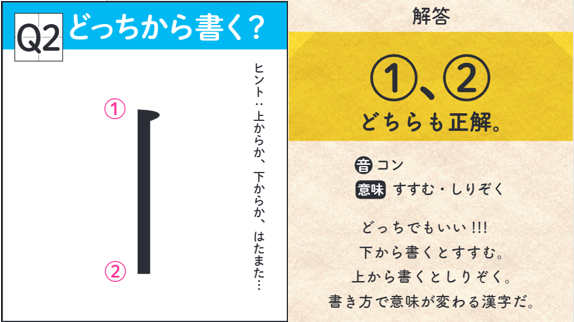
On the flip side, there’s this character, shown below, that’s just a single vertical line. But though it looks simple, it’s really not. When written from the bottom up, it means “to proceed”, but when written from the top down (as pictured below), it means “to withdraw”.
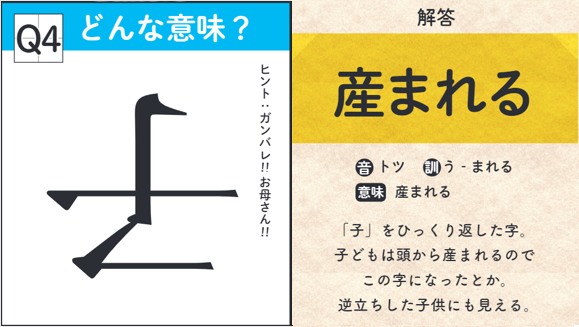
Some strange characters make a lot of sense, once you think about them. For example, the character for “child,” (子), turned upside-down was once used as “to be born”–since children are born head-first.
If this piques your interest, you’ll love the new book “Kimyona Kanji” (奇妙な漢字 “Strange Kanji”), which is where the above excerpts were taken from.
▼ Written by Kotoku Sugioka, the Japanese book was published by Poplar and released on January 11.
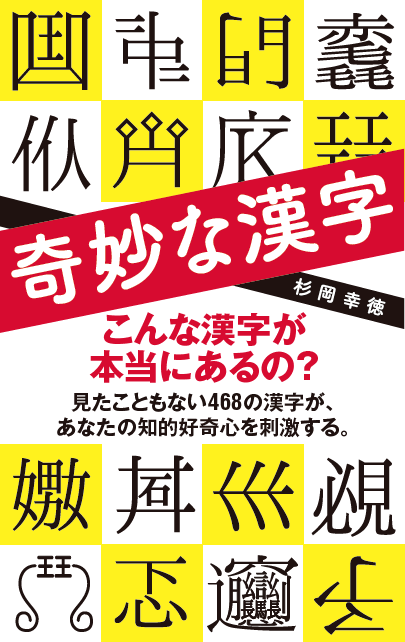
It’s a must-see for fans of kanji or linguistics. There are altogether 468 unusual kanji to explore, so it looks set to be a very interesting read! You can find it on Amazon Japan or Poplar’s official website for 990 yen (US$7.58).
And if you’re looking for more Japanese language fun, here are some really cool phrases to add to your vocabulary, or you can learn 11 different ways to say “father” in Japanese.
Source, images: PR Times
● Want to hear about SoraNews24’s latest articles as soon as they’re published? Follow us on Facebook and Twitter!
[ Read in Japanese ]
 Japanese government tells teachers not to be so strict, at least about some kanji radicals
 Cool design on Japanese posters lets you look at kanji upside-down for a whole new meaning
 German linguist living in Japan says kanji characters used for Germany are discriminatory
 Why is the Japanese kanji for “four” so frustratingly weird?
 Japanese study tip: Imagine kanji characters as fighting game characters, like in this cool video
 Mt. Fuji decorated with a 500,000-flower pink carpet is Japan’s ultimate spring view
 30 Pikachus want to share a Tokyo hotel room with you that has separate Grass, Water, Fire spaces
 Pringles Chocolate, but with a Japanese twist, is the snack hack you should be trying right now
 Howl’s Moving Castle’s scene-stealing dog is here to clean your home as a plushie mop
 Does a long line mean a sweeter deal? We compare two sweets from a Hokkaido food fair【Taste test】
 What does a kanji with 12 “kuchi” radicals mean? A look at weird, forgotten Japanese characters
 Japanese fashion company’s modernized haori half coats will keep you warm and samurai chic
 New Travelling Bento pouches turn your luggage into a Japanese lunch box
 Drink vending machines disappearing in Japan as number drops to lowest in 30 years
 Hey, 2020s kids! The ’90s have a sticker picture message waiting for you in Tokyo
 Japan reportedly adding Japanese language skill requirement to most common foreigner work visa
 Pokémon and Ikea Japan cross over into each other’s worlds with collaboration events
 Starbucks Japan closing only Shinkansen platform branch for popularity-triggered renovations
 You can assemble a well-balanced team of Pokémon, them eat them, thanks to Japanese cake chain
 Two food hacks take Japan’s convenience store fried chicken to amazing new sandwich heights
 7-Eleven Japan’s new baked-in-store sweet treat is only available in three parts of the country
 Man bites woman at cherry blossom park in Japan, dies shortly after
 Peanuts and Coke becomes a viral hit in Japan, but is it a trend worth joining?
 Japan now has a special desk for people who work at home with a pet cat[Photos]
 Famous Tokyo cherry blossom spot installs view-blocking screens to fight overcrowding[Video]
 Uniqlo announces new T-shirts for One Piece, Naruto and more for manga publisher’s 100th birthday
 Train station platform ramen store closes its doors on half a century of history in Tokyo
 Starbucks Japan releases new My Fruit³ Frappuccino at only 34 stores around the country
 Krispy Kreme releases Super Mario doughnuts in Japan for a limited time
 Japanese onsen egg maker from 100-yen store Daiso needs to be on your shopping list
 Studio Ghibli releases Catbus pullback keychain that runs like the anime character
 Survey asks foreign tourists what bothered them in Japan, more than half gave same answer
 Japan’s human washing machines will go on sale to general public, demos to be held in Tokyo
 Starbucks Japan releases new drinkware and goods for Valentine’s Day
 We deeply regret going into this tunnel on our walk in the mountains of Japan
 Starbucks Japan releases new sakura goods and drinkware for cherry blossom season 2026
 Studio Ghibli releases Kodama forest spirits from Princess Mononoke to light up your home
 Japan’s newest Shinkansen has no seats…or passengers [Video]
 Major Japanese hotel chain says reservations via overseas booking sites may not be valid
 Put sesame oil in your coffee? Japanese maker says it’s the best way to start your day【Taste test】
 No more using real katana for tourism activities, Japan’s National Police Agency says
 Why does Japanese writing need three different sets of characters? (Part 1)
 Why does Japanese writing need three different sets of characters? (Part 2)
 One simple kanji character in super-simple Japanese sentence has five different pronunciations
 Renowned Japanese calligraphy teacher ranks the top 10 kanji that foreigners like
 Japan’s kanji character of the year for 2017 is “north”
 W.T.F. Japan: Top 5 kanji with ironic meanings【Weird Top Five】
 Kanji Tetris is the coolest way to practice and play with Japanese that we’ve ever seen【Video】
 W.T.F. Japan: Top 5 strangest kanji ever 【Weird Top Five】
 Japan’s Kanji of the Year announced for 2021, and it’s a familiar choice
 W.T.F. Japan: Top 5 kanji with the longest readings 【Weird Top Five】
 Japan announces Kanji of the Year for 2019, and it was really the only logical choice
 Flipping the kanji for “husband” upside-down reveals slightly worrying double meaning
 U.S. college student learns the hard way to get your Japanese kanji tattoo checked by an expert
 The extremely violent backstory of how to write the word “take” in Japanese
 Students of Japanese despair – you’ve probably been writing some of the simplest kanji wrong
 Japan’s Kanji of the Year revealed, reflects both the good and the bad of 2022