
Depending on the second language you’re trying to master, pronunciation is arguably the hardest aspect to conquer. The Japanese and English languages are no exception. Japanese, with its highly syllabic alphabet, often has a hard time accommodating the often chaotic nature of natural English pronunciation.
While a native English speaker’s tongue might stumble when trying to spit out makudonarudo (McDonald) smoothly the first few times our language allows us to pick it up with a little practice. Japanese English speakers have far more adversity trying to understand all the diminished sounds of a native English speaker casually uttering the name of the famous hamburger chain.
With that, NTT has revealed technology it’s working on that may one day automatically correct a Japanese person’s English pronunciation by editing the speed and rhythm while keeping the original speaker’s voice intact.
This technology, along with several other projects, was put on display at NTT Communication Science Laboratories’ Open House 2013 on 6 and 7 June. Here, the center’s director, Eisaku Maeda, reminded everyone that these products are still very far away from hitting the market but the institute wanted to give people a hands-on experience with future technology.
To give an example of how it works, let’s say a Japanese person spoke the English sentence:
“I will choose the pink one.”
Depending on the person’s abilities it may come out as:
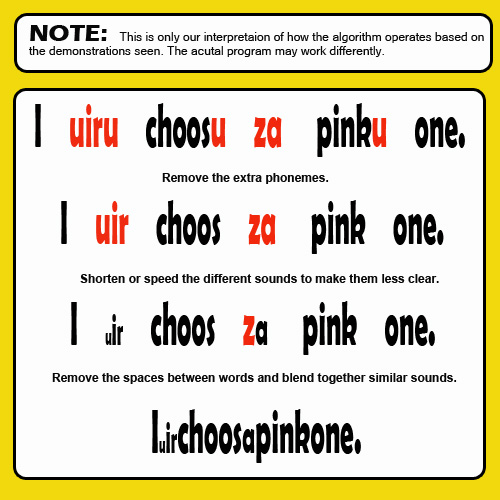
“I uiru choosu za pinku one.”
When this voice hits the machine, it will first decode what was being said and then edit the sound data to fit what a native speaker would sound like. Presumably, this is done by editing out the extraneous vowel sounds such as the “u” at the end of pinku. They might also fix up the “l” and “wi” sounds by simply shortening them.
Finally they would just edit out any gaps between words and connect similar sounds like the “s” at the end of “choose” and the “th” at the beginning of “the.” With all the edits made the end result should sound in the words of NTT “native-like.”
The biggest challenge of this project is for the software to accurately make out what the second language speakers are saying. For this, they are also developing highly accurate speech recognition technology.
NTT says that the speech recognition they are currently developing has a 17.9 percent error rate – considerably lower than the 30.1 percent rate of currently existing technology. This is accomplished by an algorithm which loops through the audio data and can “learn” the speaker’s particular habits or accents. This also improves the program’s ability to filter out noise from the data with a high degree of accuracy.
It’s unclear to what end this pronunciation smoother would do aside from clear up confusion in foreign restaurants on whether Japanese people want a beer or the bill. NTT is considering if it would be useful for international business presentations and teleconferences.
It could be useful simply as a training device. Hearing your own voice speaking with “perfect” pronunciation could be a good source of motivation to keep up the rigorous vocal training needed for Japanese people interested in eliminating as much accent from their speaking as possible.
Source: IT Media News (Japanese)
NTT Communication Science Laboratories (English/Japanese)
 Pronunciation anxiety: many Japanese people don’t want to speak English unless it’s “perfect”
 The science behind why English speakers can’t pronounce the Japanese “fu”
 “Japanese English” can baffle native English speakers — but what about Korean speakers? 【Video】
 The reason why Japanese students don’t pronounce English properly
 Japanese elementary school student teaches us all how to pronounce English like a native speaker
 Pokémon and Ikea Japan cross over into each other’s worlds with collaboration events
 You can assemble a well-balanced team of Pokémon, them eat them, thanks to Japanese cake chain
 Japan’s full-facemask Ninja Parka still lets you eat ice cream[Photos]
 Can a downtown Tokyo super sento bathhouse beat a hotel for a one-night stay?
 Starbucks Japan closing only Shinkansen platform branch for popularity-triggered renovations
 What’s the best way to spend 1,000 yen at Kura Sushi?【Japan Super Budget Dining】
 Tokyo turns its phone booths into free Wi-Fi hotspots, and here’s how to use them
 Does this video about an abandoned dog leave you wiping your eyes or shaking your fist?
 Epic melon pancakes found at hidden cafe in Tokyo
 Jamiroquai doll from Japan lets you control your own Virtual Insanity 【Video】
 Tokyo’s best museum for foreign travelers finally reopens after being closed for four years
 Pokémon lacquerware series expands for Year of the Horse with new handcrafted design[Video]
 Famous Tokyo cherry blossom spot installs view-blocking screens to fight overcrowding[Video]
 Tokyo subway and almost all Tokyo train lines now accepting credit card tap payments
 Fading Tokyo – Searching for signs of the Showa era as local neighborhoods evolve[Photos]
 Totoro Fund line of beautiful artwork and apparel lets you help the real-world Totoro Forest
 Two food hacks take Japan’s convenience store fried chicken to amazing new sandwich heights
 Studio Ghibli adds new My Neighbour Totoro 2026 Corn Gift to its anime store for Mother’s Day
 Japan now has a special desk for people who work at home with a pet cat[Photos]
 Uniqlo announces new T-shirts for One Piece, Naruto and more for manga publisher’s 100th birthday
 Train station platform ramen store closes its doors on half a century of history in Tokyo
 Starbucks Japan releases new My Fruit³ Frappuccino at only 34 stores around the country
 Studio Ghibli releases Catbus pullback keychain that runs like the anime character
 Krispy Kreme releases Super Mario doughnuts in Japan for a limited time
 Japanese onsen egg maker from 100-yen store Daiso needs to be on your shopping list
 Nine great places to see spring flowers in Japan, as chosen by travelers (with almost no sakura)
 Survey asks foreign tourists what bothered them in Japan, more than half gave same answer
 Japan’s human washing machines will go on sale to general public, demos to be held in Tokyo
 Starbucks Japan releases new drinkware and goods for Valentine’s Day
 We deeply regret going into this tunnel on our walk in the mountains of Japan
 Studio Ghibli releases Kodama forest spirits from Princess Mononoke to light up your home
 Starbucks Japan releases new sakura goods and drinkware for cherry blossom season 2026
 Japan’s newest Shinkansen has no seats…or passengers [Video]
 Major Japanese hotel chain says reservations via overseas booking sites may not be valid
 Put sesame oil in your coffee? Japanese maker says it’s the best way to start your day【Taste test】
 No more using real katana for tourism activities, Japan’s National Police Agency says
 Japanese, Korean, and Chinese speakers pronounce English words in their native languages 【Video】
 How to say every Japanese car brand’s name, and what they mean 【Video】
 Learners beware! Even Japanese people agree that their language can be really ambiguous
 “Same sh*t different day” – Nice Japanese people swearing in English 【Video】
 “We wasted so much time in English class” — Japanese Twitter user points out major teaching flaw
 Nippon or Nihon? No consensus on the Japanese pronunciation of “Japan”
 Clever font sneaks pronunciation guide for English speakers into Japanese katakana characters
 Things Japanese people believe about British vs. American English
 Ridiculous Japanese TV program says English pronunciation is to blame for coronavirus spread【Vid】
 “Don’t touch my moustache!” Japanese that sounds like English but isn’t, and vice versa!
 To –san or not to –san? Should you use the Japanese honorific suffix when speaking English?
 Hachiji juppun mae – A Japanese phrase that even Japanese people can’t agree on the meaning of
 Wasei English: 20 Words of English Origin that Japanese People Often Mistake for the Real Thing
 Pokeberu, Mr. Legs, and cho beri ba: Eight Japanese words young people can’t understand
 Testing English “loan words” on people who don’t speak Japanese (Spoiler: they don’t make sense)
 Researchers use uniformity of Japanese language to read people’s minds