

As mentioned many times before on this site, the modern Japanese language uses a set of characters to represent foreign words called katakana. Such characters are used for foreign place names such a Beverly Hills (ビバリーヒルズ) or people like Mahmoud Ahmadinejad (マフムード・アフマディーネジャード).
However, this feature of Japanese has been criticized by some for allowing the purity of the language to be polluted by foreign influences. It can also cause confusion by creating English words that have different meanings than the original.
That being said, for foreigners visiting Japan with a limited knowledge of the language this list may prove invaluable. Excluding the obvious classics like “OK” (オケ) and “McDonald’s” (マクドナルド) here are some relatively newer loan words ranked by understandability in Japanese.
Here are the top ten words determined in a survey by NTT of over 1,000 people. The words are written in their original language, followed by their Japanese counterparts and the percentage of people who understood them.
10 – Context [77.4%]
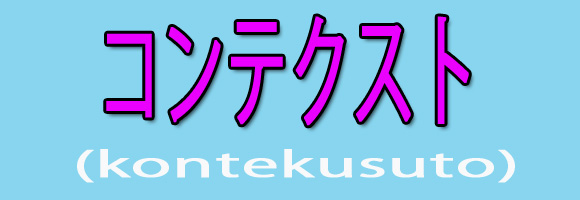
It seems like about 3/4 of Japanese people won’t need to guess the meaning of “context” from the context. However, if your Japanese grammar is limited it’s hard to image what context you could possibly use “context” in effectively.
9 – Buffer [78.0%]

Perhaps Japanese people know this word because in such a densely populated country, personal space is golden. Either that or this word might have been etched into the minds of those who had to suffer through streaming videos with dial-up modems.
8 – Scheme [79.2%]

I assume most people know of this word in the drier and more formal context of a plan or framework for things, rather than the sinister schemes concocted by supervillans.
7 – Milestone [81.4%]

They may not be able to tell you how far a mile is but they sure can tell you when a milestone has been reached in Japan.
6 – Paradigm [82.4%]

Indeed the power of this overused buzzword was so great that it has even spread into Japanese and caused a shift into a whole new… um, way of thinking.
5 – Budget [83.4%]

In Japanese this word is only really used in the sense of one’s projected spending. The other popular use of the word to express thrifty spending is much less popular here. So if anyone from the car rental agency is reading, you may want to hold off this market a little longer.
4 – Evidence [84.8%]

Evidence that detective novels are really popular around here. Actually, a lot of netizens who read the rankings seemed to feel that this was the katakana word they used the most.
3 – Alternative [89.5%]

The English “alternative” is used in Japanese in the sense of something different from mainstream like “alternative medicine” or “alternative education.” Even the ironically titled “alternative rock” that was anything but is used in Japanese. Yet, oddly enough, the band Pearl Jam is surprisingly not as well-known as you would expect. Go figure.
2 – Authorize [98.8%]
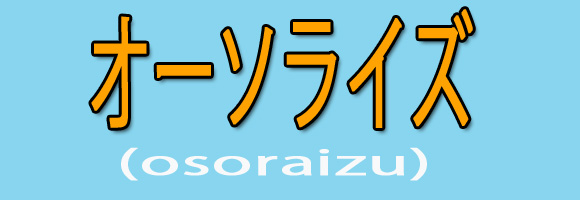
This is another English word that probably got etched into Japanese people’s heads as it flashed on the computer screen while they scrambled for their iTunes password that they hadn’t used in six-months.
1 – Agenda [100%]

I’m honestly a little surprised at the number one spot and a hundred percent understanding of this loan word. Something like “alternative” I could see being used in all walks of life, but “agenda” seems relegated to more formal contexts like business or education. Still, perhaps it is the way the word is constructed that makes it easily understandable in Japanese. Many of the top 10 words use unusual sounds in Japanese like V or TH, but “agenda” fits rather nicely in the Japanese phonics set.
By the way, the entire NTT survey ranked 45 words which we’ll print out at the end of the article. It would appear that they chose more recent words that crossed over only from English although katakana often uses German, Dutch, and Portuguese among others. In the meantime, if you happen to encounter a Japanese person who doesn’t speak English, just tell them “There is evidence we will have to authorize putting buffers into the alternative budget scheme in context of the milestone setting paradigm shift as mentioned on the agenda.”
Chances are they’ll know what you mean.
Source: Goo via My Game News Flash (Japanese)
45 – Manifesto [20.8%]
44 – Potential [27.5%]
43 – Vitality [28.1%]
42 – Constant [32.1%]
41 – Aggressive [32.7%]
40 – Response [33.7%]
39 – Neglect [37.2%]
38 – Minority [38.8%]
37 – Routine/ Routine Work [40.2%]
36 – Logic [40.8%]
35 – Alert (as in warning) [41.4%]
34 – Default [41.6%]
(as in both “failure to pay” and “original settings”)
33 – Wallet [42.8%]
32 – Compliance [45.1%]
31 – Resume (as in CV) [46.3%]
30 – Sector [46.3%]
29 – Resource [48.3%]
28 – Critical [50.9%]
27 – Feature [51.1%]
26 – Fact [51.1%]
25 – Brush Up [51.9%]
24 – Majority [54.7%]
23 – Priority [55.0%]
22 – Conference [55.6%]
21 – Benefit [59.6%]
20 – Commit/Commitment [62.6%]
19 – Agree [66.5%]
18 – Gimmick [68.3%]
17 – Summary [68.7%]
16 – Drastic [69.1%]
15 – Initiative [70.7%]
14 – Pending [70.9%]
13 – Consensus [72.3%]
12 – Incentive [74.7%]
11 – Governance [76.4%]
10 – Context [77.4%]
9 – Buffer [78.0%]
8 – Scheme [79.2%]
7 – Milestone [81.4%]
6 – Paradigm [82.4%]
5 – Budget [83.4%]
4 – Evidence [84.8%]
3 – Alternative [89.5%]
2 – Authorize [98.8%]
1 – Agenda [100%]
 10 Japanese words you know now that irritate some Japanese businessmen (because they’re English)
 Why there were 19 syllables in the Japanese word for “saxophone” during WWII
 Yahoo! Japan finds most alphabetic and katakana words Japanese people want to find out about
 The top 10 words to describe Japanese people (according to foreigners)
 Hachiji juppun mae – A Japanese phrase that even Japanese people can’t agree on the meaning of
 Pokémon and Ikea Japan cross over into each other’s worlds with collaboration events
 You can assemble a well-balanced team of Pokémon, them eat them, thanks to Japanese cake chain
 Japan’s full-facemask Ninja Parka still lets you eat ice cream[Photos]
 Can a downtown Tokyo super sento bathhouse beat a hotel for a one-night stay?
 Starbucks Japan closing only Shinkansen platform branch for popularity-triggered renovations
 What’s the best way to spend 1,000 yen at Kura Sushi?【Japan Super Budget Dining】
 Tokyo turns its phone booths into free Wi-Fi hotspots, and here’s how to use them
 Does this video about an abandoned dog leave you wiping your eyes or shaking your fist?
 Epic melon pancakes found at hidden cafe in Tokyo
 Jamiroquai doll from Japan lets you control your own Virtual Insanity 【Video】
 Tokyo’s best museum for foreign travelers finally reopens after being closed for four years
 Pokémon lacquerware series expands for Year of the Horse with new handcrafted design[Video]
 Famous Tokyo cherry blossom spot installs view-blocking screens to fight overcrowding[Video]
 Tokyo subway and almost all Tokyo train lines now accepting credit card tap payments
 Fading Tokyo – Searching for signs of the Showa era as local neighborhoods evolve[Photos]
 Totoro Fund line of beautiful artwork and apparel lets you help the real-world Totoro Forest
 Two food hacks take Japan’s convenience store fried chicken to amazing new sandwich heights
 Studio Ghibli adds new My Neighbour Totoro 2026 Corn Gift to its anime store for Mother’s Day
 Japan now has a special desk for people who work at home with a pet cat[Photos]
 Uniqlo announces new T-shirts for One Piece, Naruto and more for manga publisher’s 100th birthday
 Train station platform ramen store closes its doors on half a century of history in Tokyo
 Starbucks Japan releases new My Fruit³ Frappuccino at only 34 stores around the country
 Studio Ghibli releases Catbus pullback keychain that runs like the anime character
 Krispy Kreme releases Super Mario doughnuts in Japan for a limited time
 Japanese onsen egg maker from 100-yen store Daiso needs to be on your shopping list
 Nine great places to see spring flowers in Japan, as chosen by travelers (with almost no sakura)
 Survey asks foreign tourists what bothered them in Japan, more than half gave same answer
 Japan’s human washing machines will go on sale to general public, demos to be held in Tokyo
 Starbucks Japan releases new drinkware and goods for Valentine’s Day
 We deeply regret going into this tunnel on our walk in the mountains of Japan
 Studio Ghibli releases Kodama forest spirits from Princess Mononoke to light up your home
 Starbucks Japan releases new sakura goods and drinkware for cherry blossom season 2026
 Japan’s newest Shinkansen has no seats…or passengers [Video]
 Major Japanese hotel chain says reservations via overseas booking sites may not be valid
 Put sesame oil in your coffee? Japanese maker says it’s the best way to start your day【Taste test】
 No more using real katana for tourism activities, Japan’s National Police Agency says
 Japanese dictionary removes heteronormative definitions of love and sex
 Testing English “loan words” on people who don’t speak Japanese (Spoiler: they don’t make sense)
 Top 10 most irritating Japanese borrowed words – Part 2 (The people’s top 10)
 Why does Japanese writing need three different sets of characters? (Part 1)
 Learning Japanese? Beware these 19 loan words—they’re not what they sound like!
 Top 10 most irritating Japanese borrowed words
 Majority of surveyed Japanese teens don’t call parents by standard Japanese words for mom and dad
 The top 70 words that keep showing up in Japanese light novel titles (and yes, isekai is one of them)
 18 Japanese words understood around the world
 Japanese Twitter shares the funniest “mysterious Japanese” that they’ve heard from foreigners
 Why does Japanese writing need three different sets of characters? (Part 2)
 Wait, the Japanese word daijoubu can mean both “yes” and “no?” Why? HOW?!?
 10 things foreigners do that Japanese people find amusing
 Seven mistakes foreigners make when speaking Japanese—and how to fix them
 Foreigners misreading Japanese kanji of “two men one woman” is too pure for Japanese Internet