

Wait, what? These weren’t in chapter one of Genki….
If you’ve studied Japanese, then chances are you’ve seen the voicing marks (tenten in Japanese) that go above some hiragana. You’ve also probably encountered the little circles (maru in Japanese) that go above the hiragana for ha, hi, fu, he, ho, turning them into pa, pi, pu, pe, po.
But something you might’ve never seen before is the little circles being used with other hiragana, namely ka, ki, ku, ke, ko.
▼ Everything I thought I knew about Japanese is a lie….
They may look a little strange to learners of Japanese. How would you even pronounce them? P-ha, p-hi, p-fu?
Nope! These weirdos represent voiced nasal sounds and are pronounced similar to: nga, ngi, ngu, nge, ngo.
▼ Skip to 0:30 in this video to have a nice man in a hat pronounce the difference between the normal ga, gi, gu, ge, go and nga, ngi, ngu, nge, ngo.
Okay, so that’s great and all, but where are these hiragana used? And if they’re so cool, why aren’t students of language ever taught them?
Good questions! These voiced nasal sounds are mostly exclusive to the Eastern dialect of Japan in the Kanto and Tohoku regions (Tokyo, Fukushima, Aomori, etc.). In the Western regions (Hiroshima, Kyushu, etc.), the voiced nasal sounds don’t exist, and they somehow get along just fine with only ga, gi, gu, ge, go.
Since Tokyo Japanese is considered “standard” Japanese, news anchors and announcers have to go through rigorous voice training programs to ensure that they’re giving the “correct” nasal touch to their voiced sounds.
So if you want to sound like a fancy Tokyo-ite, then here’s a handy guide to when your ga, gi, gu, ge, gos should turn into nga, ngi, ngu, nge, ngos:
▼ Red represents the voiced nasal (ng),
and blue represent the normal voiced (g).
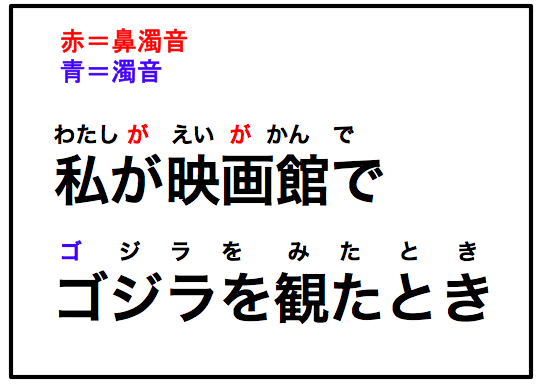
▼ The voiced nasal is used for the particle ga, and for every
ga, gi, gu, ge, go sound that doesn’t come at the beginning of a word.
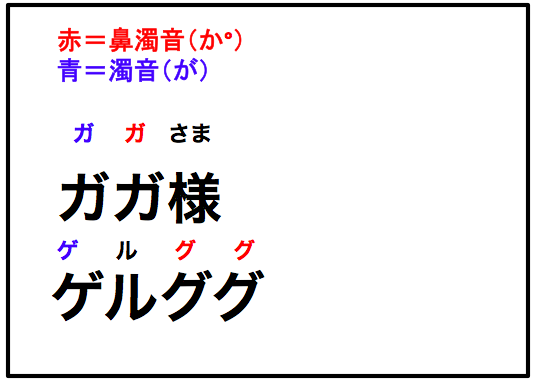
Aside from those undergoing announcer training though, most Japanese people never encounter these bizarre-looking hiragana, and that’s why students of Japanese aren’t taught them.
It makes sense though; in the U.S., we don’t usually take dialect differences into account when spelling English either: “aunt” is spelled the same even in places that pronounce it as “ant,” and “soda” is spelled the same even in places that pronounce it as “pop.”
According to Japanese linguists, the voiced nasal has been slowly dying off, being replaced by the normal voiced sounds that we’re all familiar with. At this rate it might not be too much longer before they’re extinct sounds.
▼ Skip to 1:40 to see how the red circles (normal g) has been invading from the west to take over the green circles (nasal ng) over the past 50 years.
Personally I know that whenever I use the voiced nasals, I just feel like I sound pretentious, so I usually keep them hidden away in my nose. But what do you do when you speak Japanese? Were you taught to use the voiced nasals? If so, let loose with some in the comments, so we can preserve their nasal-y beauty for all eternity.
References: NHK Online, Notre Dame Seishin University
Images: ©RocketNews24
[ Read in Japanese ]
 Learn Japanese through ridiculous manga: A Tick on Titan 【Episode #3】
 Learn Japanese through ridiculous manga: Fullmedal Alchemist 【Episode #5】
 Learn Japanese through ridiculous manga: Dragon Bowl【Episode #4】
 Learn Japanese through ridiculous manga: Death Vote 【Episode #6】
 How do you pronounce “Among Us” in Japanese? Simple question has linguistically deep answer
 Starbucks Japan adds new Sweet Potato Frappuccino and Latte to the menu, but do they deliver the taste of autumn?
 Japan’s first fall color forecast for 2026 is here!
 German woman rescued from Mt. Fuji after suffering altitude sickness symptoms, hiking to peak anyway
 A real-world Pokémon Poké Ball hotel is opening in Japan at a still-secret location [Video]
 Kyoto temple bans visitors from wearing kimono
 American tourist in Japan arrested on charges of attempted murder and arson
 Starbucks Japan reveals new Tsukimi Moon-Viewing drinkware and gifts for autumn 2026
 Solo travel in Japan: $3 all-you-can-drink deal at this conveyor belt restaurant is a fun time for one
 Japan’s revolving sushi restaurant king Sushiro coming to U.S. this fall with high prices, no tipping
 Mini CRT-lookalike Final Fantasy figurines are awesome pixel art music boxes [Video]
 Japan’s final Penguin Suica train cards have already shipped, and when they’re gone, they’re gone
 Studio Ghibli unveils new anime calendars and diary planners for 2027
 Solo travel in Japan: Hidden beer garden in Tokyo is a haven for single visitors
 Hobonichi unveils new 2027 planners, diaries and stationery with One Piece, Suica Penguin, Hello Kitty and a must-buy Mini Techo
 Farewell Final Ceremony announced for Tokyo’s life-size Gundam statue, will stream live
 Family Mart releases new Human Made Cup Noodle in Japan, with freebies for Nigo fans
 Japan approves foreign resident visa renewal fee increases of up to 967 percent, starts soon
 One Piece Day 2026 brings new art, music, and new cast announcements
 Hikaru Utada sings new song in Shinkansen commercial for Japan’s Supreme Class cabins
 12-year-old British girl who went missing in Tokyo found safe after visiting anime sites around Yokohama
 7-year-old boy left behind on Mt. Fuji by his own dad
 Sushi Bus: Japan’s first conveyor-belt bus lets you eat sushi while sightseeing around Tokyo
 Pokémon Center Online designates first Pokémon items that will require Japanese ID card to buy
 Japanese toilet aims to attract foreign tourists but not everybody is happy about it
 New Japanese vending machine at Shinkansen station sells cups of ice on platform
 Study finds hundreds of people in Indonesia legally named after Naruto, Inuyasha, other anime stars
 Japan announces sudden 400-percent increase in visa fees for foreigners entering the country
 Japan’s human washing machines will go on sale to general public, demos to be held in Tokyo
 Studio Ghibli has a new anime out, and there’s only one place in the world where you can see it
 Starbucks Japan releases new drinkware and goods for Valentine’s Day
 Starbucks Japan releases new sakura goods and drinkware for cherry blossom season 2026
 Japan’s newest Shinkansen has no seats…or passengers [Video]
 Tokyo subway installing new ticket gates that don’t accept payment through Suica or other IC cards
 Japanese ninja certification exam attracts 131 candidates from Japan and abroad
 Salomon releases Japan-exclusive Mt. Fuji hiking gear that doubles as an amazing souvenir
 Put sesame oil in your coffee? Japanese maker says it’s the best way to start your day【Taste test】
 The science behind why English speakers can’t pronounce the Japanese “fu”
 The surprising reasons why some hiragana aren’t allowed to be used on Japanese license plates
 Why does Japanese writing need three different sets of characters? (Part 2)
 Japanese writing system gets turned into handsome anime men with Hiragana Boys video game
 Why does Japanese writing need three different sets of characters? (Part 1)
 World’s first moaning hiragana character either a stroke of genius or just plain weird【Video】
 The top 10 hardest Japanese words to pronounce – which ones trip you up?【Video】
 Japanese elementary school student teaches us all how to pronounce English like a native speaker
 Magazine teaches Japanese using Kemono Friends anime, Japanese netizens can’t stop laughing
 Learn Japanese through ridiculous manga: Narutoe 【Episode #2】
 The reason why Japanese students don’t pronounce English properly
 One simple kanji character in super-simple Japanese sentence has five different pronunciations
 Pronunciation anxiety: many Japanese people don’t want to speak English unless it’s “perfect”
 Seven mistakes foreigners make when speaking Japanese—and how to fix them
 Let’s learn how to sing “Jingle Bells” in Japanese with the help of Santa Pikachu!【Video】
 Japanese students despair over the many, MANY ways you can describe a dead flower