

Fan thinks Japanese linguistic stubbornness is limiting the potential audience of Japan’s artists and creators.
You really can’t overstate the massive scale of Comiket, Japan’s twice-a-year gathering of dojinshi (independently published comic) artists. Hundreds of different creative groups participate in the multi-day market, and with most being small organizations without big marketing budgets, it’s generally up to shoppers themselves to find the booths that are selling the items they’re looking for.
To make that process a little easier, Comiket assigns location codes to each booth inside Tokyo Big Site, the event’s convention center venue. But while that system works reasonably well for Japanese fans, the codes have a major shortcoming when it comes to helping foreign otaku, as pointed out by bilingual Japanese Twitter user Rich Mikan (@richmikan).
I noticed a significant problem with Comic Market. That is "KANA," which are the Japanese alphabets, are used to identify exhibitor locations.
— Rich Mikan (@richmikan) January 11, 2020
Foreigners who don't know Japanese can't read them. And, they also don't know the alphabet order, which is needed to seek exhibitors.
Rich Mikan became aware of the situation when he was talking to a foreign Comiket shopper who was looking for a certain group’s booth, which Rich Mikan knew the code for. Booth codes consist of a phonetic kana character, a number, and a Latin alphabet letter. In this case the code was ヨ46a, and that ヨ, read as “yo,” was a major communication roadblock for the foreign fan.
But ヨ isn’t that complicated a symbol, and if a helpful Japanese person jotted it down for you, you’d be able to easily find the booth without any other language skills, right? Not necessarily. The “alphabetic order” for Japanese isn’t the same as the one English uses. Instead, Japanese words/kana are ordered through a combination of their initial consonant and terminal vowel sound. For example, ヨ/yo comes after ユ/yu and before ラ/ra, so unless know both how to read kana and their order, having the booth’s code probably isn’t going to be enough to navigate the Comiket floor.
▼ Turn back if you notice the vegetation starting to get especially thick.

It seems like a multi-segmented, purely numeric code, or one that uses only numbers and Latin letters, would be more broadly understood, considering that the average Japanese person’s understanding of the Latin alphabet/alphabetic order is much stronger than the average foreigner’s grasp of the corresponding kana concepts. However, Rich Mikan’s observation of Comiket’s current code protocol’s potential problems wasn’t met with much sympathy when he tweeted about it in Japanese, which resulted in responses including:
“Even if there are a lot of foreigners who come to Comiket, it’s still and event that’s being held in Japan.”
“If people are going to come to Japan, I want them to learn Japanese.”
“If they can’t read kana, they’ll just have to take searching by trial and error as part of the fun of the event, and if they can’t, they’ll just have to learn how to read them, or find someone who can give them directions without using the code.”
“Pretty much all the dojinshi sold at Comiket are in Japanese, so if someone can’t read Japanese, there’s really not much point in coming to Comiket, is there?”
Setting aside the gap in logic from the last comment (a lot of shoppers at Comiket because they like the medium’s artwork, even without understanding the dialogue and story), this might seem like a cold response from a country that prides itself on customer service and hospitality, but it could have something to do with the fact that for some time Comiket’s exhibitors have firmly held that the shoppers aren’t customers, but simply fans participating in an event. That attitude may have been born out of a necessity to present the event in as non-commercial a way as possible, since a huge portion of the items sold at Comiket make unlicensed use of copyrighted anime/manga characters, with the industry turning a blind eye to the practice as long as creators are of “amateur” status and produce their work in small batches.
That atmosphere also means, though, that Comiket doesn’t always operate under the prevailing Japanese business wisdom that the customer is always right and must be accommodated in every way. So even as Rich Mikan lamented later in the thread that language barriers are a severe limiting factor for the works of Japanese artists, it won’t be a surprise if Comiket sticks with its current booth code system for some time to come…
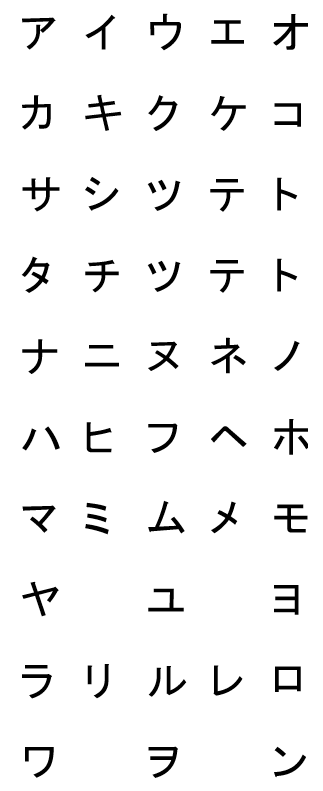
…so here’s a kana order chart (start at the left, proceed to the right, and then drop down to the next line) in case you’re still learning Japanese, or just at Comiket for the visual appeal.
Source: Twitter/@richmikan (1, 2) via Hachima Kiko
Top image: Pakutaso
Insert images: Pakutaso, SoraNews24
● Want to hear about SoraNews24’s latest articles as soon as they’re published? Follow us on Facebook and Twitter!
Follow Casey on Twitter, where he learned how to read the kana バ to make it easier for him to look for Bubblegum Crisis soundtrack CDs.
 Manga artist fails to sell a single book at Comiket, still considers the day a major success
 Japanese government to make first change to romanization spelling rules since the 1950s
 Shopping at Comiket? Don’t forget a Gentleman’s Bag to keep your racy purchases on the down low
 Free condoms to be distributed at Comiket anime fan event in Tokyo
 The best booths and cosplayers from Summer Comiket 2024【Photos】
 Japan reportedly adding Japanese language skill requirement to most common foreigner work visa
 Man bites woman at cherry blossom park in Japan, dies shortly after
 Peanuts and Coke becomes a viral hit in Japan, but is it a trend worth joining?
 New Japanese KitKats come in sakura flavour, with poetic symbolism for success
 McDonald’s Japan adds new Hello Kitty and Pompompurin drinks to the menu for a limited time
 New 7-Eleven sandwich goes viral in Japan, but is it everything it’s cracked up to be?
 Famous koi ponds overwhelmed with tourists throwing thousands of coins in them
 How to take your home ramen to the next level by making your own chashu pork in a frying pan
 You don’t have to go all the way to Haneda to find a vending machine that sells airplane meals
 Japan’s new difficult-to-drink-from beer glass protects your liver, but it’s a brutal experience
 Pokémon and Ikea Japan cross over into each other’s worlds with collaboration events
 Starbucks Japan closing only Shinkansen platform branch for popularity-triggered renovations
 Two food hacks take Japan’s convenience store fried chicken to amazing new sandwich heights
 You can assemble a well-balanced team of Pokémon, them eat them, thanks to Japanese cake chain
 Fading Tokyo – Searching for signs of the Showa era as local neighborhoods evolve[Photos]
 Pokémon lacquerware series expands for Year of the Horse with new handcrafted design[Video]
 Tokyo turns its phone booths into free Wi-Fi hotspots, and here’s how to use them
 Tokyo teahouse serves up a sakura matcha dessert you won’t find anywhere else
 Totoro Fund line of beautiful artwork and apparel lets you help the real-world Totoro Forest
 Japan now has a special desk for people who work at home with a pet cat[Photos]
 Famous Tokyo cherry blossom spot installs view-blocking screens to fight overcrowding[Video]
 Uniqlo announces new T-shirts for One Piece, Naruto and more for manga publisher’s 100th birthday
 Train station platform ramen store closes its doors on half a century of history in Tokyo
 Starbucks Japan releases new My Fruit³ Frappuccino at only 34 stores around the country
 Studio Ghibli releases Catbus pullback keychain that runs like the anime character
 Krispy Kreme releases Super Mario doughnuts in Japan for a limited time
 Japanese onsen egg maker from 100-yen store Daiso needs to be on your shopping list
 Survey asks foreign tourists what bothered them in Japan, more than half gave same answer
 Japan’s human washing machines will go on sale to general public, demos to be held in Tokyo
 Starbucks Japan releases new drinkware and goods for Valentine’s Day
 We deeply regret going into this tunnel on our walk in the mountains of Japan
 Studio Ghibli releases Kodama forest spirits from Princess Mononoke to light up your home
 Starbucks Japan releases new sakura goods and drinkware for cherry blossom season 2026
 Japan’s newest Shinkansen has no seats…or passengers [Video]
 Major Japanese hotel chain says reservations via overseas booking sites may not be valid
 Put sesame oil in your coffee? Japanese maker says it’s the best way to start your day【Taste test】
 No more using real katana for tourism activities, Japan’s National Police Agency says
 Comiket returns! Japan’s largest otaku convention announced for 2021 with new admission policies
 The crazy huge crowds of Summer Comiket【Photos, videos】
 The best independent fan cosplayers of summer Comiket【Photos】
 Record number of foreign children in Japan need help understanding Japanese in school
 Tokyo politician creates dojinshi manga, will be at Comiket selling it
 The best cosplayers from Day 1 of Winter Comiket 2023【Photos】
 The best cosplayers from Day 1 of Summer Comiket 2023【Photos】
 The best cosplayers from Day 2 of Summer Comiket 2023【Photos】
 Does Japan’s five-yen coin need a foreigner-friendly redesign?
 How to respond to Japanese people saying “I don’t speak English” when you’re speaking Japanese?
 A lesson in doujinshi convention manners from our resident doujin artist
 Foreigner says he wants to learn Japanese because he loves manga, real reason is what he hates
 We joined the 10,000 otaku who recently congregated in Madrid for Japan Weekend