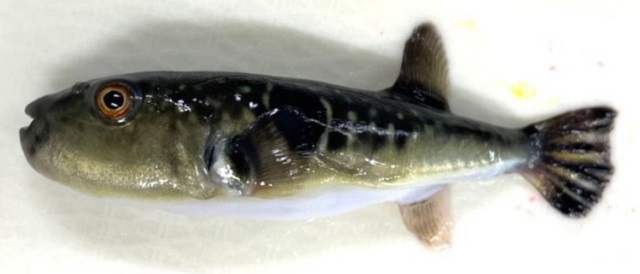
”Here, little fishies! Come get your poison!”
Fugu, as pufferfish is called in Japan, is famous for two things it can do: make your taste buds rejoice and flat-out kill you. That’s because fugu livers, ovaries, eyes, and even skin contain tetrodotoxin, a powerful neurotoxin that causes paralysis, leaving those afflicted by the poison, for which there is no known antidote, to suffocate.
However, fugu don’t produce tetrodotoxin themselves. Instead, they acquire it through eating other sea creatures that contain bacteria with tetrodotoxin in smaller amounts, developing a resistance to the harmful effects in the process. So though fugu in the wild naturally gravitate towards a diet that leads to tetrodotoxin permeating their skin and organs, if their diet from birth was limited to foods without those bacteria, you’d have non-poisonous fugu.
But what if you took some non-poisonous fugu, who’d been hatched and then raised in a research facility and were thus tetrodotoxin-free, and started feeding them tetrodotoxin? That’s the question being asked by scientists at Nagasaki University, who’ve started mixing a dose of tetrodotoxin in with the feed for a group of non-poisonous fugu.
▼ A diagram of the experiment (hopefully the spray bottle of neurotoxin is very clearly labeled so that no one mistakes it for Febreze)
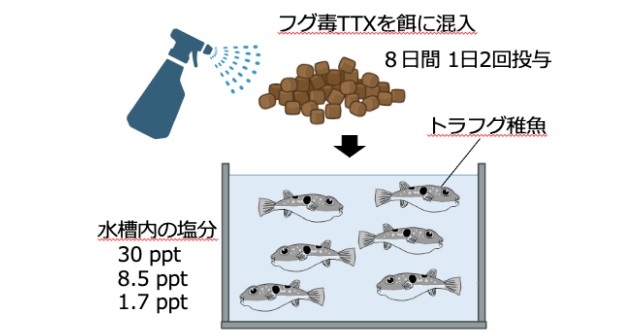
To answer the most immediate question that springs to mind, the fugu haven’t died, as apparently the dosage is small enough to not be life-threatening. However, the researchers have observed changes in the composition of the fugu’s intestinal flora, i.e. their gut bacteria. These changes could also possibly affect the functions of the fugu’s gut microbiome relating to metabolizing lipids and sugars. Whether these changes have a positive or negative effect on the fugu’s wellbeing is a question the researchers say will require further study to answer.
Another question that might be springing to mind is “Why?” Why, after going to the trouble to raise non-poisonous pufferfish, would you think “OK, let’s poison these guys up!”? The goal is to better understand fugu physiology in order to apply that knowledge to aquaculture. Though non-toxic fugu were first bred more than 20 years ago (also by scientists at Nagasaki University), farm-raised fugu is yet to really catch on among foodies, leaving demand for the fish to be supplied almost entirely on wild catches. Being able to more effectively raise fugu, with a flavor replicating that of wild-caught fish, could lessen the environmental impact of the pufferfish-eating practice.
The researchers say they should have further results ready for public announcement next summer.
Source: TBS News Dig via Jin, Nagasaki University
Images: Nagasaki University
● Want to hear about SoraNews24’s latest articles as soon as they’re published? Follow us on Facebook and Twitter!


Treat Yourself to this Japanese Delicacy if You Dare – Ovaries From a Poisonous Fish!

Aichi supermarket caught selling poisonous puffer fish livers, “been selling it for decades”
Nagoya man hospitalized after eating fish with name including “fugu,” a.k.a. “poisonous blowfish”
10-year-old Japanese girl is youngest person ever certified to prepare deadly poisonous blowfish
We eat fugu pufferfish semen at a Japanese restaurant in Tokyo
Even at twice regular Daiso price, this handy item is still great for summer travel in Japan
Japanese convenience store shows us how to dress for the rainy season
Kyoto public junior high school becomes first in Japan with a hoodie school uniform
Uniqlo reveals third round of massive 100-year-anniversary manga T-shirts for Jump’s Shueisha
Tokyo’s Pokémon Cafe reopens this month with brand-new sweets and Pikachu show
Tourists brave Typhoon Jangmi to queue at two famous sites in Tokyo
Japan’s sticker wars are reaching a breaking point, even for enthusiasts
Video of man spraying liquid on conveyor belt sushi leads to arrest in Japan
Osaka is hosting a “hentai” event, but it’s probably not what you think
Starbucks Japan unveils new Frappuccino showcasing “mottainai” culture
New official Ghibli anime food cookbook will teach you how to make Ponyo’s ramen and more
Japanese convenience store Lawson launches new “mini supermarket” chain, L Minimart
What’s up with the Ghibli Park photo and video ban?
Japan’s adorable pudding chick becomes a transit card mascot
Starbucks Japan has a problem with its sell-out breakfast that might annoy solo diners
Pikachu cakes and other adorable Pokémon 30th anniversary food coming to Tokyo luxury hotel
Krispy Kreme releases a new Doughwich… at only one store in Japan
Tokyo’s life-size Gundam anime mecha statue will be removed this summer
Ichiraku Ramen-inspired ramen sets from Naruto anime pay homage to Naruto, Sasuke, and Sakura
Kanji ice cream becomes a sell-out hit in Japan
Japan now has gyoza doughnuts, and they taste like no other doughnut we’ve tried before
Japan’s real-world Pokémon hot spring’s first photos are here![Photos]
Japan has a new cute and clever sunblock for cat lovers
Japan’s human washing machines will go on sale to general public, demos to be held in Tokyo
Starbucks Japan releases new drinkware and goods for Valentine’s Day
We deeply regret going into this tunnel on our walk in the mountains of Japan
Starbucks Japan releases new sakura goods and drinkware for cherry blossom season 2026
Japan’s newest Shinkansen has no seats…or passengers [Video]
Major Japanese hotel chain says reservations via overseas booking sites may not be valid
Put sesame oil in your coffee? Japanese maker says it’s the best way to start your day【Taste test】
Japan reportedly adding Japanese language skill requirement to most common foreigner work visa
Japan’s 5.3 million beautiful Hitachi Nemophila flowers are now in full bloom[Photos]
Pokémon and Ikea Japan cross over into each other’s worlds with collaboration events
Picture of a pufferfish vomiting water is the Japanese Internet’s newest darling