Many are assuming this is a backlash against trendy kirakira names, but is that really the case?
For new parents, welcoming a baby into their home comes with a lot of responsibilities such as changing diapers and nighttime feedings. For new parents in Japan, though, there’s one more thing they have to do: update their family register, and come next spring, they might also have to justify to the local government why they’ve given their baby the name they did.
In Japan, every citizen has to be registered in a family register, called a koseki in Japanese. The koseki is an official legal record of the members of the family, listing the names and dates of birth of the head of the household and their spouse and children (if applicable).
Most Japanese people’s names are written in kanji characters, and most kanji can be read multiple ways. For example, the kanji 空 can be read as “sora” (and it’s where SoraNews24 gets its name), but it can also be read as “ku,” “kara,” or “a,” as well as even rarer readings such as “uro.”
▼ And no, we don’t have an evil twin named “UroNews” who steals Japanese Frappuccinos instead of recommending them.
However, despite needing to list your family members’ names in the family register, the pronunciation of those names is not required information. The city halls and ward offices that administer the records only care about how your name is written. At least, that’s been the situation up until now, but starting in the spring, you’ll be required to include pronunciations for your family members, and if city hall thinks the pronunciation you list for your new baby is too weird, they’ll be able to ask you to explain the logic behind it, and if they’re not satisfied, the name can be denied registration.
That said, it sounds like they’re going to be pretty lenient. In an advance draft of the new rules sent to municipal offices this week, the Ministry of Justice gave three scenarios for acceptable pronunciations.
1. The pronunciation aligns, at least in part, with one of the established kunyomi (indigenous Japanese) or onyomi (derived from Chinese) pronunciations for the kanji. For example, “Kokoa” is an acceptable pronunciation for the name 心愛, since it’s made with the kanji 心 (which can be pronounced “kokoro” and means “heart”) and 愛 (“ai”/”love”).
2. The pronunciation aligns with an established pronunciation for a sequence of two or more kanji outside their kunyomi/onyomi readings. For example, “Asuka” is an acceptable pronunciation for the name 飛鳥, since it’s already a widely used and understood irregular pronunciation for that specific kanji combination used for both people and place names.
3. The pronunciation aligns with an established pronunciation for okiji. We’re getting into the literally tiny details of Japanese linguistics here, but okiji pronunciations are, in simple terms, pronouncing a kanji in the same way as a more complex character that the first kanji is a component of. For example, the 心 kanji we saw above is also part of the more complex kanji, 愛.
▼ It’s a little squashed, but there’s a 心 in the middle of 愛.
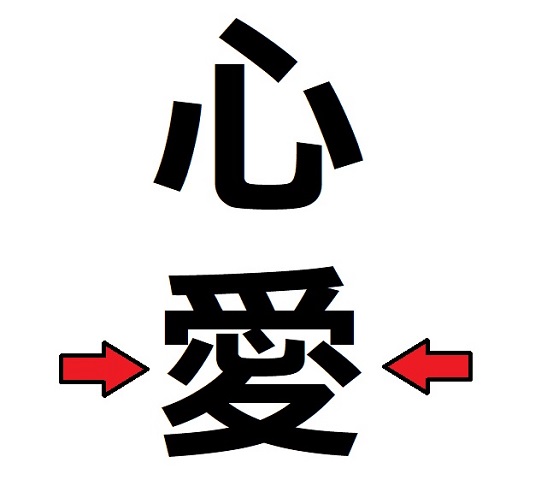
愛 is most commonly pronounced “ai,” and even though that’s not an intrinsic pronunciation for 心, it’s still a permissible one under the new family register rules. So, for example, Aito would be an acceptable pronunciation for the name 心人.
On the other side of the issue, the Ministry of Justice also gave examples of pronunciations that would be deemed not permissible under the new rules. The broadest potential problem is “pronunciations that cannot be mentally associated with the characters.” For example, if you tell city hall that your son’s name is written with the kanji 太郎, the same kanji used in the common name “Taro,” but that you want those kanji to be officially pronounced “Michael,” they’ll tell you nope.
Also pointed out as unacceptable by the ministry are pronunciations which are the opposite of the kanji’s meaning (such as registering “Hikushi,” meaning “low,” as the pronunciation of 高, the kanji which means “high”) and pronunciations that would lead one to think the individual is a different person (such as insisting that 太郎 be pronounced not as Taro, but as the different name “Jiro,” which is already written with different kanji as 次郎). Both of those situations, though, seem like they’d also be disqualified for being “pronunciations that cannot be mentally associated with the characters.”
Additionally, the ministry stated that pronunciations that are societally inappropriate or detrimental to the child will not be allowed, such as “Akuma” as the pronunciation for 悪魔. However, this really isn’t an example of a pronunciation matter, as “akuma” is the standard pronunciation for those kanji, which mean “devil.” Ostensibly, though, this part of the rules would allow city hall to veto “Akuma” as a name made up of other kanji chosen with the intent to create an alternate to 悪魔 that’s pronounced the same way.
▼ It’s unclear if Akuma would be an acceptable pronunciation if you’ve given birth to a literal devil, but supposedly this would be decided on a case-by-case basis, and may require additional hellspawn-related paperwork. Consult your local dark enchanter for more information.

A lot of reactions to the addition of pronunciation requirements for family registers, and the associated government approval process, assume it’s part of a pushback against so-called “kirakira (sparkling) names,” trendy, flashy names that push the pronunciation envelope, sometimes to the point of incoherence. However, the new rules don’t do anything to prohibit gaudy (or clever, depending on your point of view) wordplay, as long as there’s some sort of linguistic basis for it. The above-mentioned Kokoa (心愛), for example, is arguably a kirakira name because it’s a new, trendy name that’s pronounced exactly the same as “cocoa” in Japanese, giving it an air of girlish sweetness. Since that pronunciation falls within the kunyomi pronunciations for those kanji, though, it won’t get flagged.
On the other hand, kirakira names that completely ignore established pronunciation, like writing a name with 月, the kanji meaning “moon,” and saying it should be pronounced “Light” or “Raito” (as a reference to moonlight), would run into problems. However, actual real-world examples of this second type of kirakira name are few and far between. It’s also important to keep in mind that a pronunciation getting flagged isn’t the final decision on the matter, as parents will be allowed to present their case, if they have one, as to why they feel the pronunciation should be allowed.
In other words, though the Japanese government is going to require name pronunciations for family registers, these new rules aren’t going to do much to legally limit creativity or ostentatiousness…which makes sense, because that’s not why pronunciations are being required. The real reason the government wants people to provide pronunciations for their names is to facilitate digitization of records, something Japan has been lagging on for some time. When typing Japanese names (or any Japanese words) on a keyboard, you first type it in phonetically, then select the corresponding kanji, and with kanji so often having multiple possible pronunciations, knowing which pronunciation corresponds to a particular person makes for more efficient data entry and record accessing.
Of course, with the pronunciation requirement not going into effect until next spring, there are already millions of people in Japan whose names are entered in family registers with no provided pronunciation. For everyone currently alive (or being born before the spring), local governments will take their best guess at how the names should be pronounced based on available information, then notify individuals of what the preliminary pronunciation has been registered as. If it’s correct, there’s nothing more that needs to be done, and if it’s wrong, individuals can contact their city hall and have it corrected.
It’s also worth remembering that the pronunciation requirement isn’t an attempt to flatten out the diversity of Japan’s non-ethnically Japanese population. Foreign names from non-kanji languages, such as English, are already written in Japanese using the phonetic script called katakana, so there’s no change for them. Names from non-Japanese languages that also use kanji, such as Chinese, have long retained their home-country pronunciation (or at least the closest pronunciation possible to be rendered in Japanese) within Japan. City hall may or may not be able to tell on its own that a Chinese resident with the name 王 pronounces it as “Wang,” but the government isn’t going to force him to change the pronunciation to “Oh” just because that’s how 王 is pronounced in Japanese.
Incidentally, this means that theoretically naming one of our kids “Godzilla” (or “Gojira,” to use the Japanese pronunciation) remains in a gray area. Since the King of the Monsters’ name is written in katakana (ゴジラ), we’re clear on the linguistic basis, but even though he’s a globally recognized icon of Japanese culture, city hall might deem it an “inappropriate or detrimental” name. You know, because of the whole “repeatedly destroying Tokyo” thing.
The pronunciation requirement rules go into effect from May 26.
Source: Hachima Kiko, Tokyo Shimbun, Mainichi Shimbun, Okinawa Times
Top image: Pakutaso (edited by SoraNews24)
Insert images: Pakutaso, SoraNews24, Pakutaso (2)
● Want to hear about SoraNews24’s latest articles as soon as they’re published? Follow us on Facebook and Twitter!
Follow Casey on Twitter, where he’s glad his seven-year-old brother picked out a good name for him.