

The answer may not surprise you but the reason will.
Let’s say you’re at home, going through your disaster preparedness kit, and you find a bottle of spring water you bought a long time ago in case of emergency. Checking by the cap, you see that the expiry date was a few months ago, and decide to use it to water plants or top off the washing machine instead of drinking it. Well, congratulations; you just wasted perfectly good water.
Alright, “perfectly good” might be an overstatement since we’re still not sure what the microplastics floating around in there can do to us, and “waste” is also a little harsh since plants are our friends too. But the point stands that you could have drank that water and it would have been more or less as good as the day you bought it.
▼ Consider drinking that bottle of water rather than keeping it outside to ward off stray cats as some people in Japan do.
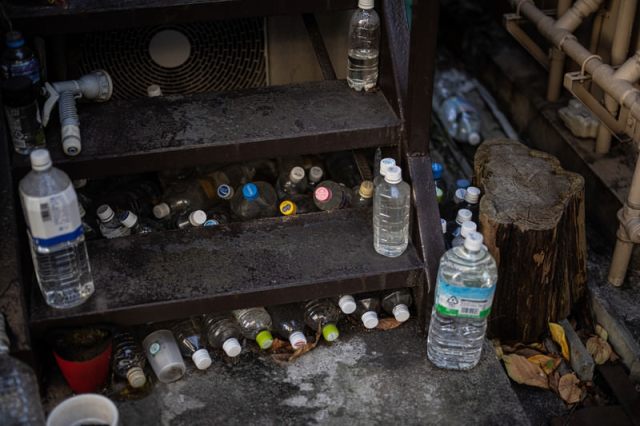 Image: Pakutaso
This is because according to the Secretary General of the Japan Mineral Water Association, the “expiration date” on bottled water isn’t used for the same reason that it’s used on perishable food. This is actually the date at which water inside the bottle is expected to have evaporated so much that the bottler cannot guarantee the amount written on the bottle is inside anymore and could be held liable for false labeling.
Water bottles in Japan are usually made of a type of polyethylene terephthalate (PET), which is slightly permeable to water vapor. Some tests have found that when stored at around 25 degrees Celsius (77 degrees Fahrenheit) around two to three milliliters (0.07 – 0.1 ounces) of water vapor can escape per month. Also, in the hot summer months of around 37 degrees Celsius (99 degrees Fahrenheit), that rate goes up to about 4 milliliters per month.
Meanwhile, the Measurement Act of Japan states that the actual contents of a bottle must be no less than two percent under the amount listed on the label for bottles under 500 milliliters (17 ounces) and no less than 10 milliliters less than the labeled amount for bottles 500 milliliters and up. So, bottlers of water simply calculate the rate of evaporation and release through the PET bottle, apply it to the legal threshold, and an expiry date is born, but it’s not the water that expires. It’s the label on the bottle that does.
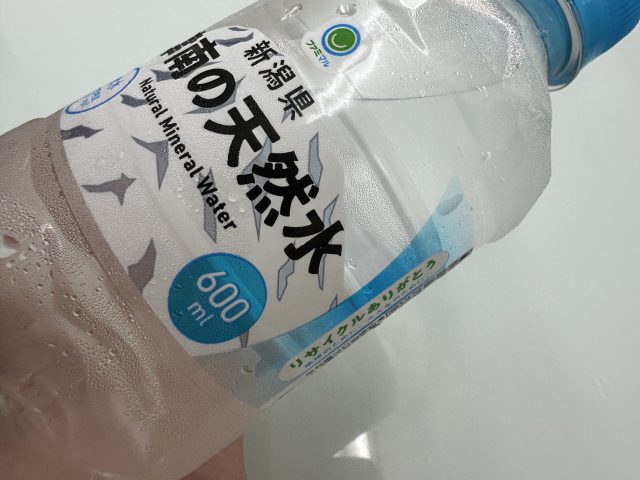
▼ Phew… Honey, can you smell this label? I think it’s gone bad.
Of course, this is a separate subject from contamination from chemicals inside the plastic of the bottle, and it’s possible both things could be occurring at the same time. But since evaporation happens rather quickly, would there even be enough time for significant amounts of potentially hazardous chemicals to seep into the water from the plastic?
Going by the rate of evaporation found in studies, at two milliliters per month we can expect a 500-milliliter bottle to be empty in 20 years and 10 months. In the case of chemicals from the plastic entering the water, known as “leaching,” the most worrisome elements are antimony and germanium. Under normal storage conditions, it would take about 71 years for enough antimony to enter the water to surpass Japanese safety standards and about 15 years for the germanium levels to surpass those deemed safe.
Mind you these are just the standards, which tend to err on the side of caution, meaning one 15-year-old 500-milliliter bottle of water — wait… 140-milliliter at that point — probably won’t send you straight to the ER. Even factoring in things like the lower concentration of water as it evaporates and the diminished leaching as the surface area shrinks, you’re still looking at about a good nine years or so before standards are exceeded.
One big caveat to all this is that it only applies to Japanese water that has been sterilized to Japanese standards and in bottles made to Japanese standards. Every country has its own standards, including what it considers the allowable limits of antimony and germanium to be, so do your own research before consuming 10-year-old bottles of water anywhere outside of Japan.
Microplastics are also still a bit of a wildcard, in terms of their effect on the human body and how rapidly they break down in a typical Japanese PET bottle of water. Most microplastics are said to enter the water during bottling at the factory, so the bulk of it will already be present in a brand-new bottle anyway, with only a relatively moderate increase over time if stored securely. Unfortunately, there don’t seem to be any studies on microplastic contamination over very long spans of time, such as 10 years.
▼ In other words, if you’re worried about microplastics you really shouldn’t even be drinking new plastic bottles of water.

This information has recently been trending online in Japan and many came out in agreement with it, either using their own theoretical knowledge or personal experiences. Others still felt it wasn’t worth the gamble.
“If the water can escape, can’t things like bacteria get in?”
“Molecules like water and carbon dioxide are 0.3 nanometers, about the same as gaps in permeable plastic, but a virus is about 20 nanometers so it can’t get in.”
“If I leave water out, I just use it for laundry.”
“I’m still just going to use it for cleaning and watering plants.”
“Water is always fine, isn’t it?”
“I had some water that I’d been keeping for seven years in case of emergency. I drank it when I replaced it and it was fine.”
“I’ve been given expired ones before and there definitely seemed like less water inside.”
“If the bottles are breathable I probably shouldn’t store them next to the toilet.”
“If the bottle is shriveled that’s good because the air pressure outside is collapsing it. If the bottle is old and a normal shape, air has gotten inside and there might be bacteria too.”
“I’m still going to pour it down the drain anyway. Why take a chance?”
Whether you’re willing to crack open a seven-year-old bottle of Japanese water is entirely up to you, but the key takeaway from all this is that the expiration date written on it has absolutely nothing to do with its quality, so feel free to hang onto it at least a little bit longer than that.
Source: Yahoo! Japan News, The Sankei Shimbun, withnews, Ministry of Economy Trade and Industry, Japan Soft Drink Association, Japanese Journal of Food Chemistry and Safety, Food Safety Commission, Hachima Kiko
Images: ©SoraNews24 (unless otherwise noted)
● Want to hear about SoraNews24’s latest articles as soon as they’re published? Follow us on Facebook and Twitter!
 Japanese Twitter calls out crazy bottled water claims, gets us thinking about what we’re drinking
 Coca-Cola Japan are testing “fill your own bottles” water dispensers to help reduce plastic waste
 Bottled hot water selling like bottled hot cakes in Japan
 Internet reacts with confusion to Muji’s new fill-it-up-yourself water bottle product
 Leading bottled water brand in Japan goes label-free to reduce waste, angers many
 Japan reportedly adding Japanese language skill requirement to most common foreigner work visa
 Man bites woman at cherry blossom park in Japan, dies shortly after
 New 7-Eleven sandwich goes viral in Japan, but is it everything it’s cracked up to be?
 How to take your home ramen to the next level by making your own chashu pork in a frying pan
 Japan may finally abolish law that bans women only from remarrying soon after divorce
 Tokyo turns its phone booths into free Wi-Fi hotspots, and here’s how to use them
 How to make epic pancakes with your Japanese rice cooker
 7-Eleven Japan starts new temporary luggage storage service in over 300 branches
 McDonald’s Japan adds new Hello Kitty and Pompompurin drinks to the menu for a limited time
 Why do tourists eat noodles with a green onion instead of chopsticks in this Edo town?
 Pokémon and Ikea Japan cross over into each other’s worlds with collaboration events
 Starbucks Japan closing only Shinkansen platform branch for popularity-triggered renovations
 Two food hacks take Japan’s convenience store fried chicken to amazing new sandwich heights
 You can assemble a well-balanced team of Pokémon, them eat them, thanks to Japanese cake chain
 Fading Tokyo – Searching for signs of the Showa era as local neighborhoods evolve[Photos]
 Pokémon lacquerware series expands for Year of the Horse with new handcrafted design[Video]
 Tokyo teahouse serves up a sakura matcha dessert you won’t find anywhere else
 Totoro Fund line of beautiful artwork and apparel lets you help the real-world Totoro Forest
 Japan now has a special desk for people who work at home with a pet cat[Photos]
 Famous Tokyo cherry blossom spot installs view-blocking screens to fight overcrowding[Video]
 Uniqlo announces new T-shirts for One Piece, Naruto and more for manga publisher’s 100th birthday
 Train station platform ramen store closes its doors on half a century of history in Tokyo
 Starbucks Japan releases new My Fruit³ Frappuccino at only 34 stores around the country
 Studio Ghibli releases Catbus pullback keychain that runs like the anime character
 Krispy Kreme releases Super Mario doughnuts in Japan for a limited time
 Japanese onsen egg maker from 100-yen store Daiso needs to be on your shopping list
 Survey asks foreign tourists what bothered them in Japan, more than half gave same answer
 Japan’s human washing machines will go on sale to general public, demos to be held in Tokyo
 Starbucks Japan releases new drinkware and goods for Valentine’s Day
 We deeply regret going into this tunnel on our walk in the mountains of Japan
 Studio Ghibli releases Kodama forest spirits from Princess Mononoke to light up your home
 Starbucks Japan releases new sakura goods and drinkware for cherry blossom season 2026
 Japan’s newest Shinkansen has no seats…or passengers [Video]
 Major Japanese hotel chain says reservations via overseas booking sites may not be valid
 Put sesame oil in your coffee? Japanese maker says it’s the best way to start your day【Taste test】
 No more using real katana for tourism activities, Japan’s National Police Agency says
 Gorgeous drinking bottles using kimono fabric now available with new designs and we want them all
 Remind yourself to drink water with this conch seashell PET bottle cover
 Starbucks Japan sells a new water bottle with bonus extras to spark joy
 Suntory attempts to mess with our brains again with new milk-tea-flavored bottled water
 Asahi now sells hot bottled water in Japan as an alternative to coffee or tea
 Red Bull 330ml PET bottles being pulled from store shelves due to sell-by date snafu
 Yogurt-flavored water?!? We try Suntory’s new beverage straight, mix it with booze 【Taste test】
 New Calpis Water bottle design can only be fully seen after you drink the contents
 Kick back after a hard day with a thirst-quenching bottle of Insect Sour
 Japan’s new Leftover Bathwater drink has us strangely titillated【Taste test】
 Japan gifts the world with First Essence Tagame Gin made from a giant water bug
 Japan has a new energy drink designed to pair with one of its favorite instant noodle brands