When the announcement was made that Tokyo would host the 2020 Olympic Games, there was much reason for celebration in Japan. Leading up to the decision, the Japanese leader for the Olympic bid emphatically stressed that the Fukushima disaster would have no impact on life in Tokyo–a claim that was reiterated after the bid was won.
Around that time, a cartoon appeared in a French newspaper depicting mutating sumo wrestlers in front of radiation suit wearing spectators. The Japanese government took issue with it and angrily reaffirmed the safety of the rest of Japan. Still, among many of the citizens, there is sneaking yet widespread suspicion over how safe the Tohoku and Kanto regions actually are, especially with regards to their food products.
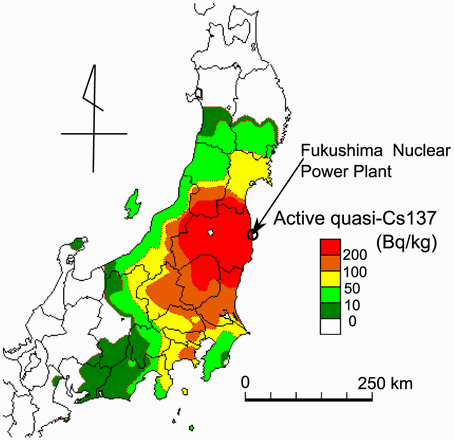
A blog posting on Asyura2 compiled some charts regarding radiation in the regions. First is this map from the website Yes To Life No To Radioactivity which shows the radioactivity of cesium found in agricultural products by region.
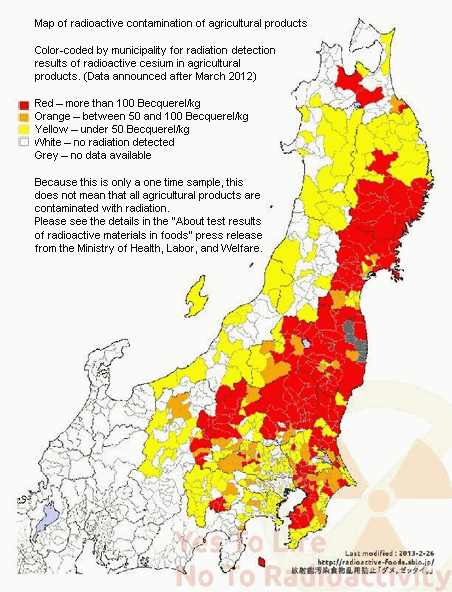
It should be noted that this data was taken from 2012, only one year after Fukushima incident. Since then Prime Minister Abe has been very outspoken on his diet of Fukushima-produced rice in an effort to ease people’s concerns of the region’s produce. This a tactic he has stepped up recently by eating fish and octopus caught off of the prefecture’s shores to downplay newly discovered radioactive coolant leaks.
For a more recent collection of data, this map from Zuku Nashi No Hiyamizu radioactivity readings from wild mushrooms across the same area in Japan collected over a period leading up to October of this year.
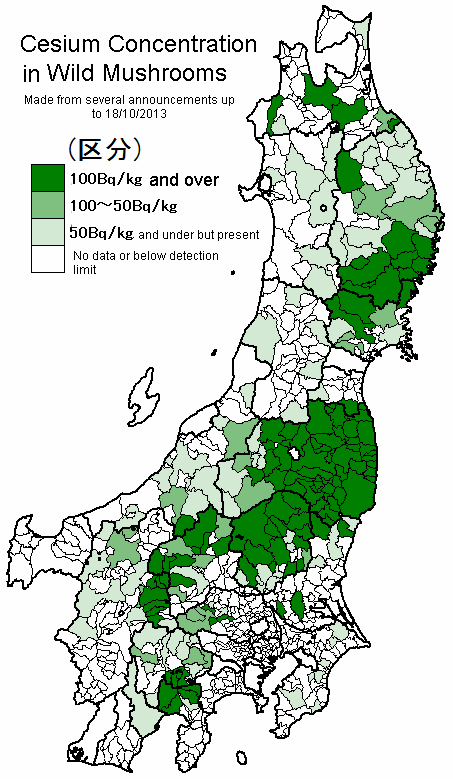
Despite different plants being tested, the area around Fukushima appears largely unchanged. On the other hand, Chiba Prefecture seems to have improved considerably, whereas a cluster of radiation appears to have been picked up around Shizuoka.
This map published on Nature.com in April of this year shows better levels in Shizuoka and Chiba when the freshwater fish ayu are measured.
Taking all of these data into consideration it’s still hard to firmly gauge the safety of Tohoku area produce. On the one hand we have forebodingly stark red and green blotches on some maps, and on the other we have the PM’s office claiming they can’t get enough of this super-healthy food. Honestly, neither seems terribly reliable.
Although it goes against my nature to side with politicians, I tend to be of the mind that the standard radiation levels set by the government are extra low, so when reports come out of radioactivity “one hundred times acceptable levels” it really might not be that bad. Still, I’m not sure I’m willing to wager my and my family’s health on that assumption.
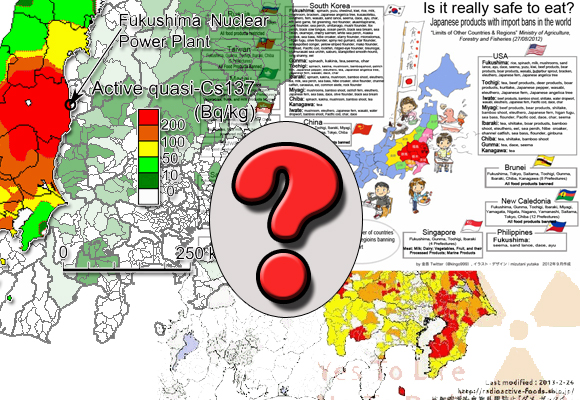
To get another perspective, kingo999 on their blog released an infographic, which we have translated into English, which suggests that if we can’t trust our own government then maybe we should see what other countries think of Japan’s agricultural products. Take a look and see what the governments around the world think about the safety of food from Japan following the disaster in Fukushima.
▼ How the world views, and limits, Japanese foodstuffs (detailed below)
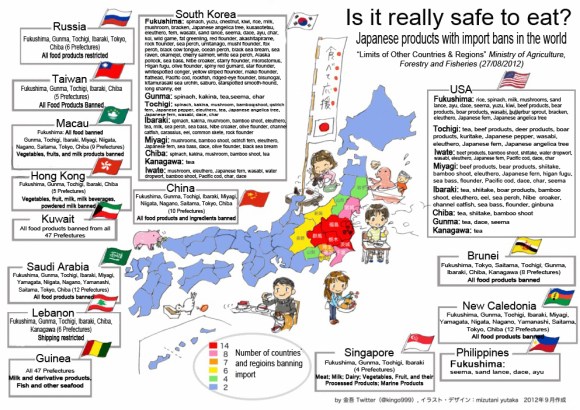
This list was taken from data back in 2012. However, recent reports suggest that countries like the USA have only become stricter with import bans after the recent water leaks discovered in Fukushima.
In the end, most of us aren’t radiation experts and can’t really measure what kinds of radiation are safe for us in what amounts. One solution is just to err on the side of caution like the above countries have done and avoid any potentially harmful products.
However, as prudent a move that might seem to be, it’s not without harmful repercussions for the agricultural businesses of Tohoku and Kanto and the livelihoods of those employed. A large-scale boycott of produce would be further crippling to an already crippled section of the country, and an unnecessary tragedy if the food is in fact safe for consumption. Perhaps the best we can do is to try to understand the situation as much as possible and make a judgment based on balanced information.
Source: Nature.com, The Telegraph, RT (English), Yes To Life No To Radioactivity, Zuku Nashi No Hiyamizu, kingo999: data (pdf), blog via Asyura2 (Japanese)
▼ Assuming you don’t have superhuman vision, here is the list of import bans from the infographic
USA
Fukushima: rice, spinach, milk, mushrooms, sand lance, ayu, dace, seema, yuzu, kiwi, beef products, bear products, boar products, wasabi, butterbur sprout, bracken, eleuthero, Japanese fern, Japanese angelica tree
Tochigi: tea, beef products, deer products, boar products, kuritake, Japanese pepper, wasabi, eleuthero, Japanese fern, Japanese angelica tree
Iwate: beef products, bamboo shoot, shiitake, water dropwort, wasabi, eleuthero, Japanese fern, Pacific cod, dace, char
Miyagi: beef products, bear products, shiitake, bamboo shoot, eleuthero, Japanese fern, higan fugu, sea bass, flounder, Pacific cod, dace, char, seema
Ibaraki: tea, shiitake, boar products, bamboo shoot, eleuthero, eel, sea perch, Nibe croaker, channel catfish, sea bass, flounder, ginbuna
Chiba: tea, shiitake, bamboo shoot
Gunma: tea, dace, seema
Kanagawa: tea
Brunei
Fukushima, Tokyo, Saitama, Tochigi, Gunma, Ibaraki, Chiba, Kanagawa (8 Prefectures)
All food products banned
New Caledonia
Fukushima, Gunma, Tochigi, Ibaraki, Miyagi, Yamagata, Nigata, Nagano, Yamanashi, Saitama, Tokyo, Chiba (12 Prefectures)
All food products banned
Philippines
Fukushima: seema, sand lance, dace, ayu
Singapore
Fukushima, Gunma, Tochigi, Ibaraki (4 Prefectures)
Meat; Milk; Dairy; Vegetables, Fruit, and their Processed Products; Marine Products banned
South Korea
Fukushima: spinach, yuzu, chestnut, kiwi, rice, milk, mushroom, bracken, Japanese angelica tree, kusasotetsu, eleuthero, fern, wasabi, sand lance, seema, dace, ayu, char, koi, wild game, fat greenling, red flounder, akashitapirame, rock flounder, sea perch, umitanago, mushi flounder, fox perch, black cow tongue, ocean perch, black sea bream, sea raven, okamejei, cherry salmon, white sea perch, Alaska pollock, sea bass, Nibe croaker, starry flounder, microstomus, Higan fugu, olive flounder, spiny red gurnard, star flounder, whitespotted conger, yellow striped flounder, mako flounder, flathead, Pacific cod, rockfish, ridged-eye flounder, bisunogai, kitamurasaki sea urchin, saburo, starspotted smooth-hound, long shanny, eel
Gunma: spinach, kakina, tea,seema, char
Tochigi: spinach, kakina, mushroom, bamboo shoot, ostrich fern, Japanese pepper, eleuthero, tea, Japanese angelica tree, Japanese fern, wasabi, dace, char
Ibaraki: spinach, kakina, mushroom, bamboo shoot, eleuthero, tea, milk, sea perch, sea bass, Nibe croaker, olive flounder, channel catfish, carassius, eel, common skete, rock flounder
Miyagi: mushrooms, bamboo shoot, ostrich fern, eleuthero, Japanese fern, sea bass, dace, olive flounder, black sea bream
Chiba: spinach, kakina, mushroom, bamboo shoot, tea
Kanagawa: tea
Iwate: mushroom, eleuthero, Japanese fern, wasabi, water dropwort, bamboo shoot, Pacific cod, char, dace
China
Fukushima, Gunma, Tochigi, Ibaraki, Miyagi, Niigata, Nagano, Saitama, Tokyo, Chiba (10 Prefectures)
All food products and ingredients banned
Russia
Fukushima, Gunma, Tochigi, Ibaraki, Tokyo, Chiba (6 Prefectures)
All food products restricted
Taiwan
Fukushima, Gunma, Tochigi, Ibaraki, Chiba (5 Prefectures)
All Food Products Banned
Macau
Fukushima: All food banned
Gunma, Tochigi, Ibaraki, Miyagi, Niigata, Nagano, Saitama, Tokyo, Chiba (9 Prefectures)
Vegetables, fruits, and milk products banned
Hong Kong
Fukushima, Gunma, Tochigi, Ibaraki, Chiba (5 Prefectures)
Vegetables, fruit, milk, milk beverages, powdered milk banned
Kuwait
All food products banned from all 47 Prefectures
Saudi Arabia
Fukushima, Gunma, Tochigi, Ibaraki, Miyagi, Yamagata, Niigata, Nagano, Yamanashi, Saitama, Tokyo, Chiba (12 Prefectures)
All food products banned
Lebanon
Fukushima, Gunma, Tochigi, Ibaraki, Chiba, Kanagawa (6 Prefectures)
Shipping restricted
Guinea
All 47 Prefectures
Milk and derivative products, Fish and other seafood banned