

Sometimes the youngest students can be the smartest learners.
When you’re learning a new language, one of the hardest things to master is pronunciation. While it can be tempting to simply pronounce new words with the same accent and intonation you’d use in your native language, if you really want to blend in with the locals you have to do some extra groundwork, and sometimes that can mean rewriting what you’ve learned in the textbook…literally.
It’s a lesson in language learning that came to everyone’s attention recently on Twitter, when the English instructors over at @KoalaEnglish180 shared the following tweet with the message:
▼ “The ears of an elementary school student hearing English for the first time are amazing. Treasure this intuition.”
初めて英語を聞いた小学生の耳がすごい。この感覚を大切にしてほしいな。 pic.twitter.com/CcZThucAvm
— こあたん🇦🇺こあらの学校 (@KoalaEnglish180) July 16, 2022
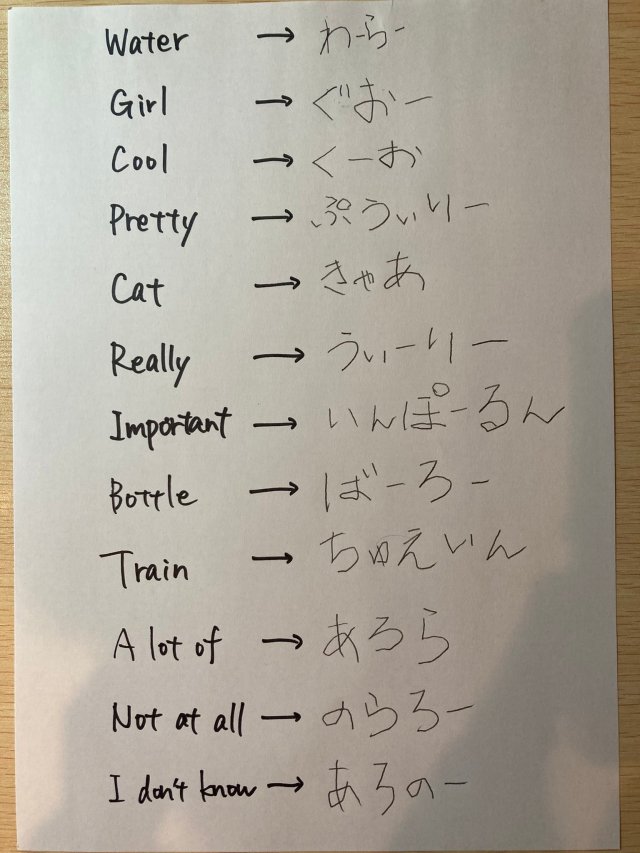
As the photo shows, the elementary school student who heard these English words being pronounced for the first time had no prior knowledge of how they’re usually rendered into Japanese, so they simply wrote them how they heard them. As a result, the pronunciation is much closer to how a local would pronounce the words, and entirely different to how students in Japan usually learn to pronounce them at school.
Taking a closer look at the elementary school student’s pronunciation list, we see that the first word, “water“, is written out as “わーらー”, which is pronounced “waaraa“. In everyday scenarios, a lot of native speakers drop the hard “t” in “water”, so if you were to say “waaraa” quickly, it wouldn’t sound that different to the way most people usually say “water”, especially when pronouncing the “r” the way Japanese speakers do, with the tongue touching the top of the palate.
Once you start learning English at a Japanese school, however, the pronunciation for “water” is written out as “ウォーター”, or if you were using hiragana like the elementary school student who hasn’t learnt the katakana syllabary yet, “うおーたー”. This is pronounced “uootaa”, which makes sense in Japanese, as “u” is used for other words starting with “w”, like “wood” (“uu-do”), but the hard “u” sound is something native speakers don’t use when saying “water”, rendering a very Japanese pronunciation of the word as a result.
▼ When an elementary school student knows more about the real world than a textbook.

Taking a look at the other words, we have:
Girl — usually pronounced “ガール” (“gaaru”) in Japanese — written as “ぐおー” (“グオー”), pronounced “guoo“, with a long “o” sound at the end
Cool — usually pronounced “クール” (“kuuru”) in Japanese — written as “くーお” (“クオー”), pronounced “kuoo“, with a long “o” sound at the end
Pretty — usually pronounced “プリティ” (“puriti”) in Japanese — written as “ぷうぃりー”, pronounced “puirii“, which drops the hard “t” sound again
Cat — usually pronounced “キャット” (“kyatto”) in Japanese — written as “きゃあ”, pronounced “kyaa”, again dropping the hard “t”
Really — usually pronounced “リアリー” (“riarii”) in Japanese — written as “うぃーりー”, pronounced “uiirii”
The last six words are:
Important — pronounced “インポータント” (“inpootanto”) in Japanese — written as “いんぽーるん”, pronounced “impoorun”, with long “o” and “u” sounds
Bottle — pronounced “ボトル” (“botoru”) in Japanese — written as “ぼーろー”, pronounced “booroo”, with long “o” sounds
Train — pronounced “トレイン” (“torein”) in Japanese — written as “ちゅえいん”, pronounced “chuein”
A lot of — pronounced “アロットオブ” (“a rotto obu”) in Japanese — written as “あろら”, pronounced “arora”
Not at all — pronounced “ノットアットオール” (“notto atto ooru”) in Japanese — written as “のらろー”, pronounced “noraroo”, with a long “o” sound at the end
I don’t know — pronounced “アイドントノウ” (“ai donto noo”) in Japanese — written as “あろのー”, pronounced “aronoo”, with a long “o” sound at the end
We’re particularly enamoured with the pronunciation of those last four on the list, which really capture the twang of a native English speaker. In fact, we could make good use of that last one in the office ourselves, as “arono” would save us a lot of time and energy on all those occasions when Mr Sato asks us to take part in his escapades.
It’s impressive to see how spot-on an elementary school student’s listening skills can be when it comes to producing natural-sounding English pronunciation. Here’s hoping they remember this lesson as they get older, and may we all harness the intuition of an elementary school student in our own language studies!
Source: Twitter/@KoalaEnglish180 via Jin
Top image: Pakutaso
Insert images: Pakutaso, Twitter/@KoalaEnglish180
● Want to hear about SoraNews24’s latest articles as soon as they’re published? Follow us on Facebook and Twitter!
 The reason why Japanese students don’t pronounce English properly
 The science behind why English speakers can’t pronounce the Japanese “fu”
 Japanese student teased for American pronunciation gets sweet revenge on classmates
 Japanese elementary school student teaches us how to solve a difficult maths problem
 Foreign English teacher in Japan calls student’s ability garbage, says it was an “American joke”
 You can assemble a well-balanced team of Pokémon, them eat them, thanks to Japanese cake chain
 Starbucks Japan closing only Shinkansen platform branch for popularity-triggered renovations
 Pokémon and Ikea Japan cross over into each other’s worlds with collaboration events
 Japan’s full-facemask Ninja Parka still lets you eat ice cream[Photos]
 Tokyo turns its phone booths into free Wi-Fi hotspots, and here’s how to use them
 Two food hacks take Japan’s convenience store fried chicken to amazing new sandwich heights
 Animal Crossing plushie pouch towels and cozy socks show up at Family Mart convenience stores
 Drawing a school girl leaping over a man firing a gun? There’s a reference book for that!
 Spirited Away adds a dash of Ghibli beauty to hanafuda flower cards【Photos】
 How often do Japanese high school kids watch anime, and do boys and girls watch the same series?
 Tokyo’s best museum for foreign travelers finally reopens after being closed for four years
 Pokémon lacquerware series expands for Year of the Horse with new handcrafted design[Video]
 Tokyo subway and almost all Tokyo train lines now accepting credit card tap payments
 Totoro Fund line of beautiful artwork and apparel lets you help the real-world Totoro Forest
 Fading Tokyo – Searching for signs of the Showa era as local neighborhoods evolve[Photos]
 Famous Tokyo cherry blossom spot installs view-blocking screens to fight overcrowding[Video]
 Studio Ghibli adds new My Neighbour Totoro 2026 Corn Gift to its anime store for Mother’s Day
 Japan now has a special desk for people who work at home with a pet cat[Photos]
 Uniqlo announces new T-shirts for One Piece, Naruto and more for manga publisher’s 100th birthday
 Train station platform ramen store closes its doors on half a century of history in Tokyo
 Starbucks Japan releases new My Fruit³ Frappuccino at only 34 stores around the country
 Studio Ghibli releases Catbus pullback keychain that runs like the anime character
 Krispy Kreme releases Super Mario doughnuts in Japan for a limited time
 Japanese onsen egg maker from 100-yen store Daiso needs to be on your shopping list
 Nine great places to see spring flowers in Japan, as chosen by travelers (with almost no sakura)
 Survey asks foreign tourists what bothered them in Japan, more than half gave same answer
 Japan’s human washing machines will go on sale to general public, demos to be held in Tokyo
 Starbucks Japan releases new drinkware and goods for Valentine’s Day
 We deeply regret going into this tunnel on our walk in the mountains of Japan
 Studio Ghibli releases Kodama forest spirits from Princess Mononoke to light up your home
 Starbucks Japan releases new sakura goods and drinkware for cherry blossom season 2026
 Japan’s newest Shinkansen has no seats…or passengers [Video]
 Major Japanese hotel chain says reservations via overseas booking sites may not be valid
 Put sesame oil in your coffee? Japanese maker says it’s the best way to start your day【Taste test】
 No more using real katana for tourism activities, Japan’s National Police Agency says
 Pronunciation anxiety: many Japanese people don’t want to speak English unless it’s “perfect”
 Japanese, Korean, and Chinese speakers pronounce English words in their native languages 【Video】
 “Japanese English” can baffle native English speakers — but what about Korean speakers? 【Video】
 English language education in Japan: Are native speakers essential?
 Japanese elementary school student’s essay about mother’s prawn pilaf is absolutely adorable
 Japanese student’s “drug dealer” English gaffe confuses foreign ALT
 Japanese Twitter user gets surprise visit from elementary school student for cutest reason ever
 Survey ranks dream jobs for Japanese elementary school students around the nation
 English teachers in Japan apologize for having low-proficiency kids say “poison” in assigned video
 “We wasted so much time in English class” — Japanese Twitter user points out major teaching flaw
 Over half of Japanese students in nationwide test score zero percent in English speaking section
 Elementary school students create a spooktacular event at school in lieu of canceled school trip
 Japanese elementary school teacher under fire after selling students’ personal info online
 ALT in Japan asked to remove earrings by Board of Education
 Elementary and junior high students speak out on Japan’s strangest school rules
 How to tell Japanese’s two most confusing, nearly identical characters apart from each other