

But is there such a thing as too much confidence?
Something that’s not always clear until you actually try to do it is that communicating in a foreign language isn’t always a binary can-or-can’t situation. Sure, if you can’t speak a single word of whatever language you’re trying to converse in, the listener won’t understand you at all, but that doesn’t mean that anything less than perfect grammar and vocabulary will be completely unintelligible.
But again, until you build up some first-hand experience trying to talk to someone in a foreign language, it’s not uncommon to assume that if the words coming out of your mouth aren’t perfect, and thus not right, they must be totally wrong, and so no one will understand you. That can make the studying a new language intimidating and frustrating, and one Tokyo-based English conversation school has a clever advertisement that seeks to dispel that misconception and encourage Japanese people to give learning English a try.
めっちゃ納得した、英会話教室の広告。 pic.twitter.com/vB1weETpFf
— ことばと広告 (@kotobatoad) April 19, 2021
The Japanese text in the ad from Coper English, a copy of which was tweeted by @kotobatoad, starts with the statement “When you think about it, it’s not like we Japanese people always use perfect Japanese either”…and as proof, it purposely misspells the word for “perfect,” kampeki, as “kankipe,” which doesn’t actually mean anything.
▼ Top: “kampeki”
Bottom: “kankipe”
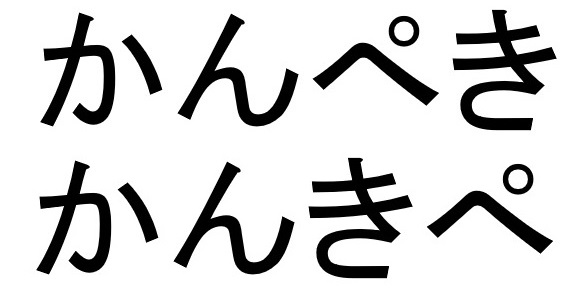
For that matter, writing kampeki as かんぺき, using the phonetic script called hiragana, isn’t the best choice either, since educated adults generally write it in kanji, like this:

It turns out that the ad’s message is peppered with errors. Tsukaettari / つかえったり (“use”) gets written instead as tsukkaetari / つっかえたり, juubun / じゅうぶん (“enough”) as jubuun / じゅぶうん, and on and on the mistakes go. And yet, Japanese Twitter commenters largely had no problem understanding what the ad is trying to say, which (after some fairly obvious corrections), works out to:
When you think about it, it’s not like we Japanese people always use perfect Japanese either. Sometimes we do, and sometimes we make mistakes or make typos.
But even still, like we’re doing here, we can somehow get our point across. We think that’s good enough when it comes to words and communication. So, please come learn English, with a lighthearted attitude. It’s OK even if you’re not perfect, because see, even these rough sentences can be understood.
It’s a warmhearted confidence booster, and @kotobatoad posted it while tweeting “This makes so much sense,” a sentiment many other Japanese commenters echoed with reactions like
“Exactly. Exactly. This is so inspiring.”
“So cool. It shows how important it is to try your best, and it’s bringing tears to my eyes.”

First and foremost, I want to say that in a lot of ways, I think it’s an extremely clever, and effective, ad. The assumption that you have to be perfect in order to be understood is a big reason many people don’t bother trying to study a foreign language in the first place, because they want to avoid embarrassing themselves and/or wasting their time should they fail to measure up to the standard of perfection. Instilling confidence in new learners, telling them “Come on, give it a try, you can do it!” and letting them know that their efforts will be rewarded even if they’re nowhere near fluent, are absolutely essential things schools and teachers need to do.
But there’s such a thing as being overconfident, as some of the other reactions to Coper English’s ad show.
“This makes perfect sense. I get the sense that I don’t have to bother studying English conversation in order to have people understand me.”
“It’s OK if your English isn’t perfect. If you just sort of line up English vocabulary words randomly, foreigners will understand you. You really don’t have to think that deeply about it.”
Yes, the idea that “Unless your language skills are perfect, they’re worthless” is a mistake. However, “It doesn’t matter how you use them, just toss out a bunch of English words and foreigners will understand you” is just as far from accurate.
▼ That sort of thinking can lead to things like the breakfast buffet in Japan that was serving something they called “near the broil with salt.”
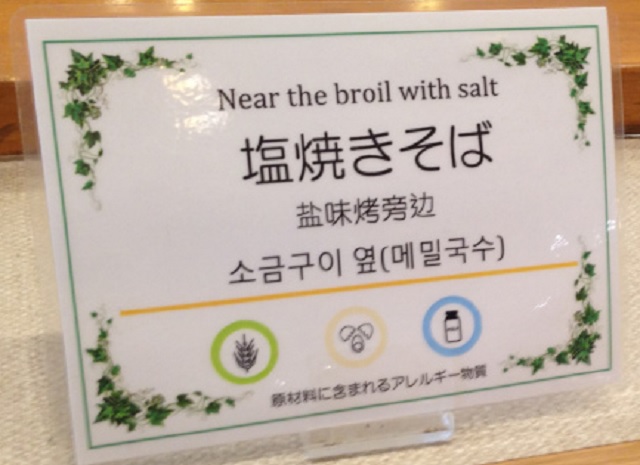
Also, as clever as the ad is, the phenomena of being able to quickly make sense of garbled text and understand the intended meaning doesn’t translate directly into speaking and listening, the skills used in a conversation. For example, later in the thread someone posted this.
なるほど。これの日本語版ですね。 pic.twitter.com/RGFvPdtHiM
— Yuko (@yuko_in_dublin) April 19, 2021
If you’re a native English speaker, you probably didn’t have too much trouble figuring out what that text is trying to say. However, even though you’re reading from left to right, your eyes move and focus quickly enough that the amount of time between when you perceive the first letter and the last is negligible. For short, commonly used words, you’re basically reading the whole thing at once, not sounding it out phonetically in your head.
In a conversation, though, you can’t hear an entire word at once, and because a listener is receiving the information (sounds) in a more noticeably sequential manner, a listener can’t autocorrect as easily as a reader can. This is pretty easy to test by reading the above text (as-is) about the Cambridge University research out loud to someone, which is guaranteed to result in more instances of “Huh?” and “What?” than reading it in your head.
There’s also an inherent risk involved with relying on the person you’re talking to to essentially “fix” your words for you. They’ll naturally fix them in the way that aligns with their way of thinking, since that’s what makes sense to them. If you’re trying to say something different than what they would expect someone to say, though, you might end up with not only your intended message not reaching the listener, but with a different one, that you didn’t intend at all, being taken as what you really mean.
As a final point to consider, the kind of mistakes shown in the ad, and the Cambridge equivalent, are mostly jumbling up what would be the correct parts of a word, usually resulting in something that sounds similar but doesn’t actually mean anything, like with jubuun instead of juubun. That triggers a response of “Wait, that word doesn’t mean anything, but it sounds like another word that does.”
Those easy-to-notice-and-fix errors are far from the only kind of mistakes language learners make, though. Expressed in English terms, if you ask someone for “orgean juice,” they’ll probably still bring you a glass of orange juice. But if you’re playing so fast and loose with your vocabulary that you ask for “red juice” (“red” is pretty close to “orange,” right?) you might end up with tomato juice instead, and if all you can manage is “thingy juice,” you might not get anything to drink at all.
▼ If only I’d filled my canteen from the thingy pool at the last oasis…

But again, and I can’t stress this enough, the ad’s core message, “You don’t have to speak English perfectly in order to communicate, so give it a try!” is a beautiful and necessary one, and this is a clever way of delivering it. At the same time, speaking from several years of experience teaching English in Japan myself, I know there are sometimes Japanese students of English conversation who’d be much better communicators if they were more committed to making an effort to use correct grammar and vocabulary, instead of passing off the responsibility of decoding what they really want to say on the listener and making no effort to fix bad habits.
Ultimately, when speaking a foreign language there’s often a sizeable margin between “absolutely perfect” and “good enough to be understood,” and while passionate perfectionist linguists will probably always want to shoot for 100 percent, there’s nothing wrong with having a less ambitious goal. It’s important, though, for students to remember that even though they don’t need to be perfect, when trying to communicate, you’re not starting at 100 percent and slipping down the scale as you make mistakes. Before you open your mouth, you’re at 0 percent, and everything you can say correctly moves you up one tick closer to the “good enough to be understood” line. The most effective strategy isn’t being blasé about making mistakes. It’s focusing on maximizing your number of successes, congratulating yourself (plus getting ample encouragement from the teacher) for the things you do get right, and trusting that if you try your best, you’ll be able to get enough right that the person you’re talking to will understand you, even if your not prefect.
Source: Twitter/@kotobatoad via Hamster Sokuho
Top image: Pakutaso
Insert images: SoraNews24, Pakutaso, Wikipedia/Fiontain
● Want to hear about SoraNews24’s latest articles as soon as they’re published? Follow us on Facebook and Twitter!
Follow Casey on Twitter, where he can still remember the exact moment he learned the word “kampeki.”
 The reason why Japanese students don’t pronounce English properly
 How to respond to Japanese people saying “I don’t speak English” when you’re speaking Japanese?
 Foreign English teacher in Japan calls student’s ability garbage, says it was an “American joke”
 Japanese student’s “drug dealer” English gaffe confuses foreign ALT
 “Don’t worry, he is a docile pervert” and other useful phrases in Japanese and English
 Japan reportedly adding Japanese language skill requirement to most common foreigner work visa
 Peanuts and Coke becomes a viral hit in Japan, but is it a trend worth joining?
 McDonald’s Japan adds new Hello Kitty and Pompompurin drinks to the menu for a limited time
 You can assemble a well-balanced team of Pokémon, them eat them, thanks to Japanese cake chain
 New hemp mascot character Asamiko-chan appears in Japan
 Deer that appeared in downtown Osaka gets a new home, a new name, and a lot of snacks[Video]
 Sailor Moon’s Artemis is part of the Artemis II NASA mission control team[Video]
 Naruto Shippuden x Maeda Coffee collaboration cafe event is coming to Kyoto this week
 Visiting Japan’s one-and-only, and only-for-a-limited-time, Dragon Ball noodle restaurant[Photos]
 The results are in! One Piece World Top 100 characters chosen in global poll
 Pokémon and Ikea Japan cross over into each other’s worlds with collaboration events
 Pokémon lacquerware series expands for Year of the Horse with new handcrafted design[Video]
 Starbucks Japan closing only Shinkansen platform branch for popularity-triggered renovations
 Two food hacks take Japan’s convenience store fried chicken to amazing new sandwich heights
 Tokyo’s best museum for foreign travelers finally reopens after being closed for four years
 Totoro Fund line of beautiful artwork and apparel lets you help the real-world Totoro Forest
 Fading Tokyo – Searching for signs of the Showa era as local neighborhoods evolve[Photos]
 Tokyo turns its phone booths into free Wi-Fi hotspots, and here’s how to use them
 Japan now has a special desk for people who work at home with a pet cat[Photos]
 Famous Tokyo cherry blossom spot installs view-blocking screens to fight overcrowding[Video]
 Uniqlo announces new T-shirts for One Piece, Naruto and more for manga publisher’s 100th birthday
 Train station platform ramen store closes its doors on half a century of history in Tokyo
 Starbucks Japan releases new My Fruit³ Frappuccino at only 34 stores around the country
 Studio Ghibli releases Catbus pullback keychain that runs like the anime character
 Krispy Kreme releases Super Mario doughnuts in Japan for a limited time
 Japanese onsen egg maker from 100-yen store Daiso needs to be on your shopping list
 Nine great places to see spring flowers in Japan, as chosen by travelers (with almost no sakura)
 Survey asks foreign tourists what bothered them in Japan, more than half gave same answer
 Japan’s human washing machines will go on sale to general public, demos to be held in Tokyo
 Starbucks Japan releases new drinkware and goods for Valentine’s Day
 We deeply regret going into this tunnel on our walk in the mountains of Japan
 Studio Ghibli releases Kodama forest spirits from Princess Mononoke to light up your home
 Starbucks Japan releases new sakura goods and drinkware for cherry blossom season 2026
 Japan’s newest Shinkansen has no seats…or passengers [Video]
 Major Japanese hotel chain says reservations via overseas booking sites may not be valid
 Put sesame oil in your coffee? Japanese maker says it’s the best way to start your day【Taste test】
 No more using real katana for tourism activities, Japan’s National Police Agency says
 Over half of Japanese students in nationwide test score zero percent in English speaking section
 “We wasted so much time in English class” — Japanese Twitter user points out major teaching flaw
 Pronunciation anxiety: many Japanese people don’t want to speak English unless it’s “perfect”
 Japanese university English teacher fights student misbehaviour with eccentric new rulebook
 Foreign English teachers in Japan pick their favorite Japanese-language phrases【Survey】
 Japanese student’s English homework captures futility of life
 English for otaku – New book provides fans with skills to internationalize their oshikatsu
 English teachers in Japan apologize for having low-proficiency kids say “poison” in assigned video
 New book teaches Japanese people English to help out foreign travelers
 The science behind why English speakers can’t pronounce the Japanese “fu”
 English language education in Japan: Are native speakers essential?
 Japanese netizens give their thoughts on how English has changed the meaning of “senpai”
 English-speaking-only bar opens in Osaka and Tokyo, yellow cards for those who don’t follow rules
 Crazy, heartless wife stars in Japanese textbook’s shocking conversation for English learners
 Japanese student teased for American pronunciation gets sweet revenge on classmates
