Here’s a story that’s bound to ruffle a few feathers down south. According to those in the know, okonomiyaki – a savoury “pancake” dish loved by millions and one of Osaka’s most acclaimed culinary delights – may in fact have been created in none other than Tokyo.
culture (Page 66)
As linguists and scholarly types routinely profess, language is something that is continually evolving. It is a living, breathing entity that twists, turns and grows on an almost daily basis. As our lives change, so too does language. We don’t always like the changes, but, realising that the amount of time we spend on this earth is a mere blink of the eye compared to how long language itself has existed, we come to accept that words are no more ours than the valleys and hills we trek over. (Although I must confess that I still face-palm whenever I hear someone utter the phrase “I could care less” to suggest that they do not care an iota about something.)
Nevertheless, when changes in language begin to occur, people notice them. The first time we heard the word “Facebook” used as a verb or saw our first “LOL”, many of us likely furrowed out brows and thought, “Is that right?” In much the same way, in July and August last year Japanese broadcasting giant NHK launched an online survey asking the people of Japan whether they had noticed the rather peculiar use of the word “arigatou” (thank you) cropping up in conversation in recent times.
Japanese are generally perceived as being particularly fastidious when it comes to bodily cleanliness, what with the special toilet slippers and showering before getting in the bath and all. But it turns out that doesn’t keep some of them from engaging in a much debated activity: peeing in the shower. Read More
Flipping through any travel guide about Japan you will learn that Japan is a country where tipping is non-existent. Leaving your change on the table at a restaurant may result in the waiter chasing you down to give it back.
But in Japan there actually is a system of tipping that exists but is tangled in a mysterious system of formality that no one really seems sure of. In an interview with Yahoo! Japan, Nobuko Akashi of the Japan Manners & Protocol Association attempts to unravel this system so we can all know when and where it’s appropriate to tip in Japan.
“Ignore the rules and you’ll get jam in your sneakers.”
The teachers may not always know about them, but throughout schools in Japan there are a number of unwritten rules that have been passed down from school generation to school generation and must be obeyed. First graders may only use the old, “haunted” toilet block nearest to the gym; only third graders may wear their backpack with just one strap; the cute art teacher must never be gazed upon by anyone other than the boys from class 2-F…
Entering a new school and being told to obey these long-standing rules “or else”, many kids probably wonder why their seniors, or “senpais“, are such jerks. But as the years go by and they, too, slowly rise to power and reap the rewards of having aged a couple of years, few are in a hurry to abolish the “ura“, or “other side”, code of conduct.
According to a report by Japan’s Yomiuri Online, however, students at a school in Tainai City, Niigata Prefecture have taken the unusual step of openly discussing these rules and swearing to abide by them no more.
No matter how much you love someone, once you start living with them minor irritations are bound to come to the surface. The object of your affections – that perfect specimen of a human being whose every movement used to be cute, sexy or endearing in some way – suddenly becomes just another person with flaws of their own. Perhaps they slurp their coffee too loudly. Maybe they have a habit of leaving hair in the plug-hole or not changing the toilet roll when the old one is finished. These minor issues are the kind of thing that we only come to notice after the initial “honeymoon” dating period when we were always dressed to impress and only have to keep our bad habits in check for the duration of a single evening at a time.
In a recent story about marital relations, Japanese website News Post Seven heard from both relationships experts and a number of married women who were distinctly irked by their husbands’ bad habits. While issues such as of a general lack of help with the housework or cooking frequently cropped up as the cause of arguments and unhappiness, one of the most common complaints made was of husbands making as mess while peeing. Told to take a seat while draining his spuds, however, one Japanese man was seemingly morally offended by the mere suggestion, stating that to pee standing up is “a matter of honour”.
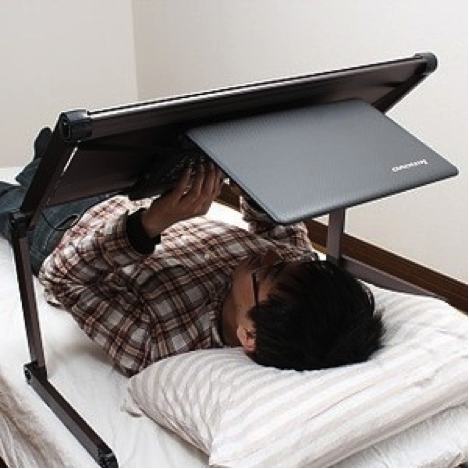
Now all you need is an intravenous drip, catheter and bed pan…
On 7 February, a new day of sloth dawned with the issue of Thanko’s new upside-down laptop desk, aptly named Aomuke Gorone Desk (“Napping Face Up Desk”) for 7,980 yen (US$86).
According to a study conducted by the National Institute of Population and Social Security Research, about half of unmarried women report that they are not dating anyone with any serious intent. Why are so many available ladies completely unattached? Could it be that they just don’t see the appeal of having a partner? Or conversely, maybe they are holding out for an unrealistic Prince Charming.
Goo Rankings decided to look into the issue and asked the single ladies what they would ideally want a boyfriend to do for them, if they had one. The surprising answers after the break: Read More
After a long week at the office, our Japanese writer Yoshio was in dire need of a pick-me-up. After stretching and clicking his back, he stood up at his desk, tucked his wallet into his back pocket and announced in unusually glum tones that he was popping out to the convenience store to grab a few things.
A few minutes later, Yoshio walked back into office and placed his little white plastic bag down on his desk with a tired sigh. But then he stopped. Looking down at his purchases inside the bag, he suddenly began beaming with a level of happiness that we hadn’t seen in quite some time.
“Oo! Sugoi!” (“Oh! That’s awesome!”) he softly exclaimed.
Consumers are always hoping to get more than they paid for products and services, but in reality, the reverse is just as common. We’ve all been suckered in by a wily shopkeeper at one point or another, but what knowledge and preparation can we arm ourselves with to avoid being taken advantage of?
There are a bounty of goods and services available to us, all of which are marketed with beguiling strategies. Some of them will be such good values our hearts will delight in our own cleverness, while others will simply satisfy with their averageness. Of course, the remaining products, for all their appeal, will be deeply disappointing. Maybe billionaires can just spend for the joy of spending without worrying if something is really a good value, but for common people like you and me, making a poor decision can impact our wallets and our self-esteem for a long time to come.
In the hope of protecting their readers from it, Japanese weekly magazine SPA! has set out to discover what exactly is behind this buyer’s remorse in all its complex forms. Read More
There are train hobbyists and then there are train hobbyists. Japan’s particular breed of railway aficionados are referred to by the somewhat-affectionate term densha otaku, or train nerds, and are famous for feats like memorizing complex, phonebook-size timetables or visiting every single one of the country’s almost 10,000 stations.
Of course, when they aren’t trying to increase their encyclopedic knowledge of all things rail-related, they are out looking for like-minded people to impress with it. As it turns out, Tokyo offers the densha otaku a wide selection of appropriate watering holes, or perhaps we should call them bar cars. So grab your subway map and let’s go see this elusive creature in his natural habitat. Read More
In a survey carried out late last year, Japan’s Shonan Beauty Clinic asked 1,400 Japanese men and women what their favourite words were. The results were remarkably wholesome.
If you ever wondered how Japanese people truly think, or thought for a second that the stern expressions worn on busy commuter trains each morning were accurate representations of passengers’ inner feelings, you were way off the mark.
Instant noodles – also known as cup noodles and what this writer lived off during most of his university days – have been a food staple for the busy, cost-conscious and kitchenphobic since their inception back in 1958. Peel back the lid, pour in some hot water, wait a few minutes and you have a hot, filling, if not especially nutritious meal for about the cost of a cup of coffee.
But with the handy meals being something that many associate with students and lonely bachelors, many women shy away from instant noodles, regardless of the fact that they’re just as pressed for time as their male coworkers. And all stigmas and stereotypes aside, few women in their 20s and 30s would be especially happy about replacing their nutritious mid-day meal with a plastic cup of rehydrated noodles swimming in a salty broth.
Enter the girly noodle.
In a survey conducted by Japanese magazine Nikkan Spa, 200 married male office workers aged between 20-40 were asked whether they had ever considered divorcing their spouse. As part of our recent love and relationships series, we’ve translated the results below for your delectation. Get ready for some seriously blunt answers and eye-opening reading.
Although the recent otaku marriage hunting party showed good results, millions of nerds still have to struggle with more conventional dating methods. Feeling ill-equipped in the social graces, these poor souls further entrench themselves in their obsessions lessening the chances of hooking up even more.
Luckily to the rescue comes Who’s Afraid of the Goukon? the latest book by Yoshi. This book is intended for mainly for otaku nerdy types but could be used by anyone feeling too socially awkward to take part in the Japanese group blind dates known as goukon.
Heavily-illustrated with manga examples, this how-to guide depicts the entire goukon culture assuming the reader knows absolutely nothing about them and provides hints as well as dispelling common misconceptions about these outings.
It’s not surprising that in Japan, the land of cute and cuddly, pretty much everything has a fuzzy mascot. Even prefectural and city governments are getting in on the merchandising mania with adorable (or terrifying, depending on your point of view) characters called yuru-kyara meant to promote tourism and local products.
This week, 141 yuru-kyara from 25 prefectures across the country gathered in Sasebo, Nagasaki Prefecture, to make their mark on history by becoming the largest group of mascots ever to do the same dance together. Jaw-droppingly awesome video after the break. Read More
“This is one thing that I want to continue using until the day I die.”
Of all the things that Japan is renowned for– all of its architectural triumphs, pioneering technology, sexy shenanigans and mind-bending animation — it comes as a surprise to this writer to read that one Chinese blogger in Japan values one thing above all else. Residing in Japan for more than 15 years, this 39-year-old blogger and professor of fine arts claims that, were he to return to his homeland, he’d miss one item more than anything else, and simply can’t begin to fathom why it hasn’t caught on back home.
Forget underwater Walkman music players, forget strawberry ramen and cuddle cafes; for this man, the humble nylon wash cloth is the pinnacle of Japanese invention, and it has become an essential part of his life.
By now we’ve all either heard stories of their efficiency or ridden them in person, but Japanese trains remain something of a source of amazement to many tourists visiting the country. They’re so clean! People obey the rules (well, usually…)! And the doors open exactly where they’re supposed to!
The following videos are examples of just how precise Japanese train drivers are expected to be, and how the simple process of lining up the doors of their train’s carriages with a couple of arrows painted on the platform is something that can bring great joy to many when they see it happen, and incredible anger and irritation to others when it doesn’t quite work out.
Surrounded by multi-story buildings and forever glued to our computers and smartphones, we often forget that the world we live in was once a much simpler place. People took time over writing letters, arranged to meet with friends and loved ones well in advance and, without streaming video and compact, waterproof music players to keep us entertained, took the time to appreciate the little things in life.
As a reminder of Japan’s once much more subdued yet intrinsically beautiful lifestyle, RocketNews24‘s sister site Pouch presents us with the following collection of photographs, which feature stunning Japanese gardens, arching wooden bridges over rivers, and ordinary folk just going about their day some 100 years ago.
So grab yourself a cup of tea, switch your phone to silent mode and take a few minutes to appreciate just how different life in Japan used to be.
Though some have questioned the advisability of pairing up with a Japanese guy, there are definitely those of us who would love nothing more. For girls looking to nab a Japanese fellow,website Yahoo! has recently investigated what sweet nothings make nihonjin weak in the knees, and have come up with nine lines that supposedly do the job.
Get out your notebooks, ladies (and gaydies), and let’s go hunting. Read More


Starbucks Japan ready to get Year of the Horse started with adorable drinkware and plushies【Pics】
Nara unveils new vending machines that sell deer crackers
Can a dirty butthole make you filthy rich in Japan? We’re starting a New Year’s lottery experiment
Mr. Sato accosts award-winning actor Hideaki Ito【Interview】
7 great places to see Mt. Fuji from without having to climb it
Japanese thug wear from Birth Japan perfect for those breaking bad next year
We found possibly the quietest Japanese-style hotel in Tokyo’s bustling Shinjuku district
Eight Ways You Really, Really Shouldn’t Use a Japanese Toilet
Fashion model Yutaro trolls online shoppers in funny April Fools’ Day cosmetics prank
You can now visit a recreation of Evangelion’s Tokyo-3 and live there in miniature form in【Pics】
Lacquerware supplier to emperor of Japan and Pokémon team up for new tableware
Japan may add Japanese language proficiency, lifestyle classes to permanent foreign resident requirements
7-Eleven Japan’s ramen-cooking robot whipped us up a bowl of noodles【Taste test】
Cyberpunk anime meets traditional culture in Ghost in the Shell gold leaf Japanese changing screens
Disillusionment at Tsukiji’s tourist-target prices led us to a great ramen restaurant in Tokyo
Hello Kitty Choco Egg figures are an adorable trip through three periods of Japanese pop culture【Pics】
Starbucks Japan releases new zodiac chilled cup drink for 2026
Japan’s otoshidama tradition of giving kids money at New Year’s gets a social welfare upgrade
7-Eleven Japan starts new temporary luggage storage service in over 300 branches
Starbucks teams up with 166-year-old Kyoto doll maker for Year of the Horse decorations【Photos】
Tokyo considering law requiring more trash cans following litter increase in heavily touristed area
Tokyo’s Tsukiji sushi neighborhood asks tour groups to stay away for the rest of the month
Nintendo’s Kirby now delivering orders at Kura Sushi restaurants, but not in Japan
Tokyo event lets you travel back in time, for free, to celebrate 100 years since Showa era start
Sanrio theme park in Japan announces plans to expand into a Sanrio resort
Stamina-destroying “Paralysis Noodles” are Tokyo’s newest over-the-top ramen innovation
Survey asks foreign tourists what bothered them in Japan, more than half gave same answer

Japan’s human washing machines will go on sale to general public, demos to be held in Tokyo

Japan’s deadliest food claims more victims, but why do people keep eating it for New Year’s?
We deeply regret going into this tunnel on our walk in the mountains of Japan
Studio Ghibli releases Kodama forest spirits from Princess Mononoke to light up your home

Major Japanese hotel chain says reservations via overseas booking sites may not be valid
Put sesame oil in your coffee? Japanese maker says it’s the best way to start your day【Taste test】

No more using real katana for tourism activities, Japan’s National Police Agency says
Starbucks Japan reveals new sakura drinkware collection, inspired by evening cherry blossoms
Updated cherry blossom forecast shows extra-long sakura season for Japan this year
Japanese thug wear from Birth Japan perfect for those breaking bad next year
We found possibly the quietest Japanese-style hotel in Tokyo’s bustling Shinjuku district
Eight Ways You Really, Really Shouldn’t Use a Japanese Toilet
Fashion model Yutaro trolls online shoppers in funny April Fools’ Day cosmetics prank
You can now visit a recreation of Evangelion’s Tokyo-3 and live there in miniature form in【Pics】
Have you ever noticed how much Totoro looks like New Year’s mochi? This plushie’s designers did, and the result is adorable!
Hello Kitty Choco Egg figures are an adorable trip through three periods of Japanese pop culture【Pics】
More Than a Capsule Stay: Why Solo Travelers Choose “global cabin Yokohama Chinatown”
RocketNews24’s Meg models the entire line of Japan’s new schoolgirl outfit loungewear 【Photos】
Abysmal viewer ratings for Pokémon anime series does not worry its broadcaster the slightest bit
Dragon Ball Kai: Beautifully remastered but woefully censored for a new generation
Beautiful Studio Ghibli photo frames let you put yourself in the worlds of Totoro and Kiki【Pics】
Cyberpunk anime meets traditional culture in Ghost in the Shell gold leaf Japanese changing screens