
Kanji quirk leads to some harsh language in reminder to pet owners.
Like a lot of people, since the start of the pandemic I’ve spent a lot more time going for walks around my neighborhood than I ever did before. When you’re feeling cooped up in the house but still trying to avoid crowds, Japan’s often congested trains and subways aren’t such an attractive transportation option.
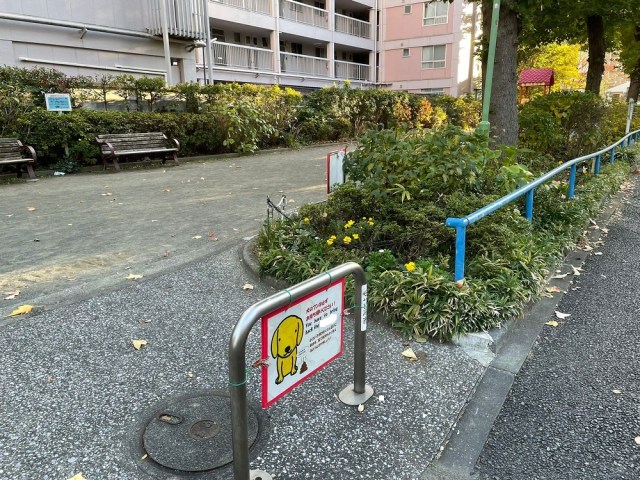
On the bright side, my neighborhood in Yokohama is a pretty nice one, with a couple of tree-lined streets and multiple parks. They’re not anything fancy, but most have benches and shade, making them inviting spots to sit down and eat a takeout meal or sip a hot bottle of green tea.
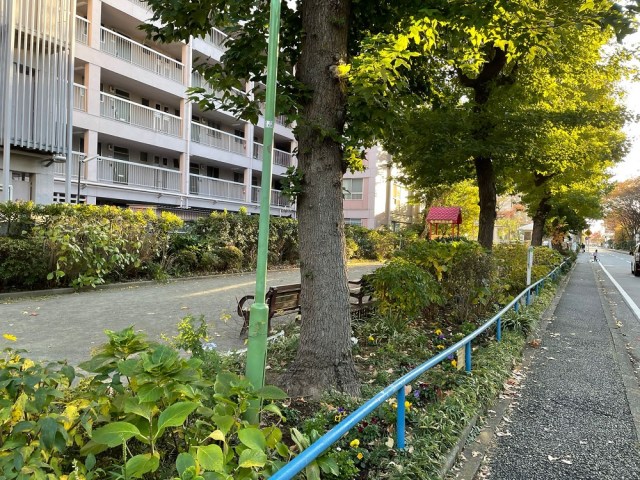
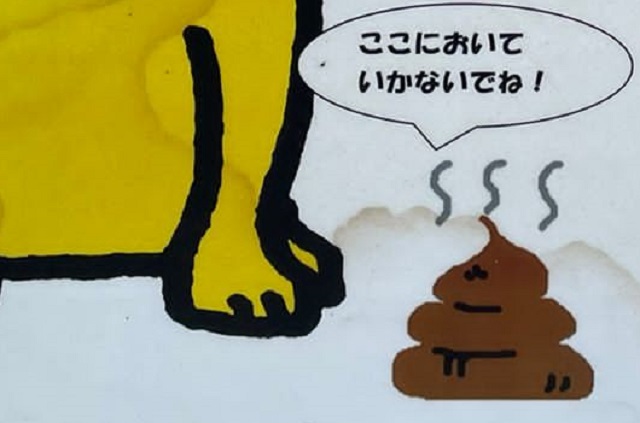
But apparently they’ve been having a bit of a problem at the park in these photos. The nice, leafy street is also a popular place for local pet owners to take their dogs for walks, and some of them are stopping by the park when their dogs need to drop a deuce, then leaving the mess behind. Because of that, the park has put up a sign at the entrance politely asking owners to take care of their pooch’s poo.
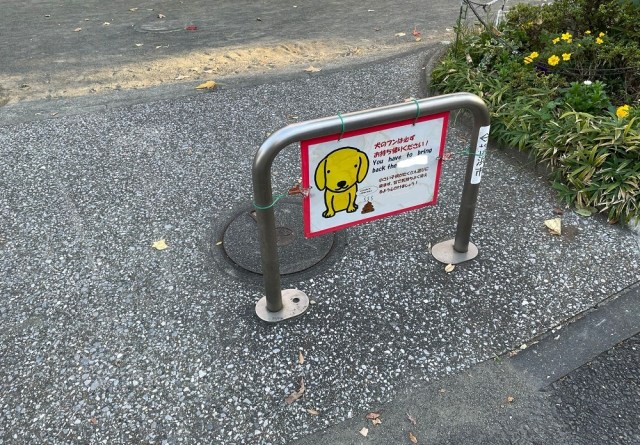
Well, more accurately, the sign’s Japanese text asks relatively politely, saying “Inu no fun wa kanarazu omochikaeri kudasai!”, or “Please make absolutely sure to take your dog’s droppings home with you,” with fun being an inoffensive Japanese word similar to the English “droppings” or “feces.”
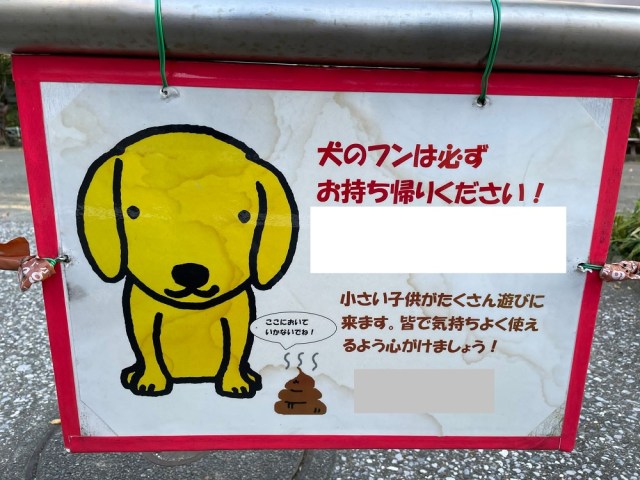
The sign’s English version of the message, though? Its vocabulary is a little more colorful.
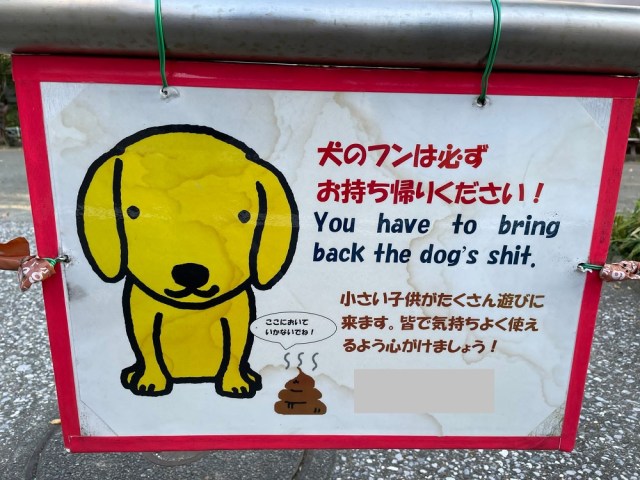

“You have to bring back the dog’s shit,” the sign informs English readers. The harsher vocabulary is somewhat offset by the lack of the Japanese version’s exclamation point, though, but that almost makes the matter-of-fact dropping of the expletive even more startling.
So how’d the sign end up like this? Going back to the word used in Japanese, fun, on the sign it’s rendered as フン, in the phonetic script called katakana. That’s kind of unusual, since katakana is most commonly used for foreign loanwords, but it also sometimes gets used for Japanese words with kanji characters that aren’t commonly used (as with certain scientific or medical terms). But because Japanese has so many words that are pronounced the same way but have different meanings, if you plug the phonetic katakana フン into a translation program it won’t quite know what to do with it, and might try to force-fit it as a foreign word or name.
▼ Here’s Google translating フン as the Chinese surname Hung, for example.
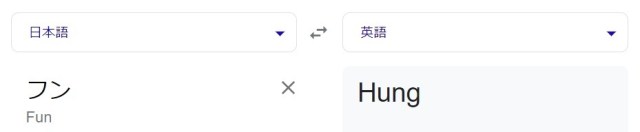
Odds are whatever ward office employee was in charge of writing the sign ran into this roadblock trying to translate fun written as フン. However, fun does actually have a kanji, even if it’s not commonly used, so presumably that was the sign writer’s next choice to plug into the Japanese-to-English translation tool. Unfortunately, the kanji for fun is this…
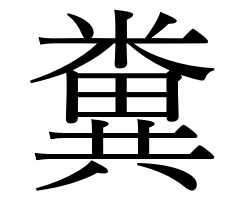
…which is also the kanji for kuso, a harsher word that’s the Japanese language’s version of “shit,” and apparently “shit” is what the sign writer got back.
▼ Google’s translation result for 糞
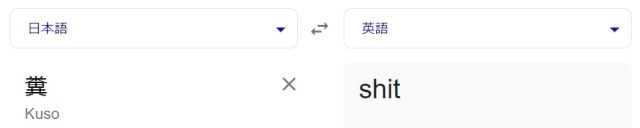
Since fun and kuso technically mean the same thing, it’s not so shocking that they share a kanji. Their very different atmospheres, though, are a big part of the reason why they’re usually written phonetically, in either katakana or hiragana, since the kanji doesn’t give the writer the ability to differentiate between the politer “droppings” and harsher “shit.”
▼ Oh, and if you were curious about the steaming coil of poo’s line of dialogue, it’s saying “Please don’t leave me behind here!”
In defense of whoever wrote, literally, this shit, it’s not like my neighborhood has a huge ex-pat population, so really any sort of English signage is a thoughtful gesture by the local parks department. And honestly, seeing some startling vocabulary is still a lot better than stepping in a brown squishy surprise.
Photos ©SoraNews24
● Want to hear about SoraNews24’s latest articles as soon as they’re published? Follow us on Facebook and Twitter!
Follow Casey on Twitter for more Japanese linguistics (and probably not much more poo).
 Why Does Engrish Happen in Japan? – Breakfast buffet edition
 Why does Engrish happen in Japan?
 Why Does Engrish Happen in Japan? Moon ultra parking edition
 Why Does Engrish Happen in Japan? 30-year-old fart-related signage mistake edition
 Kyoto accidentally calls all old people “terrible drivers”【Why Does Engrish Happen in Japan?】
 Uniqlo announces new T-shirts for One Piece, Naruto and more for manga publisher’s 100th birthday
 Fatal stabbing at Pokémon Center in Tokyo reignites concern over rising stalking cases in Japan
 Totoro and Calcifer become little light-up lanterns for Ghibli-style excursions or at-home decor
 Japan now has a “for foreign tourists only” Mt. Fuji sightseeing train[Video]
 Final Fantasy invites you to adventure in Fukushima with Fukushima Fantasy Chocobo fun[Video]
 Japan now has a special desk for people who work at home with a pet cat[Photos]
 Krispy Kreme releases Super Mario doughnuts in Japan for a limited time
 How many doughnuts can you pack in a Mister Donut all-you-can-pack deal?
 Huge life-size Eevee Eeveelution Pokémon plushies will steal hearts, conquer living rooms【Photos】
 Japanese kindness restores our faith in humanity after a highway bus accident in Tokyo
 7-Eleven Japan releases a crazy new viral sandwich: Chocolate Sprinkles and Whipped Cream
 Starbucks Japan releases new My Fruit³ Frappuccino at only 34 stores around the country
 Nine amazing off-the-beaten-path cherry blossom spots in Japan for yaezakura and shidarezakura
 Stunning central Japan wisteria festival is like a purple fantasy straight out of a Ghibli movie
 Studio Ghibli releases the My Neighbour Totoro tea caddy, with a magical self-closing lid
 Create a tiny Ghibli anime world on your bookshelf with new miniature papercraft art kits
 Studio Ghibli unveils new Rollbahn notebook in honour of Howl’s Moving Castle
 Starbucks Japan unveils new sakura cherry blossom collection for hanami season 2026
 Train station platform ramen store closes its doors on half a century of history in Tokyo
 Studio Ghibli releases Catbus pullback keychain that runs like the anime character
 Japanese onsen egg maker from 100-yen store Daiso needs to be on your shopping list
 Nine great places to see spring flowers in Japan, as chosen by travelers (with almost no sakura)
 Starbucks Japan releases first-ever Hinamatsuri Girls’ Day Frappuccino
 Cherry blossoms begin blooming in Japan with record-early starts for sakura season
 Survey asks foreign tourists what bothered them in Japan, more than half gave same answer
 Japan’s human washing machines will go on sale to general public, demos to be held in Tokyo
 Starbucks Japan releases new drinkware and goods for Valentine’s Day
 We deeply regret going into this tunnel on our walk in the mountains of Japan
 Studio Ghibli releases Kodama forest spirits from Princess Mononoke to light up your home
 Starbucks Japan releases new sakura goods and drinkware for cherry blossom season 2026
 Japan’s newest Shinkansen has no seats…or passengers [Video]
 Major Japanese hotel chain says reservations via overseas booking sites may not be valid
 Put sesame oil in your coffee? Japanese maker says it’s the best way to start your day【Taste test】
 No more using real katana for tourism activities, Japan’s National Police Agency says
 Tokyo hotel asks guests to take their used toilet paper with them【Why Does Engrish Happen?】
 Official Tokyo Marathon T-shirts get recalled for English spelling mistake
 Why does Japanese writing need three different sets of characters? (Part 2)
 What does a kanji with 12 “kuchi” radicals mean? A look at weird, forgotten Japanese characters
 Japan’s new “Cunte” contact lenses aren’t pronounced like you’re probably thinking they are
 Why does Japanese writing need three different sets of characters? (Part 1)
 Five different ways to say “children” in Japanese
 Yahoo! Japan finds most alphabetic and katakana words Japanese people want to find out about
 Strange English signs in China and Japan really hate vegetables, sometimes threaten to kill you
 Eat shit and learn Japanese with educational poo-inspired candies from Japan
 W.T.F. Japan: Top 5 Japanese words with cool ancient origin stories【Weird Top Five】
 Sega’s Like a Dragon yakuza teaches “useless” English, let’s use it to learn some useful Japanese