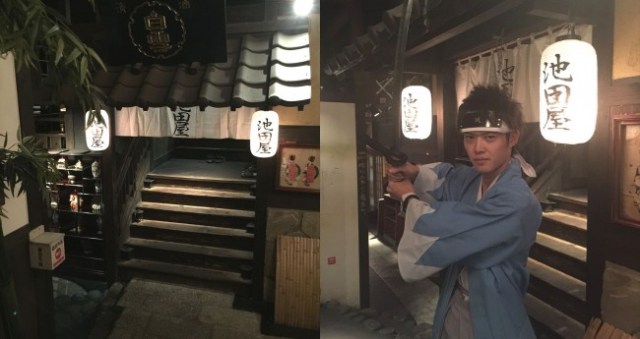
If you’ve ever wanted to immerse yourself in the atmosphere of Kyomachi, the old streets of Kyoto, there’s a special dining establishment in Tokyo that will take you there. The Kyomachi Koishigure restaurant features private dining rooms, red bridges, bamboo corridors and a running stream so you can enjoy all the traditional beauty of Kyoto without having to leave the nation’s capital.
And now, for a limited time only, the restaurant will take you back in time to the late Edo period, with a special “fair” that recreates the infamous Ikedaya Incident, a significant moment in Japan’s history when a group of masterless samurai were ambushed at Kyoto’s Ikedaya Inn.
As part of the experience, diners can enjoy a specially designed menu inside a recreation of the inn, and staff dressed as members of a sword-wielding police force who “ambush” your private room every time you place an order.
Read More







 How are you supposed to wash a Japanese futon duvet at the laundromat?
 Family Mart’s new Famima flagship in Tokyo has a hidden gem that most visitors miss
 Face lettuce appears in Japan, with the face of Death Note’s Light Yagami, but why?
 Pokémon Card Stores requiring facial recognition scans for entry in Japan in latest anti-scalper move
 Studio Ghibli adds new Ponyo glassware to its anime lineup for summer
 Tokyo subway installing new ticket gates that don’t accept payment through Suica or other IC cards
 A roadside hair salon stall in China made us Norway’s Haaland for US$1, and warmed out hearts too
 Japanese Shinkansen becomes an overnight hotel for three nights this summer
 Starbucks Japan releases a miniature display rack so you can create your very own store at home
 Studio Ghibli Laputa figure looks like it’s really flying thanks to cool visual trick
 New Shinkansen luggage drop-off system begins in Japan, making train travel even easier
 99-year-old woman rescued while attempting to climb Mt. Fuji
 Which country’s foreign tourists spend the most money per-person in Japan? Hint: Not the U..S. or China
 Giant Evangelion Spear of Longinus to be installed at Japanese train station with Eva art trains
 Cup Noodle releases cold-water instant ramen in Japan, but can it really be made with just cold water?
 Kodama Shinkansen trains on popular Japan route get a whole new look this winter
 Studio Ghibli has a new anime out, and there’s only one place in the world where you can see it
 Salomon releases Japan-exclusive Mt. Fuji hiking gear that doubles as an amazing souvenir
 Japan now has human refrigerators inspired by Japanese vending machines
 Hatsune Miku collaborates with Hokusai’s art in new Vocaloid ukiyo-e illustration series [Pics]
 Japan triples departure tax, foreign tourists and locals now must pay more to leave country
 Studio Ghibli releases anime T-shirts that pay homage to one of Hayao Miyazaki’s most personal films
 Family Mart opens new “Famima” flagship store in Tokyo that’s like a tourist attraction
 Sanrio Character Poll announces winners, Hello Kitty absent from top 10 in many countries
 Japan announces sudden 400-percent increase in visa fees for foreigners entering the country
 Japan’s human washing machines will go on sale to general public, demos to be held in Tokyo
 Starbucks Japan releases new drinkware and goods for Valentine’s Day
 Starbucks Japan releases new sakura goods and drinkware for cherry blossom season 2026
 Japan’s newest Shinkansen has no seats…or passengers [Video]
 Japanese ninja certification exam attracts 131 candidates from Japan and abroad
 Put sesame oil in your coffee? Japanese maker says it’s the best way to start your day【Taste test】
 Tokyo subway installing new ticket gates that don’t accept payment through Suica or other IC cards
 A roadside hair salon stall in China made us Norway’s Haaland for US$1, and warmed out hearts too
 Japanese Shinkansen becomes an overnight hotel for three nights this summer
 Starbucks Japan releases a miniature display rack so you can create your very own store at home
 Studio Ghibli Laputa figure looks like it’s really flying thanks to cool visual trick
 Universal Studios Japan requiring consent form for adults-only horror attraction
 Japanese Coo-Che becomes a viral sensation, and everyone wants a taste
 Pokémon’s cozy city builder game inspires Cozy (Corner) cakes in Japan! [Photos]
 Which country’s foreign tourists spend the most money per-person in Japan? Hint: Not the U..S. or China
 Giant Evangelion Spear of Longinus to be installed at Japanese train station with Eva art trains
 Why is Taco Bell failing in Japan, even as the country falls in love with tacos?
 61-year-old Kyoto man arrested for playing guitar and radio too loudly for seven years
 Starbucks Japan adds a new summer Frappuccino to the menu, but is it as refreshing as it looks?
 New Shinkansen luggage drop-off system begins in Japan, making train travel even easier