funny (Page 138)

Famous Japanese television personality mimics what foreign languages sound like to non-speakers

Kazuyoshi Morita – better known as Tamori-san, the pet name that a loving Japanese public has addressed him by for decades – is one of the longest-running comedians to appear on Japanese TV. He’s been around so long, we assume he got his start doing stand-up before TVs were even invented.

In addition to being the longest-running host of a live television program, having hosted the widely beloved morning variety show Waratteii Tomou, Tamori-san is also famous for his talent in mono mane (doing impressions). While this is common knowledge in Japan, it apparently took a decade-or-so-old clip of a (still very old-looking) younger Tamori-chan doing spot-on impressions of what foreign languages sound like to non-speakers to wake the rest of the world up to his unique skill set.

Read More

These “Engrish” T-shirts are kinda lame, compared to what we’re used to

Call us cynical, but we find that our standards over what constitutes funny Engrish have been changing.  Unless it’s something really hilarious, perhaps involving naughty words or references to embarrassing body parts, we just can’t muster up the same kind of enthusiasm we once had. When it comes to English that’s just a little bit off in certain ways, it’s sometimes just not that funny, especially when you understand the number of reasons why Engrish happens in the first place. However, visitors to Japan will always remember that first taste of Engrish fondly, even if the same example might fail to raise an eyebrow after a few years of acclimatizing. The last piece of Engrish I felt was worthy of documenting can be seen above – it’s a T-shirt from a store in Osaka and several years later it still blows my mind. However, there’s also plenty of pretty mediocre Engrish to be found, as we’ll demonstrate after the jump.

Read More

Cute dog turns traditional fish pond into personal swimming pool【Photos】

If you’ve ever been to Thailand, you know that it can get really hot. It’s enough to make anyone look longingly at the nearest fountain, pond or puddle. Well, add a fur coat to that equation and I get why this Thai dog decided he wasn’t going to let a few guppies get in the way of a quick, cooling dip!

Read More

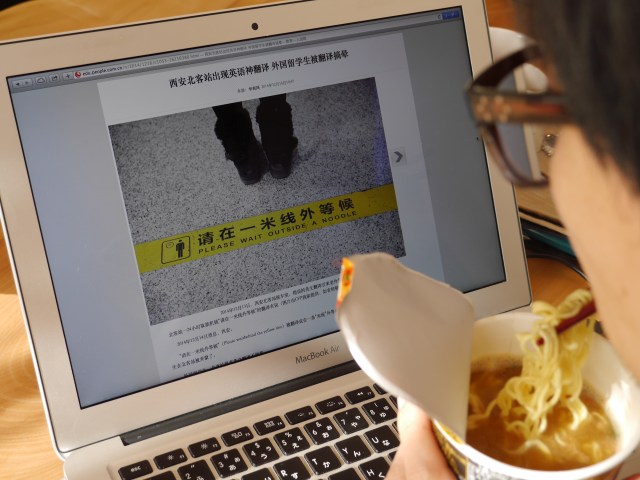
Strange English signs in China and Japan really hate vegetables, sometimes threaten to kill you

We’ve talked before about some of the reasons why bizarre English signage pops up in Asia. One of the most common causes is a fundamental difference in the way sentences are structured between English and other languages. Automated translations programs, which aren’t nearly as well sorted out as many monolingual users believe, are also among the usual suspects.

That said, looking at a flawed translation is sort of like performing an autopsy, in that sometimes there’s a limit in what it can tell you. Just like the medical examiner might say, “Well, all the baby spiders hatching inside the subject’s eyeball definitely killed him, but I’ve got no idea how the eggs got in there,” there are times like these when we look at some garbled English, and, just like we can’t stifle our chuckles, we can’t imagine why the translation went flying off the rails, or if it was even on them to begin with.

Read More

Police in Hyogo Prefecture are reporting the arrest of a man suspected of being a chikan, Japan’s embarrassing subclass of perverts that grope unsuspecting women on crowded trains. The suspect’s capture wasn’t the result of a sophisticated sting or surveillance operation, though. As a matter of fact, the arresting officer didn’t even have to chase the man down, as the police claim he was caught red, and butt, handed when he grabbed the behind of a fellow passenger who’s also a policewoman.

Read More

Most popular pet names in Japan for 2014 suggest owners obsessed with food

Earlier this week, we looked at popular baby names making the rounds this year in Japan and now we’ve discovered some data on what Japanese named their pets in 2014. The little guy above may be right to look concerned because almost every name on the list is food-related

Read More

10 girls, 10 wall-pounds – Female kabe-don is here!

One of the biggest buzzwords of the year in Japan has been kabe-don. A staple of girls’ comics in Japan for years, kabe-don, literally “wall-pound,” has traditionally been the domain of guys clumsily expressing their feelings while leaning against the wall and fencing in the object of their amour with their outstretched arm.

We live in an age of increasing gender equality, though. Today, woman govern nations, helm corporations, and are highly capable of wreaking terrible violence upon their targets with their bare hands. As such, it’s only natural to assume that women are gradually shattering the barriers that have made the world of kabe-don practitioners a boys’ club until now, and as proof, we present these 10 videos of women flipping the script and showing off their kabe-don skills.

Read More

No time to cook? Here’s how to make fried shrimp in just three seconds (with the right equipment)

One of Japan’s most popular cooking shows is Three-Minute Cooking. Broadcast by Nippon TV and sponsored by condiment maker Kewpie, the program does exactly what it promises, teaching people to make quick, tasty meals that take just three minutes of cooking.

Three-Minute Cooking started in 1963, though. In the busy 21st century, who can afford the luxury of spending that much time in the kitchen? It’s time for a faster, more modern way to cook dinner, which is where this video comes in with its demonstration of how to cook fried shrimp in just three seconds.

Read More

As handy as online Japanese-to-English dictionaries are for looking up individual vocabulary words, automated translation programs tend to spit out much spottier results. A big part of the problem is how much more Japanese relies on context for meaning, which in turn means speakers can, and often do, abbreviate and omit whole words and phrases which human listeners can easily understand implicitly.

Automated programs, though, lack this ability, which means their translations are often missing vital elements needed for the sentence to make sense in English. It’s a problem software engineers and linguists are trying to address, but adding such soft logic to machines is a difficult endeavor.

In at least one case, though, the Google Translate team seems to have been too effective, as trying to convert a Japanese phrase meaning, “Goodbye, my beloved” into English produces a result that seems to have roughly 38 hours of backstory behind it.

Read More

Since Japan is on the other side of the International Date Line from the U.S., while American families were sitting down for Thanksgiving dinner on Thursday, it was already Friday, November 28 in Japan. Even still, there were celebrations going on simultaneously in the two countries, as November 28 is also known in some circles in Japan as Knee-High Socks Day.

We feel it’s important to spread the word about this unofficial holiday, so just as we did 12 months ago, we’re back again with the Japanese Internet’s best contributions to the day’s festivities. This year, though, Knee-High Socks Day is about more than just appreciating female thighs, as Twitter users are putting their own weird and humorous spin on just who or what can participate.

Read More

In Japan, nothing says “Merry Christmas, Baby” like greasy convenience store chicken

We all know that KFC is a big, big deal in Japan around Christmas-time. Families order huge Christmas platters for the holiday and singles celebrate by inviting friends over and bringing home a bucket of Special Recipe.

While it may strike Westerners as a delightfully quirky example of holidays getting lost in translation this side of the Pacific, to the Japanese, it’s a cherished tradition. And, of course, a multi-million dollar cash cow for KFC; one that convenience store chains are always eager to get a piece of.

Read More

Timpani drummer’s crazy finale is startling, funny, more metal than you’d expect from a symphony

There’s not a whole lot of crossover between the worlds of sports and classical music. Concert pianists generally don’t play the piano with one hand while dribbling a basketball with the other, and I can’t recall the last time I saw a proper squad of cheerleaders accompanying an orchestra.

Likewise, even though “Get your head in the game!” is one of the most commonly shouted phrases in sports, I don’t think you have concert-goers yelling “Get your head in the symphony!” Not that this drummer needed to be told that, though, as shown by the startling flourish he put on the end of his performance.

Read More

Got a beef with Japan’s Christmas shortcakes? Then try one made out of chicken

I like Christmas. I get that some people feel it’s over-commercialized, but for me, I’m happy to see some nice decorations and have an excuse to get together with family and friends. Really, the only complaint I’ve got is the cake.

See, in Japan, you can’t celebrate Christmas without a cake. Ordinarily, adding cake to just about anything makes it better, with “a mug of beer” being the sole exception I’ve found so far. But almost every Christmas party here features the exact same “Christmas cake.” It’s basically a strawberry shortcake, which, by my criteria, is sorely lacking in the three most important ingredients of a really good cake, which are, in no particular order, chocolate frosting, chocolate sponge, and chocolate filling.


So if you’ve also got a beef with the standard Christmas cake, maybe you’d prefer one that’s made out of chicken.

Read More

Unsettling softball-playing scarecrows keep Japanese town entertained, creeped out

Living in the Japanese countryside has many advantages, from access to the freshest produce to breathing clean air, but for many who love the big city, the slow-paced lifestyle and lack of attractions can make rural life quite boring.

But one Japanese man living in a town outside of Fukuoka in southern Japan is showing us life doesn’t have to be boring when you have access to several dozen scarecrows, old softball uniforms and an open rice field. Every November after the rice is harvested, he dresses scarecrows up as softball players and has them “play” a month-long game, keeping score the entire time.

Read More

Neko Montage! The most fun you can have with a cat and a sharpie【Photos】

It’s often the simple things that bring us most pleasure in life – like these giggle-inducing ‘neko montage’ photos making waves on Twitter in Japan.

Join us after the jump for delightful paper-augmented cats looking cute, angry, surprised, and plain old baffled!

Read More

Adorable chicken traveller actually headed to nauseating final destination in series of promo pics

“Go forth, young one,” the adorable fowl’s equally adorable parents probably said. “It is time for you to strike out on your own. You are destined to do great things.”

We picture a bittersweet farewell, tears running down the proud parents’ beaks, each pecking nervously at the ground in turn, their prodigal son equipped with nothing but the knapsack ‘round his neck and a meager meal of two leeks.

If only the proud parents had known their young son’s final destination…

Read More

The weirder the better? These Japanese zakka are hot sellers in Korea

There are many Japanese products that are popular overseas, such as Japanese snacks, beauty products, character goods… the list goes on. Character franchises aside, some of the more common reasons why people living outside of Japan purchase Japanese products is because they generally tend to be produced under higher quality and hygiene standards, and more often than not come in temptingly beautiful or cute packaging.

Japanese zakka (sundries/miscellaneous goods), however, are popular for entirely different reasons. Check out these Japanese zakka that a Korean retailer has picked for their website to get a clearer idea of what tempts the purse strings of Korean consumers!

Read More

Can you spot the problem that led to the recall of this otherwise cute Japanese New Year’s card?

While people in Japan don’t send Christmas cards to each other, it’s customary to send New Year’s cards to relatives, friends, and work associates. Called nengajo, these are delivered on New Year’s Day, and typically feature whatever the Chinese zodiac animal for the year is.

However, since the end of the year is a busy time for most people, it’s not hard to imagine that some of the artists, distributors, and even buyers of these cards are too busy to really stop and scrutinize them, which is how one nengajo ended up with a very unusual ram on it.

Read More


Many of Japan’s tasty regional delicacies don’t exactly qualify as low-calorie dining options, such as Fukuoka’s pork stock ramen, Osaka’s deep-fried kushikatsu skewers, and Nagoya’s miso pork cutlets. However, Yamanashi Prefecture’s local specialty, hoto, is relatively healthy, as it’s primarily a vegetable stew with miso broth.

With that in mind, the fact that a zoo in Yamanashi is home to a raccoon who’s so plump he’s almost spherical is a little ironic…and also pretty adorable.

Read More

It’s one of the sad facts of life that it generally takes longer to build up a good mood than to tear one down. A quick bit of bad luck can ruin your afternoon (just ask anyone who’s been pooped on by a pigeon), but blissful joy is often the result of building off a string of successes and blessings.

We say “often” because sometimes you stumble across a shortcut to a genuine smile or heartwarming laugh, which is definitely the case with the twist ending to this short video of a hamster having its ear stroked.

Read More

  1. 1
  2. ...
  3. 135
  4. 136
  5. 137
  6. 138
  7. 139
  8. 140
  9. 141
  10. ...
  11. 163